
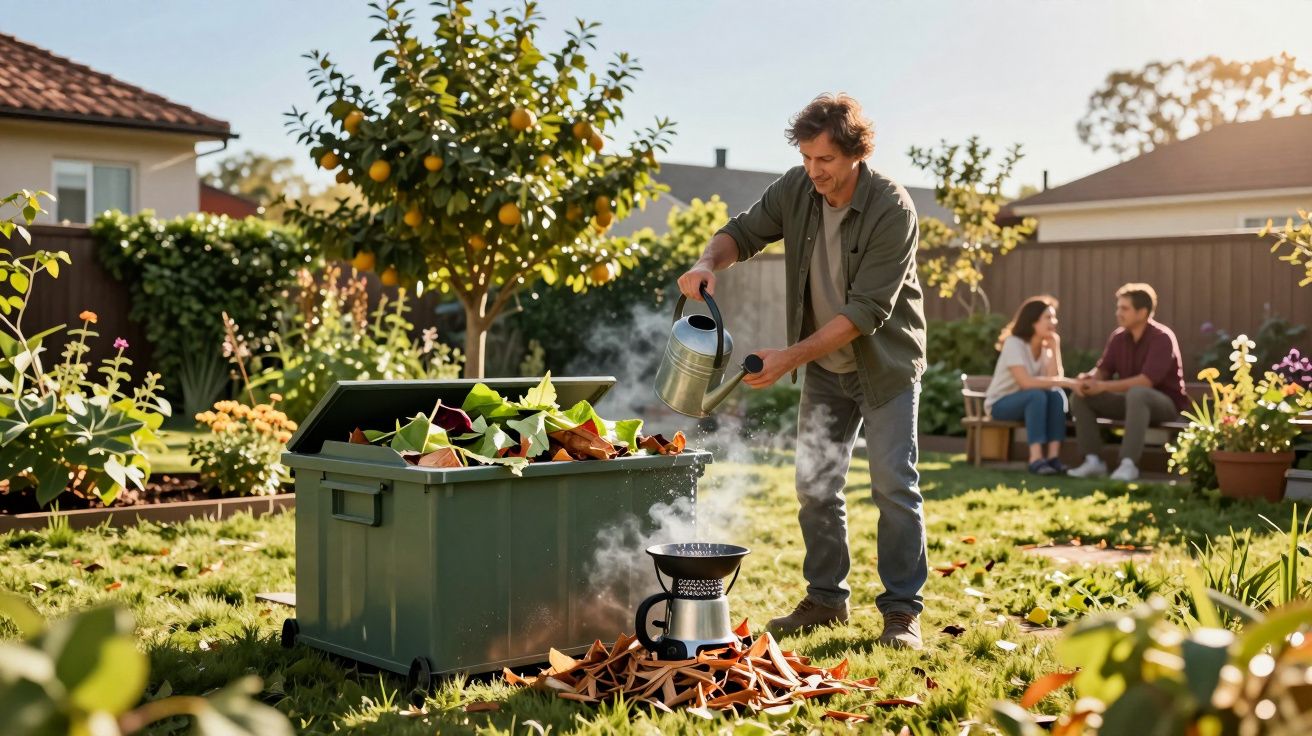
Smoking piles of leaves and branches have long been part of many people’s spring routine in their own gardens. But that tradition is changing fast. More and more German states and local councils are clamping down on the “controlled” burning of prunings and leaf litter - sometimes by tightening the rules step by step, and sometimes by introducing an outright ban from a fixed date. Anyone who simply lights a fire as usual now risks fines, angry neighbours and a great deal of hassle.
Deadline 31 March: why garden fires are being stopped in many areas
Legally, the position is clearer than many assume: under Germany’s Circular Economy Act, burning garden waste is generally prohibited nationwide. The fact that bonfires still happen in many places does not mean they are automatically allowed - in practice, states, districts and local councils rely on time-limited exemptions.
In many municipalities, the exemption ends as early as 31 March - after that, a de facto garden-fire ban applies.
Typical exemptions run from autumn through to early spring, during which leaves, twiggy prunings and other plant material may be burned only under strict conditions. Often the cut-off date is 31 March; in some regions it extends to around mid-April. After that, it stops - either until the next autumn, or permanently, depending on the local by-law.
The reasons behind these deadlines are rooted in environmental and public health protection:
- As the weather warms up, people spend more time outdoors, and smoke quickly becomes a nuisance.
- Fine-particulate and pollutant levels rise sharply with every individual fire.
- Wildlife in the soil and dead plant material starts to become active again - fire destroys habitat.
Ignoring local rules can lead not only to a fine but also to complaints from nearby residents. Many local enforcement offices now act far more firmly than they did a few years ago.
Mecklenburg-Western Pomerania garden waste: complete ban from 2029
A look at Mecklenburg-Western Pomerania shows where things may be heading. The state’s Environment Minister, Till Backhaus, has announced plans to prohibit the burning of garden waste entirely from 1 January 2029. From then on, private garden fires based on leaves, branches and green cuttings would come to an end.
The rationale is alignment with federal waste law and a stronger focus on protecting air quality and the climate. What some still see as harmless “natural material” is treated by modern waste law as a valuable resource. Green cuttings can be turned into high-quality compost and even used to produce energy - in a bin or at a composting facility rather than going up in smoke.
Garden waste is no longer viewed as rubbish but as a raw material - it should go back into the cycle, not disappear into smoke.
Other German states are also tightening rules over time. In some places, old exemptions are being removed entirely; elsewhere, limits on quantities, seasons and separation distances are being narrowed so much that having a garden fire scarcely feels worthwhile.
Why garden fires are more problematic than many people realise
The idea of a “natural” garden fire is stubbornly persistent - after all, it’s “only” leaves, small branches and spent plant growth. The downsides are often invisible at first, because they show up as fine particles and gases that end up in people’s lungs and in the atmosphere.
Impact on air quality and health
Burning damp leaves and green cuttings produces large amounts of smoke and fine particulates. People who are more vulnerable - such as children, those with asthma, or older adults - can react with irritated airways, coughing and headaches. In built-up residential areas, a single garden fire can blanket an entire street.
There is also a common problem: many piles contain more than clean garden waste. Painted wood, treated timber and bits of plastic are repeatedly found in fires. When that happens, additional pollutants are released - often far more toxic than smoke from a campfire made with dry, untreated wood.
Loss of valuable nutrients
Anything burned is no longer available to the soil. Leaves, grass clippings and small twigs contain nutrients that can be returned to the garden through composting. After burning, little remains except ash - and in typical garden quantities that ash is of limited use as a fertiliser.
Modern circular-economy thinking targets exactly this point: organic material should be returned to the nutrient cycle as completely as possible. Burning everything interrupts that process.
What garden owners should do now - garden fires and local rules
Even if “that’s how it’s always been done”, relying on old habits has become risky. Each municipality can set its own detailed rules, so a quick check before lighting anything is now essential.
Check the legal position to avoid unpleasant surprises
- Look at your town or municipality website; useful search terms include “garden waste”, “burning” and “low-emission disposal”.
- If anything is unclear, ask the local public order or environmental office directly.
- Check the permitted periods carefully: many by-laws name 31 March explicitly or use similar cut-off dates.
- Follow any rules on times of day, distances from neighbouring properties and maximum quantities.
Depending on the region, ignoring these points can lead to fines in the hundreds - or even thousands - of euros. In serious cases, the fire service or police may attend if neighbours report a blaze.
Legal alternatives: making good use of garden waste instead of burning it
Rather than setting light to garden debris, there are several practical ways to deal with it without conflict. In many cases, these options are easier and cheaper in the long run because they reduce the need to buy fertiliser.
| Option | Benefit | Particularly suitable for |
|---|---|---|
| Home compost | Produces free soil improver for your own garden | Leaves, grass clippings, small twigs, kitchen peelings |
| Food and garden waste bin (“green bin”) | Convenient collection via the local authority | Small household volumes, softer material |
| Recycling centre / green-waste drop-off point | Accepts large quantities and coarse material | Thick branches, large volumes of leaves, shrub prunings |
| Municipal composting facility | Often allows you to buy back finished compost | Mixed garden waste from larger gardens |
Composting - more than a heap at the back
If you have the space, a home compost setup is well worth considering. A simple timber or metal frame is often enough. The key is a balanced mix:
- Soft, green material such as grass clippings adds nitrogen.
- Dry, brown material such as leaves or shredded twigs provides carbon.
- Turning it occasionally introduces air and speeds up decomposition.
After a few months, you can end up with a crumbly, dark compost that improves borders, lawns and pots. Many home gardeners find they need to buy noticeably less fertiliser afterwards.
Extra low-effort options: shredding, mulching and leaf mould (added)
If burning is no longer allowed where you live, it helps to reduce volume at source. A garden shredder can turn twiggy prunings into mulch for paths and borders, and shredded material also composts faster because it has more surface area. Leaves can be stored separately in a breathable bag or bin to create leaf mould - an excellent soil conditioner that is especially useful for improving heavy soils and for mulching around shrubs.
For people with limited space, some councils and community groups offer seasonal green-waste collections or shared composting schemes. These can be a practical alternative to repeated trips to a recycling centre, particularly after hedge cutting or autumn leaf fall.
A quieter neighbourhood: avoiding disputes with neighbours
Garden fires are not just an environmental or legal issue - they are often a social flashpoint too. Smoke rarely rises neatly upwards; it drifts into bedrooms, across patios and into children’s rooms. In densely built areas, that can trigger conflict very quickly.
Choosing not to burn typically eases tensions locally. Especially in terraced housing areas and closely spaced villages, many municipalities report that complaints have dropped significantly since garden fires were heavily restricted or banned.
Common misconceptions about garden bonfires
A few myths continue to circulate, and authorities encounter them repeatedly:
- “It’s only a few leaves - that can’t be forbidden.” Most by-laws do not make allowances based on quantity. If burning is prohibited, it remains prohibited whether the pile is small or large.
- “I’ve done this for 20 years, so I’m allowed.” Long-standing habits do not create legal entitlement. As soon as the by-law changes, the new rule applies - regardless of how long you have done it.
- “If I light it after dark, nobody will notice.” Smoke is often more noticeable in the evening. Neighbours tend to react strongly if they suddenly get fumes in a bedroom with the windows open.
Why giving up garden fires pays off in the long term
Even if some people feel the new approach is heavy-handed, adapting usually brings practical benefits. A well-organised system using home composting, the green bin and the occasional trip to a recycling centre takes a bit of planning - but it puts the garden’s nutrients back into the soil instead of sending them up in smoke.
It also reduces the risk of an uncontrolled fire. In dry, windy conditions, a few sparks can be enough to endanger hedges, sheds or neighbouring land. Insurers repeatedly point out that reckless behaviour - which can include an unauthorised fire - may jeopardise cover if damage occurs.
So if you are still tempted to burn a pile “quickly”, do not just look at the calendar - check the local by-law first. The direction of travel is unmistakable: garden waste belongs in the circular economy, not in the flames.





Comments
No comments yet. Be the first to comment!
Leave a Comment