
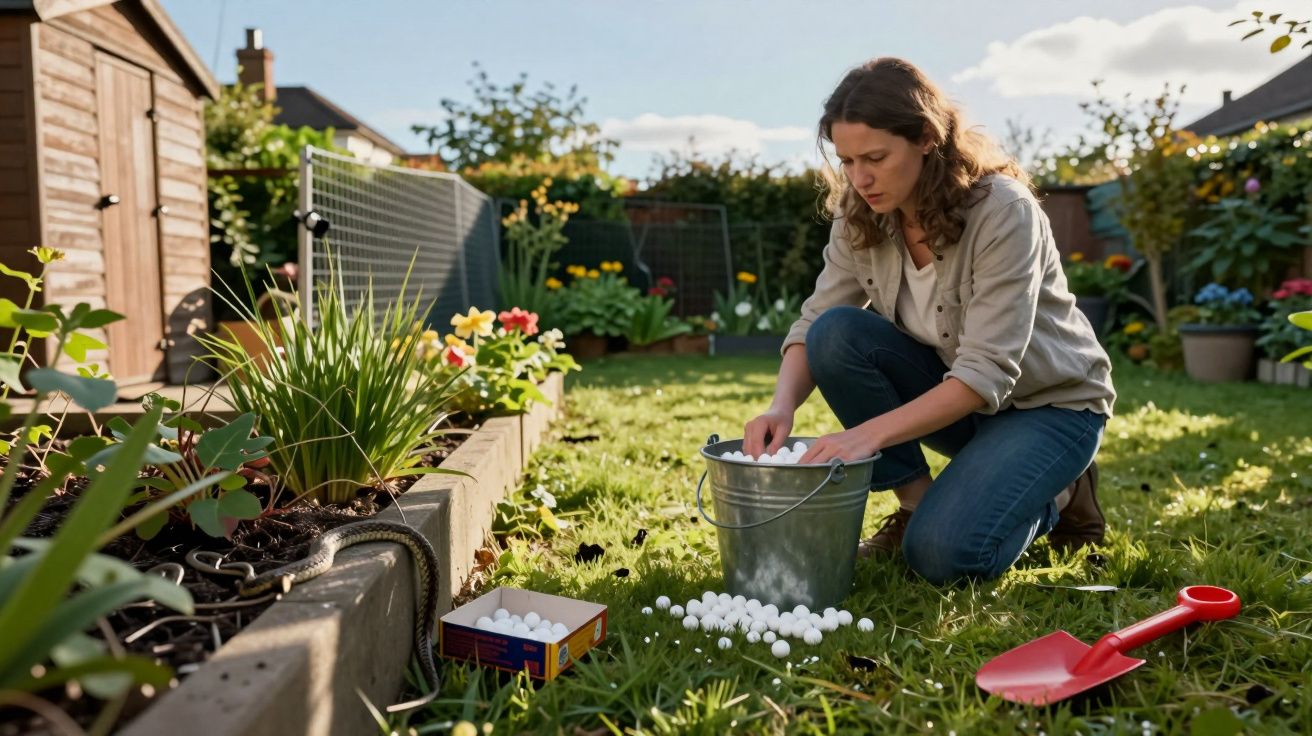
The tip refuses to die: people claim mothballs will keep snakes out of the garden and yard. You see it repeated in online forums, neighbourhood chats and even over the fence. What rarely gets mentioned is the reality: those little white balls do virtually nothing to deter snakes, but they can put people, pets and wildlife at risk.
What mothballs actually are - and what they’re meant for
Mothballs are a throwback household product, originally used to protect stored clothing from clothes moths and their larvae inside sealed storage.
They typically contain one of two active ingredients:
- Naphthalene - a strongly scented, volatile hydrocarbon
- Paradichlorobenzene - another toxic substance that evaporates easily
Both chemicals only work properly in an enclosed space. The fumes have to build up to a high enough concentration to kill moths and larvae. That is the use they’re approved for: sealed boxes, garment bags, and tightly closed wardrobes.
Outdoors, the toxic vapours disperse so quickly that any “effect” disappears - but the risk remains.
Scattering mothballs around the home or garden means using them outside their approved purpose. In many places this is treated as improper pesticide use and can lead to enforcement action. More importantly, it creates a dangerous illusion of protection: believing you’ve “dealt with snakes” can stop you from taking measures that actually work.
Do mothballs keep snakes away? What research and experts say
Herpetologists (reptile specialists) and pest-control professionals are broadly aligned: mothballs are not an effective snake repellent.
Why the smell doesn’t deter snakes in the way people expect
The assumption is understandable: “If it reeks to us, it must be unbearable to a snake.” That matches human experience - but reptiles don’t respond to scent in the same way.
- Humans react strongly to pungent smells through the nose.
- Snakes “sample” chemical cues mainly using the tongue and Jacobson’s organ.
- Their behaviour is driven far more by prey, shelter, temperature and threats than by every harsh odour in the environment.
In field observations where mothballs were placed directly in areas snakes regularly used, many animals simply moved past them - and some even travelled right over them - without obvious avoidance or panic.
Snakes follow food, cover and warmth - not the smell of mothballs.
So why does the myth persist? Chance often does the heavy lifting. A snake may leave anyway because temperatures drop, prey moves on, or it shifts its seasonal shelter. If mothballs were scattered shortly beforehand, it’s easy to connect the two events and assume cause and effect. That story gets repeated, and the misconception sticks.
Health risks in the garden: what mothballs can do outdoors
Using mothballs outside brings a package of hazards onto your property - with no meaningful benefit against snakes.
Risks to children, pets and neighbours
The small white balls can look deceptively harmless, which is exactly what makes them dangerous:
- Children may mistake them for sweets, gum or toys.
- Dogs and cats often sniff them out; some animals may even eat them.
- Neighbours can inhale vapours if the wind carries them.
Potential effects from contact or inhalation include:
- headaches, dizziness and nausea
- vomiting at higher exposures
- anaemia, particularly in young children or people with G6PD deficiency
- liver and kidney harm with repeated exposure
- irritation of the airways, eyes and skin
Veterinary practices and wildlife rescues regularly see poisoning incidents after birds, hedgehogs, dogs or cats ingest mothballs. In a garden where children play, they can become a serious ingestion hazard.
Slow, ongoing contamination of soil
With each bout of rain, small amounts of the chemicals can leach out and move into soil and potentially groundwater. The damage doesn’t stop at the “target”; it can affect beneficial and vulnerable organisms, including:
- earthworms and other soil life that support healthy, fertile ground
- pollinators such as solitary bees and other insects
- small mammals such as moles and shrews
A handful of “harmless-looking” balls can disrupt the balance of an entire garden habitat.
If you’re aiming for a thriving, wildlife-friendly garden, mothballs are a double loss: they don’t deter snakes, yet they can harm the very species you’re trying to encourage.
What actually attracts snakes - and how to discourage them (without mothballs)
If you want fewer snake visits, focus on what snakes need to survive. Three drivers matter most: food, shelter and warmth.
| Factor | Why it matters to snakes | What homeowners can do |
|---|---|---|
| Food | Rodents, frogs, insects | Avoid rubbish and clutter; reduce open feeding areas |
| Shelter | Log piles, dense undergrowth, gaps and cracks | Tidy up; raise or remove stacks; cut back dense cover |
| Warmth | Stones, walls, dark sun-warmed surfaces | Seal gaps; secure high-risk spots |
Make the habitat less appealing to snakes (and to their prey)
The most reliable approach is straightforward: remove the conditions snakes are looking for. Practical steps include:
- Cut back tall grass and dense vegetation along paths and close to walls.
- Store logs, rubble and old timber neatly, ideally raised off the ground.
- Keep compost heaps away from patios and main doorways.
- Seal holes, voids and cracks around foundations and structures.
- Position bird feeders so spilled seed doesn’t create a rodent problem.
Less shelter and fewer mice usually means fewer snakes - and this link is far more consistent than any supposed effect from scattering chemicals.
Physical barriers: fences that genuinely help keep snakes out
For sensitive areas - such as chicken runs or children’s play spaces - a properly designed physical barrier is often the most dependable option.
A “snake-resistant” fence typically works best when it is:
- made of fine mesh with minimal gaps
- fitted close to the ground with no easy crawl-under points
- installed so the bottom edge is secured (for example, pegged and/or buried to prevent lifting)
- kept clear of vegetation and clutter that could act as a bridge
This doesn’t require poison, doesn’t contaminate the soil, and reduces the chance of accidental exposure for people and pets.
If you find a snake in your garden in the UK
In the UK, most encounters are with non-aggressive native species, and many snakes are protected under wildlife legislation. If you spot one:
- keep children and pets away and give the animal space to leave
- don’t attempt to handle or harm it
- remove immediate attractants (spilled seed, rodent food, dense cover) once it has moved on
- if a snake is trapped indoors or you need advice, contact your local wildlife rescue, animal welfare charity or council for guidance
In most cases, calm, practical habitat changes are the safest and most effective “deterrent” - and they avoid the very real risks that come with using mothballs outdoors.



Comments
No comments yet. Be the first to comment!
Leave a Comment