
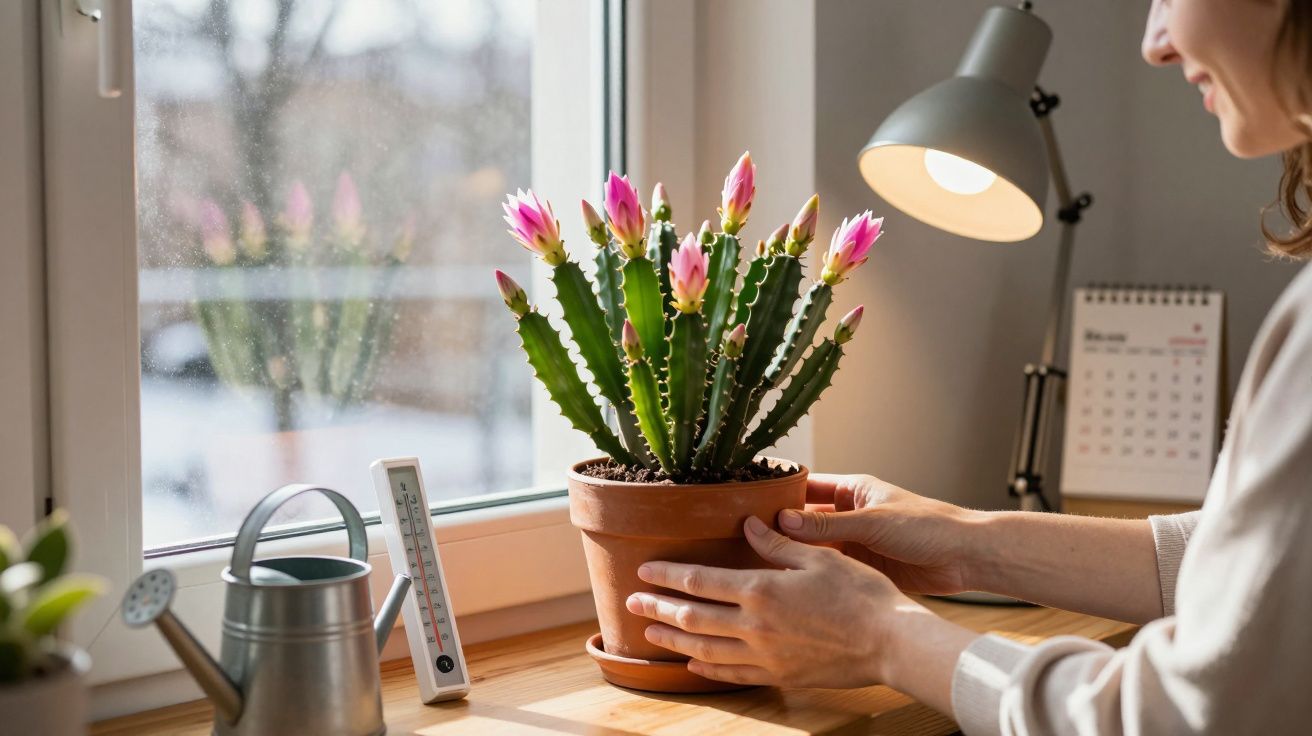
Does your Easter cactus look perfectly healthy, yet stubbornly refuses to flower every spring?
In nearly every case, the cause is a handful of easy-to-miss mistakes made over winter.
Many houseplant growers recognise the pattern: in year one, the Easter cactus comes home from the garden centre covered in bright, starry blooms. In year two, it sits in the pot looking lush and green-yet when Easter arrives, nothing happens. No buds, no colour, just disappointment. That isn’t a “bad” cactus; it’s usually a mismatch between the plant’s needs and how it’s been treated with light, temperature and watering in the months leading up to spring.
What makes the Easter cactus (Rhipsalidopsis/Hatiora) so different
The Easter cactus-botanically Rhipsalidopsis or Hatiora-is not a desert plant at all. In the wild it comes from humid South American forests, where it grows high in the canopy, attached to branches rather than rooted in heavy ground. That origin dictates what it expects indoors.
Instead of baking sun, it prefers:
- bright but filtered light
- a light, airy potting mix with no waterlogging
- moderate humidity and cooler rest periods
If you treat an Easter cactus like a desert cactus, you’ll usually get plenty of segments-but very few flowers.
Its natural flowering season is spring, roughly March to May. At its best, it covers itself in upright, star-shaped blooms. That display is exactly what you lose when the winter rest period isn’t right.
Don’t mix it up with a Christmas cactus
A common reason for “missing” spring flowers is that the plant on the windowsill isn’t an Easter cactus at all-it’s a Christmas cactus. They look similar, but they behave differently.
| Feature | Easter cactus | Christmas cactus |
|---|---|---|
| Flowering time | Spring (around Easter) | Winter (Advent and Christmas) |
| Flower shape | Star-shaped, upright | More layered, usually hanging |
| Segments | Rounder, softer outlines | More toothed or pointed edges |
If the plant is misidentified, care is often scheduled to the wrong calendar-then you end up staring at a green pot in spring, wondering what went wrong.
The yearly plan: how to get your Easter cactus into bud on time
Spring and summer: the growth phase
Once flowering finishes, the cactus moves into a rebuilding period. This is when it stores the energy it will later use to form buds.
- Position: bright, but avoid harsh midday sun (an east- or west-facing windowsill is ideal)
- Temperature: about 18–23 °C
- Watering: every 1–2 weeks; allow the top layer of compost to dry slightly in between
- Feeding: every 4–6 weeks with a mild liquid feed for flowering houseplants, used sparingly
During this phase the plant is effectively “charging its batteries”. If it is left hungry, or parked in a dim hallway, you reduce the chance of strong flowering the following year.
Autumn: slow everything down
From late summer onwards, the plant should clearly feel that the resting season is approaching.
- water a little less often
- stop feeding
- move it to a slightly cooler spot, such as a bright stairwell or an unheated bedroom
The idea is to signal “rainforest winter”: growth eases back and the plant starts preparing for bud initiation.
Winter: the make-or-break resting period
This is where the most common mistake happens-and where flowering is usually lost. The Easter cactus needs a genuine winter break, not constant warm living-room conditions.
Eight to twelve weeks in a cool, quiet spot is the ignition key for buds around Easter.
From roughly November to January, aim for:
- Temperature: 10–15 °C, noticeably cooler than a heated room
- Light: still bright, but no direct sun; ordinary daylight is enough-no prolonged artificial lighting
- Dark period: around 8 hours of diffuse daylight and about 12 hours of darkness-avoid evening light from ceiling lamps or the television
- Watering: a small drink every 3–4 weeks, just enough to prevent the stems from shrivelling
This “short holiday” of cool, calm conditions tells the plant: once this phase ends, it’s time to reproduce by flowering. If that pause never happens, buds often never appear either.
The biggest mistakes that stop an Easter cactus flowering
1) Keeping it too warm in winter
The classic scenario: the cactus sits above a radiator at a steady ~20 °C. Instead of resting, it continues growing. Typical results include:
- lots of new segments but hardly any bud formation
- soft, stretched growth
- few to no flowers in spring
2) Night-time light pollution
Easter cactus responds to day length. If the room stays bright in the evening, or a strong streetlight shines in, the crucial dark period is interrupted. Bud formation becomes erratic-or fails entirely.
A practical fix: during the rest period, move it to a cool spare room that is genuinely dark at night.
3) Too much water and the wrong compost
As a canopy-dweller, an Easter cactus never sits in dense, soggy soil in nature. In a pot, it therefore needs a very airy mix, for example:
- about two-thirds good-quality houseplant compost
- one-third perlite, pumice, coarse sand, or fine pine bark
If the roots stay wet, you’ll often see soft, slightly translucent segments-an unmistakable warning sign of root rot. In the rest period, as noted, a small amount of water every few weeks is plenty.
4) Stress right before or during bud formation
As soon as buds appear, the Easter cactus becomes sensitive. Common triggers for buds dropping suddenly include:
- moving the pot to a much brighter or much darker position
- cold draughts from ventilation
- heat shock above a radiator or in strong sun
- letting it dry out completely, then flooding it with water
During the bud stage: mark the spot and avoid changes, water evenly, and don’t experiment.
Getting the best display once buds have started
Once bud initiation has succeeded, you can help the plant hold onto buds and keep flowers looking fresh for longer. Slightly higher humidity is beneficial. A reliable method is to stand the pot on a saucer filled with damp expanded clay pellets-making sure the pot itself is not sitting in water.
During flowering, water regularly but never allow water to remain in the decorative outer pot. Keeping the rootball moderately moist helps prevent sudden segment drop and reduces the risk of bud loss.
When to repot-and when not to
Many people reach for a bigger pot just before Easter because the plant looks “so full”. Unfortunately, that timing can cost you energy and flowers. The best moment to repot is a few weeks after flowering, when the cactus is not under pressure.
- choose a pot only 1–2 cm wider
- remove old, compacted compost generously
- replant into an airy, free-draining mix again
By contrast, avoid repotting in winter or during the bud stage. Any disturbance to the roots can undo months of careful preparation.
Two extra checks that protect flowering (often overlooked)
A steady position matters more than many people expect. Even outside the bud stage, frequent turning, relocating between rooms, or placing the plant close to heat sources can subtly disrupt its rhythm. If you do rotate the pot for even growth, do it gradually and stop completely once buds begin to form.
It is also worth watching for common indoor pests such as mealybugs and scale insects, which can weaken growth and reduce flowering potential. If you spot cottony clusters or sticky residue, isolate the plant and treat promptly (for example, by wiping with a cotton bud dipped in diluted soap solution or using an appropriate houseplant treatment), then reassess watering and airflow-infestations are more likely when plants are stressed.
Why the effort is worth it
A well-managed Easter cactus can live for many years-sometimes decades. Each year it typically gains volume, and that often translates into a larger, more impressive flush of flowers. Once you’ve internalised the rhythm of a cool winter rest, cautious watering and a stable position, the routine becomes straightforward.
If you’re new to the plant, a reminder on your phone can be surprisingly effective: one alert in autumn to begin the “cool cure”, and another in late winter to bring it back to a warmer, brighter spot. After one or two cycles, the timing starts to feel natural-and the once-quiet green mound reliably turns into a vivid spring firework on your windowsill, right on cue for Easter.






Comments
No comments yet. Be the first to comment!
Leave a Comment