
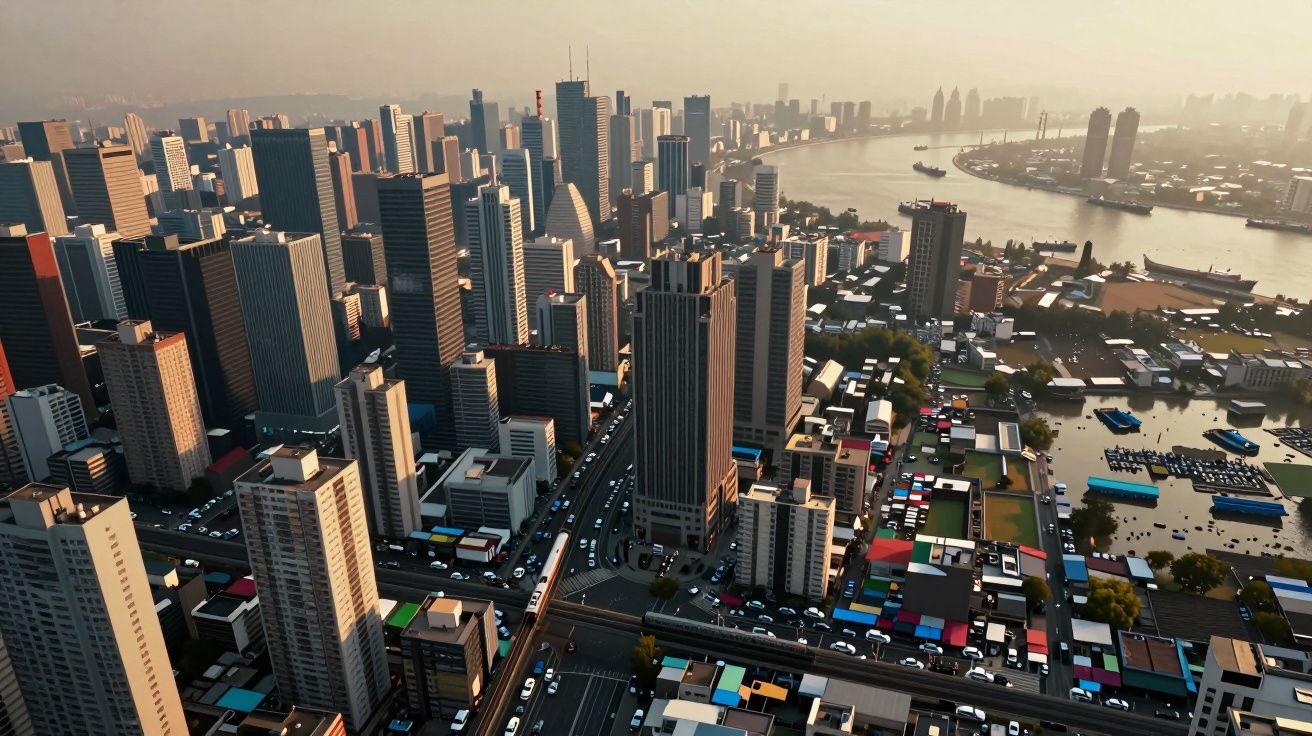
Around the world, metropolitan regions are expanding to almost unimaginable scales. Places that were once villages or modest port towns now hold tens of millions of residents, clogged streets and glowing skylines - alongside plenty of tension and competing needs. A look at the world’s ten largest cities by population shows just how quickly the planet is urbanising.
Where the world is most crowded: Tokyo at the top of the ranking
According to United Nations figures (World Urbanisation Prospects, analysed by World Population Review), Tokyo is currently the largest urban agglomeration on Earth. Roughly 36.95 million people live across Greater Tokyo - more than the entire population of Canada.
Tokyo is not only the most populous metropolitan region in the world; it is also a vivid example of how high technology, tradition and overcrowding can collide.
The wider city region covers about 8,231 km². Ultra-modern skyscrapers, neon signs and electronics shops sit alongside ancient shrines, traditional izakaya pubs and Buddhist temples. In some neighbourhoods, robots deliver meals and toilets talk to their users - while, at the same time, pilgrims pray in temples that have stood for centuries.
Tokyo did not begin as a megacity at all. Historically, it was a small fishing settlement called Edo. Only in 1868 did the Emperor relocate there from Kyoto, make Edo the capital and rename it Tokyo. Since then, the city has grown almost continuously, even as Japan as a whole faces an ageing and declining population. For that reason, experts expect Tokyo may lose its number-one position in the coming years.
A hallmark of Tokyo is its blend of nature and dense urban life. During spring cherry blossom season, thousands of trees line parks such as Ueno Park, where more than 1,000 cherry trees bloom at once in pale pink. On clear days, Mount Fuji appears on the horizon about 100 km to the west. The 3,776 m stratovolcano is regarded in Shinto as a powerful natural force and an important destination for pilgrims.
Top 10 megacities: the world’s largest cities by population (metropolitan regions)
This ranking is based on metropolitan regions, not official city boundaries. Here are the current figures (as of 2025):
| Rank | City | Country | Population (approx.) |
|---|---|---|---|
| 1 | Tokyo | Japan | 36,953,600 |
| 2 | Delhi | India | 35,518,400 |
| 3 | Shanghai | China | 31,049,800 |
| 4 | Dhaka | Bangladesh | 25,359,100 |
| 5 | Cairo | Egypt | 23,534,600 |
| 6 | São Paulo | Brazil | 23,168,700 |
| 7 | Mexico City | Mexico | 23,016,800 |
| 8 | Beijing | China | 22,983,400 |
| 9 | Mumbai | India | 22,539,300 |
| 10 | Osaka | Japan | 18,873,900 |
What these megacities share is their pull on people from rural areas - often in search of jobs, education, healthcare and a better life. The world population now stands at roughly 8.3 billion and increases by about 80 million each year. The strongest pressure is felt in cities.
India’s giant population magnets: Delhi and Mumbai
Delhi: gridlock and a smog canopy
With around 35.5 million inhabitants, Delhi ranks second worldwide. Part of this vast metropolis is the capital territory of New Delhi. Set on the Yamuna river, the city can be broadly understood as an older, extremely dense Old Delhi alongside the wider, more formally planned New Delhi, known for its grand colonial-era buildings.
In 1911, the British colonial administration moved the seat of government from Kolkata to what is now New Delhi, laying out broad boulevards, government complexes and ceremonial squares with a visibly European character. Today, wealthy villa districts and diplomatic enclaves sit in sharp contrast to narrow lanes, crowded markets and slum areas.
Delhi’s growth is rapid - projections suggest more than 43 million residents by 2035. A key driver is internal migration from poorer rural regions into the capital area. Over one million people live in slums; traffic jams are part of daily life; and the city struggles with some of the worst air pollution on the planet. To reduce exhaust emissions, authorities are increasingly promoting buses, taxis and tuk-tuks powered by natural gas.
Mumbai: India’s financial engine - and home to vast slums
Mumbai, formerly Bombay, has about 22.5 million residents and is widely seen as India’s industrial and financial heart. The city began as a cluster of several islands; during the colonial period, land was reclaimed to form a continuous urban mass, divided into trading areas, administrative zones and bazaar districts - a layout that remains recognisable today.
The south now contains many high-end residential neighbourhoods and corporate headquarters, while the north includes dense industrial areas and factories. At the same time, enormous slums have spread. Estimates indicate that around 54% of Mumbai’s population lives in informal settlements. Glassy luxury towers can stand just metres from tin-roofed shacks - an extreme illustration of social division.
Economically, Mumbai is a powerhouse: it hosts the country’s most important stock exchange, and from here India directs a significant share of its trade. The city is also the home of Bollywood, the huge film industry producing series and films for hundreds of millions of fans.
China in a double feature: Shanghai and Beijing
Shanghai: from fishing village to financial giant
With roughly 31 million people, Shanghai is China’s largest city and a hallmark of the country’s economic rise. As recently as the 19th century, Shanghai was a small fishing village - until Britain took control in 1842 after the First Opium War and established a special zone for foreign residents.
That era left a lasting international imprint. Shanghai became one of Asia’s most important hubs for trade and finance. After the Communists took power in 1949, heavy taxes and tight regulation slowed development. Momentum returned with economic reforms from 1992 onwards: the metropolis has since grown by up to 15% per year, with skyscrapers rising at speed.
Even with all the glass façades and shopping centres, the city still contains Ming dynasty gardens and temples that open a window onto its imperial past.
Beijing: a political centre with a smog crackdown
Beijing, at just under 23 million residents, is China’s second-largest city and one of the world’s most historically significant capitals. It already served as a political centre during the Zhou dynasty, and it received its present name in 1403 under the Ming dynasty.
Today, Beijing is home to the national leadership, headquarters for countless corporations and an important financial centre. More than 60 high-rise buildings exceed 150 m in height. Not far from the modern skyline are landmarks such as the Forbidden City and access to the Great Wall of China, stretching roughly 21,000 km.
For years, Beijing was shorthand for smog and dirty air. In 2014, the government launched the programme “War on Pollution”. New emissions rules, factory closures and tighter oversight of coal-fired power plants had a clear effect: between 2012 and 2021, air pollution fell markedly - demonstrating how policy can reshape a megacity.
Megacities of the Global South: Dhaka, Cairo, São Paulo, Mexico City, Osaka
Dhaka: density, growth and flooding
Dhaka, the capital of Bangladesh, has around 25.36 million inhabitants and ranks among the most densely populated cities on Earth. Cycle rickshaws dominate many streets, earning it the nickname “the rickshaw capital”.
Dhaka’s history stretches back centuries; around 1608 it became a regional capital of the Mughal Empire and grew into a hub for trade and textiles. Today, as a finance and services centre, the north of the metropolitan area is expanding fastest, while the south grapples with older neighbourhoods and slum conditions.
A major challenge is its position in a delta landscape: during the summer monsoon, flooding occurs almost every year. The hardest hit are poorer residents, whose homes offer little protection against water damage and disease.
Cairo: between pyramids and tower blocks
With approximately 23.5 million residents, Cairo is the largest city in Africa and the Middle East. Set on the Nile, it draws on more than 1,000 years of urban history. Historic mosques, older districts, museums and modern high-rises combine into a cityscape that can feel chaotic - yet undeniably striking.
About 18 km to the south-west stand the Pyramids of Giza, around 4,500 years old and attracting millions of visitors each year. The largest, the Great Pyramid of Khufu, is 139 m tall and built from roughly 2.3 million stone blocks. At the same time, dormitory suburbs, satellite towns and informal settlements continue to spread around Cairo to absorb heavy in-migration.
São Paulo: an economic engine with global character
São Paulo, South America’s largest metropolitan area, has about 23.17 million people. Founded by Jesuits in the 16th century, it experienced its major boom in the 19th century thanks to coffee plantations in the hinterland. Workers arrived from Europe and Asia, including particularly large numbers of Japanese migrants - and São Paulo still hosts the largest Japanese community outside Japan.
Today, São Paulo is Brazil’s economic heart, home to banks, major companies and start-ups. At the same time, it struggles with congestion, smog and extreme inequality.
Mexico City: a megalopolis in a volcanic basin
With around 23 million residents, Mexico City sits in a high basin surrounded by volcanoes at roughly 2,200 m above sea level. Nearly one fifth of Mexico’s entire population lives here. The modern metropolis stands on the ruins of the Aztec capital Tenochtitlán, which Spanish conquistador Hernán Cortés captured in the 16th century.
As an economic hub, it has drawn migrants from rural areas for decades, especially after crises such as the oil price collapse of the 1980s. Many newcomers end up in huge slums on the urban fringe. The consequences include chronic strain on infrastructure, water scarcity, mountains of waste and high crime levels.
- High air pollution from traffic and industry
- Thousands of tonnes of rubbish every day, with only part officially disposed of
- An informal recycling economy that provides income for many poorer residents
- A strong presence of drug cartels and gangs
Even so, Mexico City remains one of Latin America’s most visited destinations, thanks to its colonial architecture, museums and Aztec archaeological sites.
Osaka: a trading city and Japan’s food capital
Osaka, in western Japan, completes the top 10 with just under 18.9 million people. The city on Osaka Bay was already a major hub for the rice trade in the 17th century. Today it is seen as a finance and industrial centre - and as a culinary stronghold. Many well-known Japanese dishes and cooking techniques originate here, and streets packed with restaurants and food stalls shape nightlife areas such as Dotonbori.
However, rapid industrial and infrastructure expansion has had side effects. In parts of the city, land has subsided by more than 2 m due to heavy groundwater use, alongside issues such as air pollution and noise.
What drives megacities - and what they are up against
Why do people move into these vast metropolitan regions when they bring noise, smog, high rents and near-permanent traffic? Three recurring reasons appear across countries:
- Rural poverty: where farming provides little income, cities with factory and service-sector jobs look more promising.
- Better provision of services: hospitals, universities, transport hubs and cultural life are far more concentrated in major cities.
- Networks and opportunity: whether someone is looking for work, wants to start a business or hopes to gain training, megacities make useful connections more likely.
These trends create huge pressures: housing becomes scarce and expensive; slums expand; transport networks buckle under millions of commuters; and waste and sewage systems reach their limits. Air pollution in Beijing, flooding in Dhaka and waste crises in Mexico City are all different expressions of the same underlying urban surge.
It also matters what the numbers actually describe. Terms such as metropolitan region and megacity do not refer only to a city in the narrow administrative sense, but to entire built-up areas that have merged with suburbs, satellite towns and commuting zones. When comparing figures, it is essential to check whether the count covers only the core municipality or the full urban area - which is precisely why this list ranges from around 20 million to almost 40 million people.
Many governments therefore see these urban giants as both a problem and an answer. They generate a large share of national economic output, attract investment and function as testbeds for new technologies - from public transport to energy supply. At the same time, they expose the cost of weak planning: shortages of social housing, gaps in climate policy, inadequate disaster preparedness and unequal access to opportunity.
Two additional pressures are increasingly shaping how megacities develop. One is extreme heat: dense construction and limited greenery can create urban heat islands, pushing up temperatures and energy demand, particularly during heatwaves. The other is water management, whether that means coping with too much water (monsoon flooding in Dhaka) or too little (water scarcity in Mexico City). Across the largest metropolitan regions, solutions such as shaded streets, more parks, permeable paving, upgraded drainage and tighter control of groundwater extraction are becoming central to livability.
At the same time, the most successful megacity strategies tend to combine infrastructure with governance: reliable mass transit, cleaner vehicle standards and well-enforced building rules matter, but so do transparent planning processes and investment that reaches informal settlements. As these ten metropolitan regions show, the future of cities will be decided as much by policy choices as by population growth.






Comments
No comments yet. Be the first to comment!
Leave a Comment