
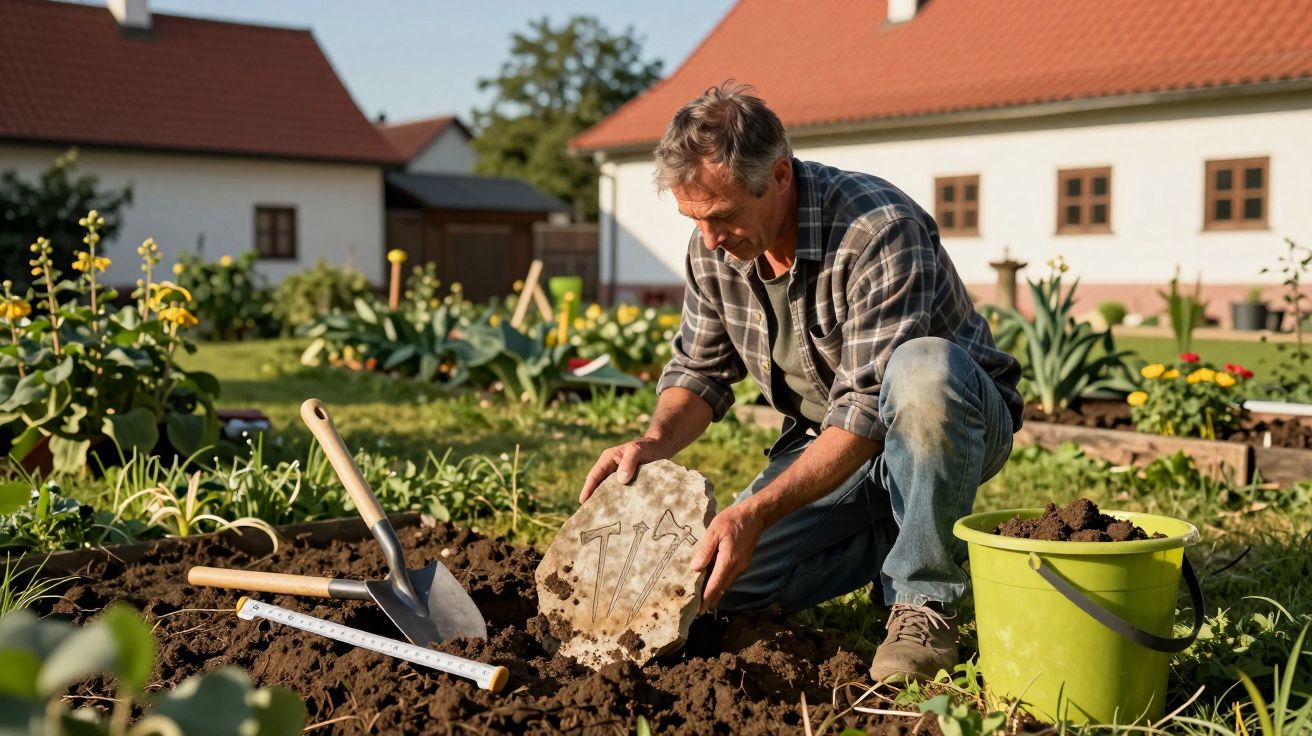
What looks like an ordinary lump of rock turns out to be a viewing window into the past: in the small village of Morkůvky in South Moravia, archaeologists have identified a 3,300-year-old casting mould stone. Study of this unremarkable block reveals how tightly trade, warfare and technology were already intertwined in Central Europe during the Late Bronze Age-and it challenges comfortable assumptions about how connected and organised that world really was.
A “stone from a barn” that caused a global stir
The story begins in 2007 in Morkůvky, South Moravia (Czechia). A local resident-referred to in specialist literature as J. Tomanec-noticed a rectangular grey stone slab protruding slightly from the soil in his garden. It was not there by chance: for years it had been used to stabilise the foundations of a barn.
Tomanec was struck by its unusually smooth edges and the remarkably regular shape. He lifted the slab out, set it aside, and then left it alone. At the time, he did not recognise what he had.
Only in 2019 did he take the stone to the Moravian Museum in Brno, where archaeologist Milan Salaš examined it-and quickly realised it was not building rubble at all, but an archaeological piece with significance far beyond the village.
In the debris under a barn foundation lay a perfectly made Bronze Age casting stone-and with it, an entire history of exchange.
The slab is about 23 cm long, weighs roughly 1.1 kg, and is made from hard volcanic rock. Cut into its face is an elongated hollow with crisp edges and precise geometry: the negative impression of a lancehead.
How Late Bronze Age smiths used a mould to cast weapons in batches
The slab is one half of a two-part casting mould. Moulds like these were typically made as a matched pair of stones. Cavities were carved into the inner faces so that, when brought together, they formed the full negative shape of a weapon or tool.
Analyses by Salaš and colleagues show that the surviving half still preserves enough information to reconstruct the entire production method. The two mould stones were set upright, pressed tightly together, and secured with copper wire. Molten bronze was poured from above through a casting channel, filling the interior cavity.
The carved form matches a leaf-shaped socketed lancehead. In practical terms, the lower end of the metal point was made as a hollow socket that could be fitted onto a wooden shaft. Prominent ribs ran lengthways along both blade and socket-clearly visible in the mould. These ridges strengthened the weapon and helped it resist bending on impact.
The stone surface also carries dark discolouration and fine cracking. Laboratory work points to repeated exposure to high heat, leading the researchers to conclude that the mould was used not once, but many times.
- Material traces indicate numerous casting cycles
- The mould design supports rapid repetition
- The resulting weapons were standardised in shape and size
Salaš’s team estimates that several dozen lanceheads could have been produced from this single mould. For the Bronze Age, that amounts to a form of small-batch production-evidence of organised manufacture rather than occasional, one-off craft work.
Geology provides the clue: the stone travelled hundreds of kilometres
The next major surprise came from geology. Brno-based geologist Antonín Přichystal examined samples using X-ray diffraction, a method that identifies the crystal structure of rock and, by extension, its composition.
The result: the casting mould stone is made of rhyolitic tuff, a specific type of volcanic rock. That material does not occur in South Moravia. Comparable sources lie in northern Hungary-for example in the Bükk Mountains-and in neighbouring parts of what is now Slovakia.
Geologically, the stone in the Czech village is an outsider-its origin points straight to the Carpathian Basin.
This builds a striking picture. Around 3,300 years ago, people transported a heavy stone over several hundred kilometres across Central Europe specifically to make a highly specialised tool. This was not a random boulder picked up locally, but deliberately selected stone with properties suited to Bronze Age metalworking.
For the researchers, the implications are clear: by the Late Bronze Age, stable exchange routes already linked the area of present-day Hungary with South Moravia. Raw materials, weapons, and very likely knowledge-and perhaps craftspeople themselves-moved across long distances.
The Urnfield culture: weapons, exchange and power in Central Europe
The find fits within the Urnfield culture, which shaped large parts of Central Europe from roughly 1300 to 800 BCE. The name reflects a characteristic funerary custom: the dead were cremated, their remains placed in ceramic urns, and buried in extensive cemeteries.
During this period, settlements grew, groups coalesced into larger political units, and conflicts increasingly escalated into armed confrontation. Weapons became central to power.
The ribbed, socketed lanceheads produced by this mould are considered typical of the Carpathian Basin. Discoveries of similar weapons elsewhere show they spread well beyond their areas of origin-supporting the idea of trading networks that distributed not only bronze and ornaments, but also military equipment.
At the same time, the mould’s standardised design suggests shared expectations about kit. A warrior was not meant to carry just any spear point, but a recognised and proven form. Batch production made that consistency achievable.
What the Morkůvky casting mould stone suggests about Bronze Age warfare
Bronze Age fighters likely did not operate mainly as lone champions; they often moved in groups with comparable equipment-shield, helmet, greaves, sword or spear. Accounts from later periods, including stories of combat before the walls of Troy, describe warriors carrying multiple throwing or thrusting spears.
If a spear was lost or broken, it needed replacing quickly. That is precisely where casting moulds like the one from Morkůvky matter. Wherever such moulds existed, fresh supplies could be produced at speed. This would have strengthened rulers and communities with access to bronze, specialist metalworkers, and the trade routes that kept the whole system supplied.
From garden discovery to journal article: why research takes time
Between the garden discovery (2007) and publication of the scientific study (2025) lie 18 years-a reminder of how many steps are needed before a single object can be securely placed into its wider context.
Key stages included:
- stabilising and conserving the stone in the museum
- microscopic study of the surface
- laboratory-based geochemical and mineralogical testing
- comparison with known finds across Europe
- dating and cultural attribution within the Urnfield culture
- interpretation within the region’s histories of trade and conflict
Only by combining these strands could researchers turn an apparently ordinary stone into a decisive piece of evidence for long-distance Bronze Age networks.
Two extra angles: how specialists test such finds, and why provenances matter
One growing line of work that complements artefact analysis is experimental archaeology. By reproducing moulds and casting replica socketed lanceheads under controlled conditions, researchers can estimate how quickly a workshop could produce a “run” of weapons, how many pours a stone mould can survive, and what kinds of heat damage and residue patterns repeated casting leaves behind. Results from such experiments make it easier to judge whether moulds like the Morkůvky example were occasional tools-or part of sustained production.
Equally important is provenance: knowing where an object came from and how it was found. A barn foundation is not an archaeological layer, and the stone had been re-used as building material for years. That makes careful documentation vital-recording the exact findspot, local history of the building, and any associated materials. Without that context, the mould could be misread as a local curiosity rather than evidence of wider movement through the Carpathian Basin and beyond.
What non-specialists can take from the Morkůvky case
This discovery underlines how consequential apparently trivial objects can be. Many important finds do not come from major excavations; they appear by chance in gardens, cellars, or fields. Anyone who comes across unusual stonework, metal fragments, or pottery should avoid throwing it away. A quick check with a local museum or heritage authority can be worthwhile.
The case also shows how closely geology and archaeology depend on one another. Without identifying the rhyolitic tuff, the casting mould stone might have remained a local oddity. Pinning down its origin is what revealed a dense web of connections linking Central Europe more than three millennia ago.
For researchers, the Morkůvky stone is a compact package of evidence: it speaks to manufacturing technique, weapon design, material choice, exchange routes and military organisation. For everyone else, it carries a simpler message-sometimes the plainest object in your own back garden can rearrange whole chapters of history.





Comments
No comments yet. Be the first to comment!
Leave a Comment