
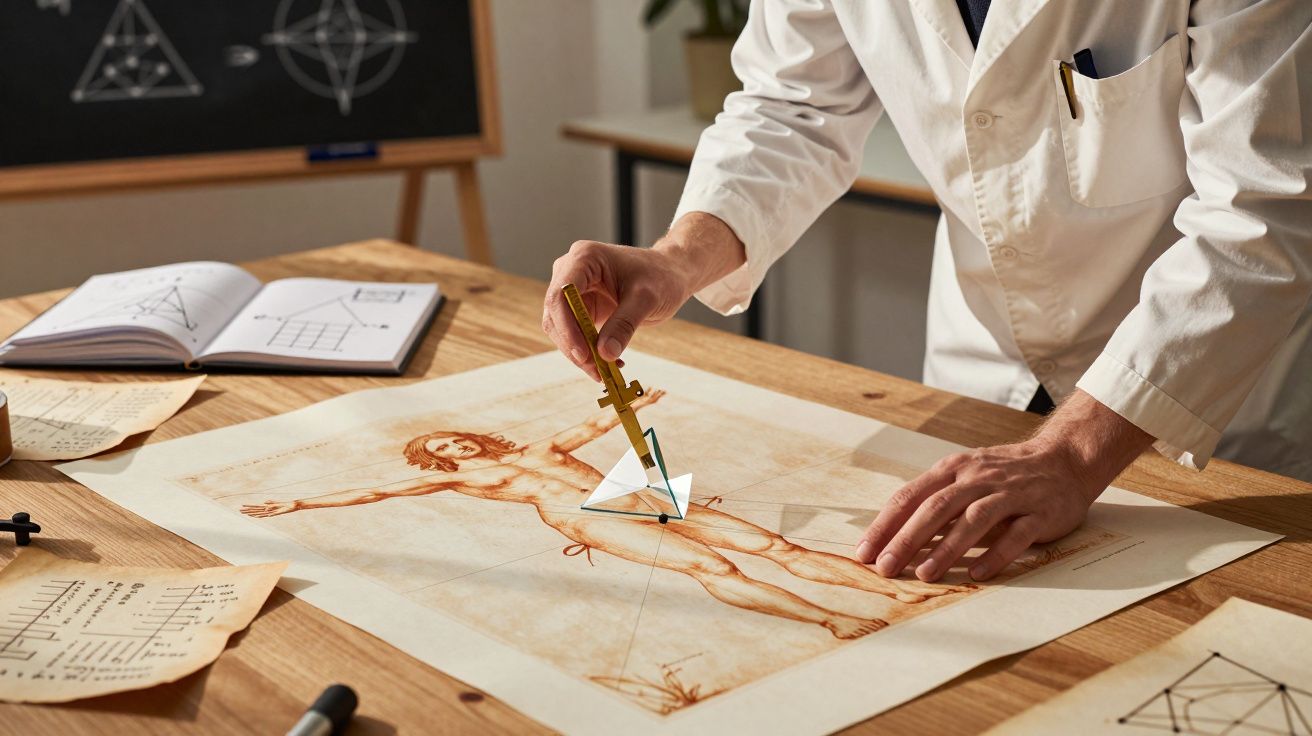
Leonardo da Vinci’s Vitruvian Man is widely treated as a Renaissance icon and a shorthand for “perfect” human proportions. For decades, art historians, mathematicians and enthusiasts of esoteric symbolism have assumed that the celebrated figure is built around the Golden Ratio. A British researcher now argues otherwise: Leonardo, he says, worked with a different, distinctly three-dimensional geometry-one that unintentionally anticipates a principle used to describe how matter organises itself.
A 500-year puzzle at the heart of the Vitruvian Man
At first glance, the Vitruvian Man appears straightforward: a nude male figure fitted simultaneously into a circle and a square, shown with two sets of arms and legs. Yet the sheet is anything but simple. It is a dense mesh of lines, measurements and handwritten notes, designed to translate the teachings of the Roman architect Vitruvius onto the human body-the human being as the measure of all things.
For a long time, the dominant interpretation has been that Leonardo constructed the figure using the Golden Ratio. This familiar value (approximately 1.618) has been celebrated for centuries in architecture and painting and later promoted in countless guides to “beautiful” proportions. In the classic reading, the navel in the Vitruvian Man divides the body according to that proportion.
However, when the original drawing is measured with millimetre-level care, a snag appears: the proportions do not land precisely on 1.618. The distances vary, which sits awkwardly with Leonardo’s reputation as a meticulous planner who thought through details down to the smallest unit. For researcher Rory Mac Sweeney, this mismatch is too consistent to dismiss as chance.
If the numbers do not fit the Golden Ratio, then we have been looking for the wrong rule.
The tetrahedral quotient (tetrahedron geometry) as a new candidate
In a study published in 2025 in the Journal of Mathematics and the Arts, Mac Sweeney proposes an alternative key: the tetrahedral quotient, a value of roughly 1.633. Unlike the Golden Ratio, which is typically applied to line segments on a flat plane, this figure comes from a spatial structure: the tetrahedron.
A tetrahedron is easy to picture in everyday terms. Take four identical spheres (tennis balls are a good mental model) and stack them so they sit as tightly together as possible. You end up with a small, triangular pyramid-like cluster. This arrangement follows strict geometric rules, and one of those relationships leads to the 1.633 ratio Mac Sweeney focuses on.
Mac Sweeney’s claim is direct: the decisive proportions in the Vitruvian Man match the tetrahedral quotient more closely than they match the Golden Ratio.
Leonardo’s drawing as a three-dimensional idea, not a flat diagram
For centuries, scholars have often treated the Vitruvian Man as a purely two-dimensional graphic problem: how to place a body neatly into a circle and a square. But Leonardo was never only a painter. He was also an engineer, architect, anatomist, inventor and acute observer of the natural world. For someone who designed flying machines and mapped complex fortifications, thinking in three dimensions would have been second nature.
Mac Sweeney builds on that broader context. In his interpretation, Leonardo did not see the body as a flat silhouette. Instead, the figure represents a system constructed in space-meaning the sheet is proportioned according to a spatial organising principle that only received rigorous mathematical description centuries later.
The margin note that changes the geometry
A central element of this reinterpretation comes from Leonardo’s handwritten notes around the figure. One instruction stands out in Mac Sweeney’s reading:
Leonardo states that, between splayed legs and raised arms, an equilateral triangle is formed, with its base touching the feet and its apex touching the head.
That line matters because it shows Leonardo deliberately working with triangles and therefore with explicit geometric forms, not merely “pleasing” proportions. Using this instruction, Mac Sweeney re-measured specific relationships, including:
- the distance between the two feet (the base of the triangle)
- the height up to the navel
From these measurements he reports a ratio in the range 1.64 to 1.65-noticeably closer to the tetrahedral quotient (1.633) than to the Golden Ratio (1.618). To Mac Sweeney, this is strong evidence that the drawing is guided by a spatial ordering logic rather than by the later-mythologised numerology of the Golden Ratio.
A practical note on measurement and materials (additional context)
Any attempt to extract exact ratios from a Renaissance drawing must also confront physical realities: paper can expand and contract with humidity, ink lines have thickness, and repeated handling can introduce tiny distortions over centuries. That does not make measurement meaningless, but it does mean the best-supported interpretations are those that remain robust even when small uncertainties are allowed-precisely the kind of “nearer fit” Mac Sweeney argues for when comparing the tetrahedral quotient with the Golden Ratio.
Where the tetrahedral quotient appears in nature
At first, a tetrahedron-based ratio can sound abstract. It becomes more persuasive when you look at how often tetrahedral structures appear in the natural sciences. Tetrahedral packing is a classic solution whenever matter needs to be both stable and densely organised.
Common examples include:
- Diamond: Each carbon atom bonds to four others at angles of about 109.5°, forming a lattice of tetrahedra-one reason diamond is so hard.
- Silicon crystals: The foundation of microchip manufacturing relies on the same tetrahedral bonding logic, using silicon atoms rather than carbon.
- Water molecules: In clusters of H₂O, bonds and lone electron pairs adopt tetrahedral-like arrangements, helping shape water’s unusual properties.
- Viral shells: Many viruses assemble protein coats from symmetrical triangular units, creating strong protection for genetic material with minimal resources.
Wherever dense packing and stability dominate, tetrahedral logic tends to appear-and with it, relationships aligned with the value Mac Sweeney believes he has identified in the Vitruvian Man. In his view, Leonardo transferred a “rule of efficient organisation” from the realm of matter to the geometry of the human body.
From the Golden Ratio to biomechanics
If Mac Sweeney’s reading holds, it shifts the emphasis of the drawing. Rather than functioning mainly as an almost mystical emblem of “cosmic harmony”, the Vitruvian Man begins to look like an early attempt to understand the body as a functional machine. The sheet would speak less about divine proportion and more about forces, leverage and structural stability.
Mac Sweeney supports this shift with a comparison to the Bonwill triangle. In 1864, the American dentist William Bonwill described an equilateral triangle of roughly 10 cm per side, whose corners are the two jaw joints and the central incisor. This configuration enables a powerful bite with comparatively efficient use of the chewing muscles.
Mac Sweeney treats this as the same efficiency principle he sees in the Vitruvian Man: triangular structures that distribute forces effectively.
Applied to the body as a whole, the implication is clear: Leonardo may have considered humans not only as reflections of a divine order, but also as outcomes of natural principles that prioritise stability and function-an idea that could have been intellectually risky in the religious climate of his time.
Why this matters to design today (additional perspective)
Seen through a biomechanical lens, the debate is not merely historical. Modern designers routinely borrow from engineering models when analysing joints and bones. Whether developing a prosthetic limb, an exoskeleton or a performance running shoe, the same questions recur: how do forces travel, which angles remain stable under load, and where does the body conserve energy? If the Vitruvian Man encodes a spatial logic akin to efficient packing and force distribution, it offers a surprisingly modern bridge between anatomy, mechanics and geometry.
How revolutionary was Leonardo’s thinking?
There is no definitive historical proof that Leonardo knew the tetrahedral quotient as a formal number. Mathematicians set out the relevant formulae clearly only long after his death. Even so, a technically gifted artist-engineer could plausibly grasp such relationships intuitively.
Leonardo dissected bodies, studied joints, drew muscle structures and devised mechanical apparatus. Working that way fosters sensitivity to recurring geometric patterns well before they are expressed as equations. In that light, Mac Sweeney’s proposal is not a fanciful distraction but a serious alternative way of reading one of history’s most examined drawings.
What “Golden Ratio” and “tetrahedron” really mean
Many readers know the Golden Ratio only as a loose aesthetic guideline-popular, for instance, in photography, where subjects are placed slightly off-centre. Mathematically, 1.618 describes a specific division of a line segment into two parts such that the whole-to-part ratio equals the part-to-remainder ratio.
The tetrahedral quotient follows the same general idea of comparing proportions, but it applies that thinking to three-dimensional structures. It is not about a single line; it is about distances and relationships inside a spatial form such as a tetrahedron. Understanding that difference also helps demystify many claims about “sacred geometry”: not every number that roughly matches a measurement points to a mystical rule.
The more genuinely intriguing cases are those where certain values repeatedly emerge in stable natural arrangements-crystals, molecules and other tightly organised structures. That is exactly where Mac Sweeney positions his analysis. He treats the human body as operating within the same broad rulebook that shapes atoms, viruses and crystals.
Whether the tetrahedral quotient interpretation gains long-term acceptance remains to be seen. What already seems certain is that the Vitruvian Man has not yielded all its secrets-and continues to be an ideal test case for connecting art history with modern geometry and the natural sciences.





Comments
No comments yet. Be the first to comment!
Leave a Comment