
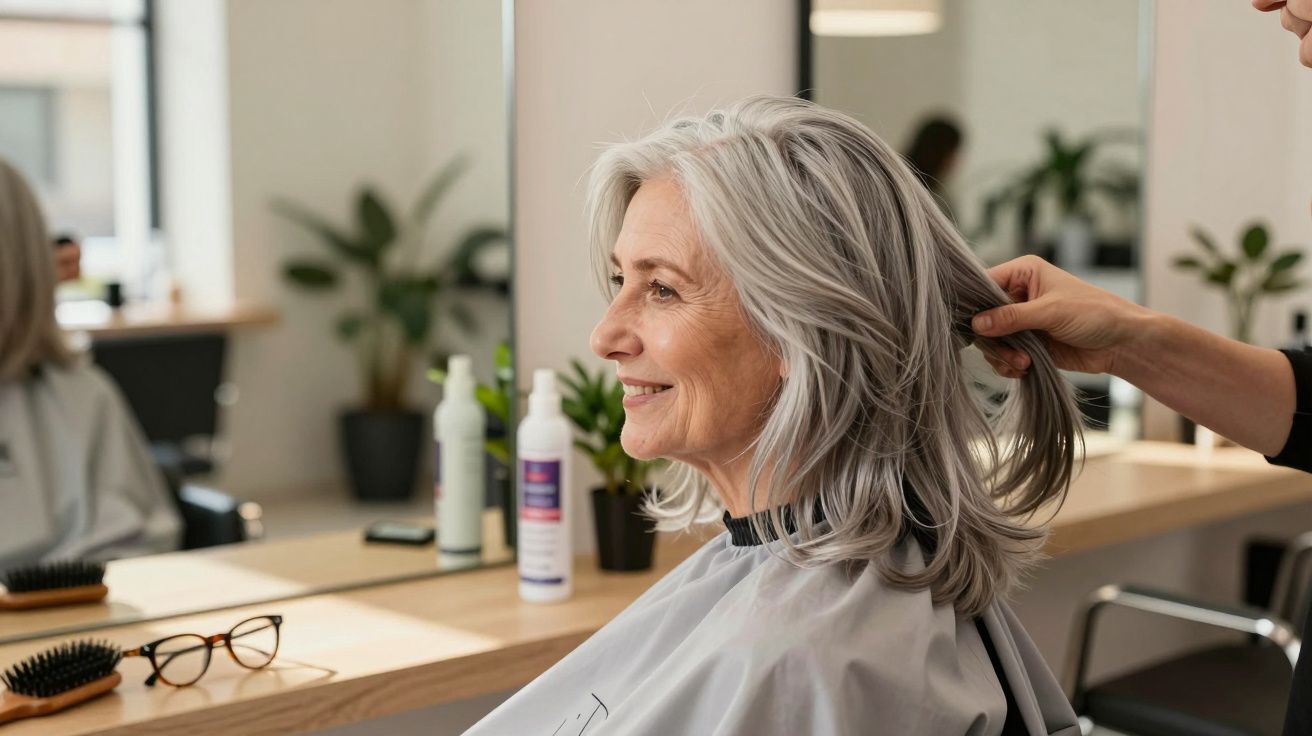
Often, it’s simply the wrong length.
As we get older, hair changes in structure, density and the way it falls. Colour tends to look lighter, facial features can appear more defined, and contours become softer. Hairdressers agree: it isn’t only the shade that influences whether you look fresh or severe - the hair length of your cut plays a huge part too. With grey hair or white-blonde hair in particular, the right cut length can make a remarkable difference.
Why the right hair length for grey hair over 60 makes such a difference
Grey hair often feels unlike it did years ago: a bit drier, frequently finer, and sometimes more unruly. At the same time, facial skin loses firmness, the cheeks can hollow slightly, and the jawline may look less crisp. A well-chosen haircut works with these changes rather than highlighting them.
The ideal length for grey hair after your 60th birthday creates volume where it matters and redirects attention away from tired contours towards brighter features such as the eyes and cheekbones.
Very long sections can quickly pull grey hair downwards. The weight reduces lift at the roots, and the lengths can simply hang - and with fine hair, the result often looks flat and sparse. At the other extreme, an ultra-short cut can draw attention to every angle: jaw, forehead, and fine lines around the mouth. Either option can make the face look sterner.
The key is finding a length that softly skims the face line, builds volume at the crown, and still shows the nape - without tipping into a harsh, severe finish.
Hairdressers’ go-to length for grey hair over 60: short, but lively with layers
Many professionals recommend a contemporary, layered short haircut for grey hair over 60. This approach relies on contrast: shorter at the nape, with more length and movement at the crown and around the face.
What this rejuvenating short cut looks like in practice
- Nape exposed: Hair at the nape is kept fairly short or lightly tapered. This removes heaviness, visually elongates the neck, and creates a more dynamic impression.
- More length on top: The hair at the crown stays noticeably longer. That’s where volume is built, which lifts the overall silhouette and refreshes proportions.
- Fine layers: Gentle layering reduces severity, softens the outline and adds fullness - particularly helpful for thinning hair.
- Loose pieces around the face: A few softly cut sections around the forehead and cheekbones frame the face and make strong lines appear less prominent.
- Texture over perfection: The finish can be slightly “messy” - intentionally not too polished, with movement and definition.
Layering also helps the hair catch and scatter light more evenly. Grey and white tones look more vibrant, and natural reflections show up more clearly. That can make the complexion look fresher - especially alongside light, natural-looking make-up.
The most problematic hair length for grey hair: a blunt jaw-length bob
Hairdressers often single out one cut length as particularly risky: a precisely cut bob that sits exactly at jaw height, with no layers. On grey or white hair, this can read as unforgivingly hard.
A bob that ends right at chin level and looks ruler-straight is considered one of the least flattering cuts for grey hair over 60.
Why this length is so tricky:
- The straight line at the jaw emphasises even slight softness in the lower face.
- Without layers, the shape can appear angular, which draws attention to fine lines and sharper contours.
- On fine hair, the compact, blunt form spotlights unevenness - hair can look flat and lacking movement.
For that reason, many salon professionals advise: if you want a bob, build in movement - with soft layers, lightly textured ends, or waves that break up the rigid line.
Grey hair over 60: hair lengths that genuinely look more youthful
There’s no single universal answer, but certain lengths and shapes tend to work especially well for grey hair.
| Length | Benefit for grey hair |
|---|---|
| Short, layered (longer at the crown) | Creates fullness, opens the face, looks modern and fresh. |
| Short to mid-length, soft bob | Flatters when lightly layered or waved; reduces harshness. |
| In-between length to just above the shoulders | Only recommended with layers and movement; otherwise it quickly feels too heavy. |
Many hairdressers see the strongest rejuvenating effect in a short, textured length - roughly between the ear and the middle of the neck. It works best when the nape stays airy and volume sits at the crown rather than gathering at the ends.
Matching the perfect hair length to your face shape (with grey hair)
The ideal hair length also depends on face shape. With grey hair, proportions can stand out more strongly because lighter colour tends to highlight edges and angles.
Rounder, softer faces
A slightly longer crown with upward volume helps visually lengthen the face. The sides can sit closer to the head, while a few face-framing pieces draw attention towards the centre. A very short, evenly rounded cut can make the face appear wider.
Square or more defined faces
These benefit from softly cut outlines and side layering. The length should avoid finishing exactly at the widest points (such as the jaw or cheekbones) and instead sit just above or below them. Relaxed waves or a side fringe can take the hardness out of the face shape.
Slim, long faces
Here, side volume matters more than extra height at the crown. A layered short cut that falls a touch wider at the sides - and isn’t taken too extremely short at the nape - creates balance. A diagonal fringe can visually shorten the forehead.
Styling tips so grey short haircuts don’t look “severe”
Even the best cut can lose its effect if styling becomes too rigid. A few simple techniques keep the look youthful and lively:
- Swap gel for a lightweight styling cream or mousse - it holds without leaving hair stiff or sticky.
- When blow-drying, lift hair with your fingers rather than flattening it with a brush to preserve texture.
- Lightly rough up the ends and define a few strands on purpose, instead of pulling everything sleek.
- If hair is very straight, add just a handful of large, loose waves with a small curling tong.
- Use shine spray sparingly so grey hair doesn’t look artificially glossy, but naturally luminous.
Another essential factor is care. Grey hair can quickly look dull. A gentle silver shampoo once or twice a week helps neutralise yellow tones, while conditioner or a mask improves softness. When hair is well cared for, the surface reflects light more evenly - and facial lines automatically appear softer.
An extra factor many people miss: glasses, fringes and face framing
If you wear glasses, your hair length and face-framing layers matter even more. Heavy, blunt sides can compete with frames and make the mid-face look busier. Softer layers around the temples and cheekbones tend to sit better with glasses, while a light, side-swept fringe can soften the forehead without clashing with the top rim.
When longer grey hair can still work
Long grey hair isn’t automatically off-limits. If you naturally have thick, strong hair, you can still look great after 60 with hair that reaches the shoulders or even beyond. The deciding factor remains the cut: longer layers, a soft fringe, or waves prevent the “curtain effect”, where two heavy sections frame the face and drag everything downwards.
If you’re unsure, it’s often best to change in stages: start with a layered mid-length cut, then go shorter step by step. That makes it easier to see at which length your expression looks noticeably fresher.
Keeping shape and movement: trims and heat protection
Short, layered cuts for grey hair over 60 tend to look their best when maintained regularly, because the shape relies on clean lines at the nape and lift at the crown. Scheduling trims roughly every 4–6 weeks helps the style stay airy rather than collapsing. If you use heated tools, a heat-protectant spray is worth adding - grey hair can be more porous and may lose shine faster if it’s over-styled.
Salon visits, consultation, and the courage to let go of old habits
Many women stick with a familiar length because they’ve identified with it for years - even if it no longer suits their hair texture or face shape. An honest conversation at the salon can help challenge long-standing routines.
Bringing photos of yourself with different lengths often makes it immediately clear which cuts lift the face and which ones pull it down. A strong consultation also considers glasses, clothing style and make-up, because all of these interact with hair length.
In the end, there isn’t one “magic” length - but there are clear patterns. A lively, layered short cut that reveals the nape, creates volume at the crown, and softly rounds the face remains one of the most reliable ways to make grey hair over 60 look visibly younger and fresher.




Comments
No comments yet. Be the first to comment!
Leave a Comment