
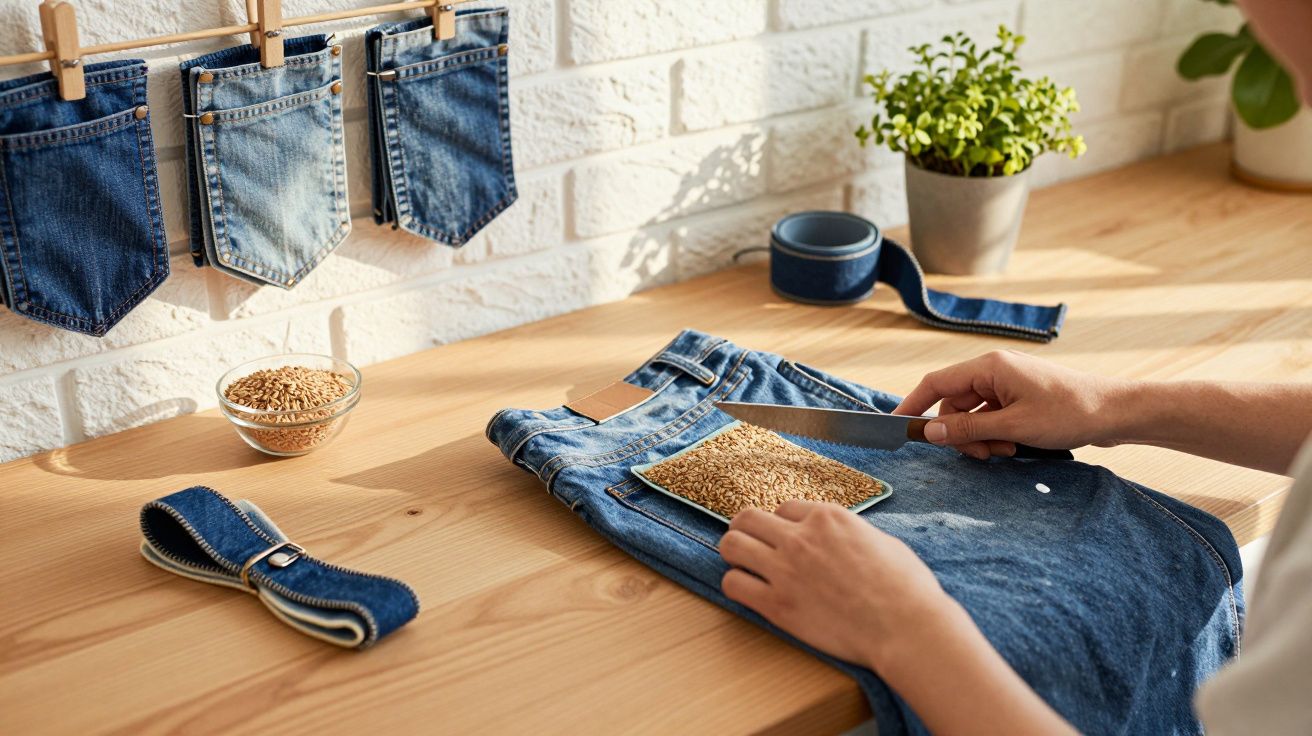
Old jeans often end up in the bin far too quickly, even though denim is one of the toughest fabrics you can have in a wardrobe. If you repurpose it thoughtfully, you save money, reduce waste and gain genuinely useful everyday items-without needing to be a sewing expert.
Why old jeans are far too good for the bin
Most people know the pattern: your favourite jeans fit perfectly and come with you through work, weekends and everything in between-until the knee splits or the seat wears thin. Then they’re shoved in a drawer or binned. That’s a classic misstep.
Denim is a high-quality material: hard-wearing, shape-retaining, easy to cut, and often already softened through wear. Those traits make old jeans perfect for upcycling projects that aren’t just decorative, but properly practical.
Throwing away an old pair of jeans means throwing away not only fabric, but also the thousands of litres of water used to produce it.
Estimates suggest that producing a single pair of jeans can take up to 10,000 litres of water, from growing cotton to dyeing. When that fabric is discarded after only a few years, the environmental cost is enormous. Upcycling squeezes far more life out of the same material.
Why denim fabric works so well for quick projects
Denim is woven using a technique called twill (often visible as a diagonal rib). Coloured warp threads and pale weft threads cross in a slanted pattern, which gives the fabric strength and helps it resist fraying as soon as it’s cut.
That’s especially helpful if you’re not confident with a needle and thread: raw edges can often be left “open” without the whole thing unravelling. Any slightly uneven cutting tends to blend in because denim already carries a natural, lived-in finish.
The fabric from an old pair of jeans is often sturdier than plenty of new kitchen items-and you’ve already paid for it.
Sort smart before you cut: repair, pass on, repurpose
Before you reach for scissors, it’s worth deciding what each pair is best suited for. This avoids chopping up jeans that still have plenty of wear left in them-while keeping genuinely worn-out denim in use.
| Condition of the jeans | Best option |
|---|---|
| Still perfectly wearable | Charity shop, second-hand sale, clothing donation, swapping group |
| Minor damage | Darning, patching, resetting a hem |
| Heavily worn | Upcycling projects such as a heat pack, organiser, washable “sponges” |
| Only tiny scraps left | Stuffing for cushions, doorstops or pet toys |
Three fast transformations in under 15 minutes (from one pair of jeans)
With a few simple steps, a damaged pair of jeans can become three particularly handy items: a reusable cleaning/scrubbing alternative, a desk or kitchen organiser, and a soothing grain heat pack.
1) A washable cleaning and dish-scrubbing alternative (Tawashi) made from denim
Instead of constantly buying new sponges, you can turn a trouser leg into a long-lasting woven scrubber-often known as a Tawashi.
- Lay a trouser leg flat and cut it into strips around 2–3 cm wide.
- Take a small wooden board or thick piece of cardboard and place nails or drawing pins in a rectangle.
- Stretch denim strips tightly across the pins in one direction, then weave strips across the other way.
- Interlace until you have a dense square.
- Knot the ends securely, or add a few stitches so nothing slips loose.
These homemade “sponges” can be washed at 60 °C, absorb moisture well, and usually last far longer than many shop-bought options.
2) A wall organiser made from back pockets (jeans organiser)
Back pockets are ready-made fabric pouches with neatly finished edges-ideal for a simple wall organiser above a desk, by the front door, or in the kitchen.
Fastest method:
- Cut out the back pockets with a little surrounding fabric, leaving about a 1 cm border.
- Choose a base: a corkboard, wooden board, or sturdy cardboard.
- Fix the pockets with fabric glue, or attach them with drawing pins or small nails.
- Let everything dry fully if you used glue.
They’re great for pens, scissors, charging cables, shopping lists or keys. If you have multiple old jeans, mixing different shades of blue creates an eye-catching patchwork effect.
3) A “dry hot water bottle”: a grain heat pack from a trouser leg
This project uses the tube of a trouser leg as a sleeve for a simple grain heat pack. It works well with rice, cherry stones, or spelt.
- Cut a piece of trouser leg about 20 cm long.
- Close one end (stitch it from the inside, or tie it off tightly with strong thread).
- Fill with roughly 500 g of rice, stones, or a similar dry filling.
- Seal the open end (stitch shut, or tie extremely firmly).
Heat the pack in a microwave for about 2 minutes (make sure there are no metal parts left on the fabric) and use it to warm your bed, sofa, or sore muscles.
Family life with jeans: when children wear through the knees faster than you can wash them
In households with children, knee holes can appear at record speed. Rather than getting annoyed at the wear and tear, you can turn it into a steady supply of useful materials.
A popular quick fix is to cut the jeans off above the hole, instantly turning them into summer shorts. Children get something wearable again straight away, and the denim doesn’t go to waste.
The cut-off lower legs can then be used immediately for heat packs or Tawashi scrubbers-so one heavily worn pair can become a small bundle of everyday helpers.
From a single, very worn pair of trousers you can make shorts, heat packs, cleaning helpers and plant ties.
Garden tip: use thick jeans seams as plant ties
Jeans often have chunky, durable seams down the sides. These are usually discarded during cutting, but if you keep them you gain free, soft ties for the garden.
Trimmed close to the edge, those seams are ideal for fastening tomato plants, runner beans and other climbers to canes or supports. Unlike wire, they won’t cut into stems, yet they still hold plants securely in place.
Extra quick denim upcycling ideas (using leftover flat pieces)
After the main projects, you’ll often have flat offcuts left. Those scraps can become more small items in minutes:
- Squares as reusable make-up remover pads or cleaning cloths
- Strips as a headband or a cover for a hair tie
- A single back pocket as a phone holder beside a plug socket
- Small patches to sew onto children’s clothes or rucksacks
On a rainy afternoon, these are also an easy, low-cost activity with children: cut, glue and knot-no pricey craft-shop materials required.
A couple of practical extras that make denim projects work better
Denim can sometimes bleed dye, especially darker washes. If your upcycling project will touch light surfaces (worktops, tiles, pale fabrics), wash the denim first and let it dry fully. For cleaning cloths and Tawashi scrubbers, an initial hot wash can also improve absorbency.
It’s also worth keeping a small “jeans parts” jar or box: buttons, rivets and sturdy belt loops can be reused later for craft projects, bag fastenings or makeshift hooks-useful bits that often end up thrown away by default.
What to watch out for: safety, cleaning and durability
For any project involving heating (such as a grain heat pack), remove all metal components. Zips, rivets and buttons do not belong in a microwave. The first time you heat the pack, test cautiously to see how hot it becomes.
Denim scrubbers and cloths should be washed regularly-ideally at 60 °C-to keep them hygienic and long-lasting. Avoid fabric conditioner, as it often reduces how well the fibres absorb water.
If you use glue, choose one specifically made for textiles and labelled as washable once dry. For high-stress areas, a few hand stitches are usually enough to reinforce the join.
Why it’s worth doing-even if you only have 10 minutes
These projects may look small, but they can shift how you think about clothing. Instead of defaulting to replacement, you start asking: what can I make from what I already have?
Once you’ve upcycled one pair of jeans, the habit often spreads to other textiles-T-shirts, bedding, towels-many of which suit similar quick projects. The result is less textile waste, a lighter hit to your budget, and a home filled with sturdy, personal everyday items that cost nothing extra.




Comments
No comments yet. Be the first to comment!
Leave a Comment