
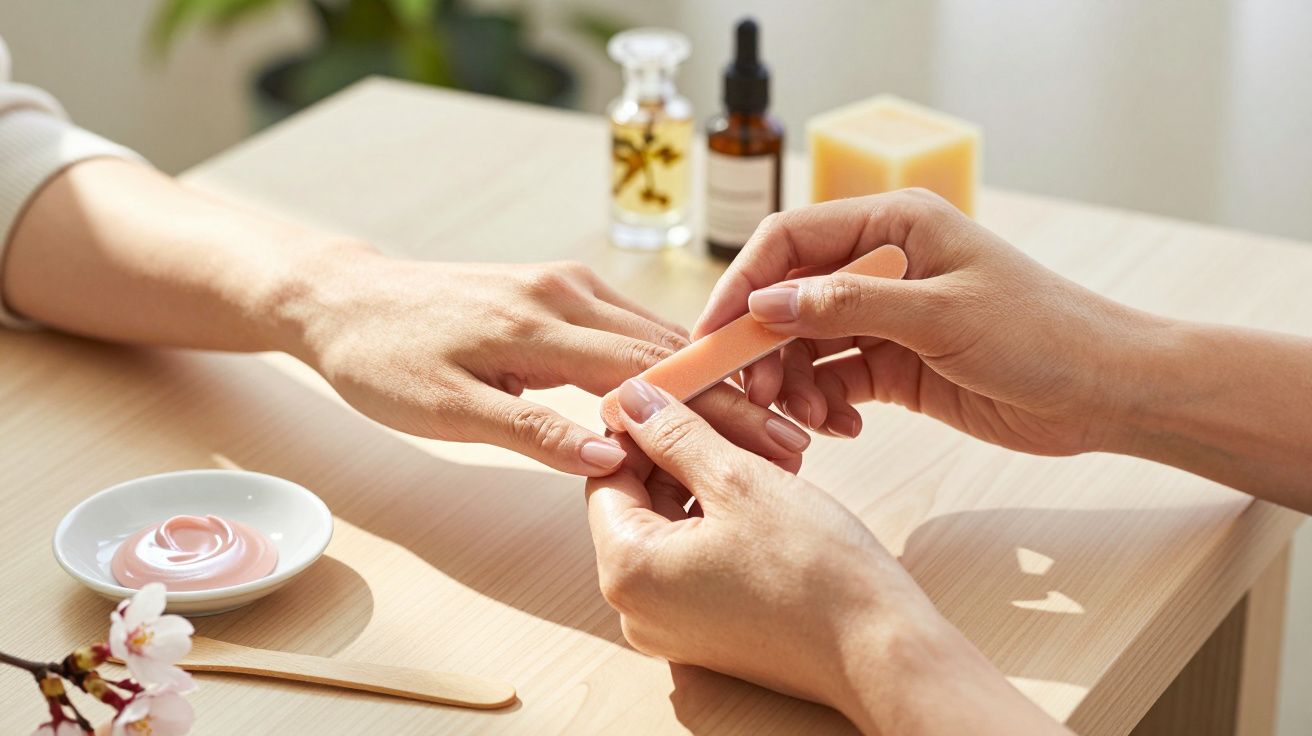
Natural nails are pushing out gel and acrylic: an old care ritual from Japan is set to become a quiet but powerful beauty trend in spring 2026.
After years of relying on gel, acrylic or builder gel overlays, many people are noticing the trade-off: nails that feel fragile, look dull and have become noticeably thinner. A technique is now taking centre stage that skips plastic layers and UV lamps entirely-and it succeeds precisely because it does. The Japanese manicure promises healthy-looking, softly rosy, light-reflective nails that read as “my nails, just better”.
What the Japanese manicure actually is (and why it works for natural nails)
A Japanese manicure is less about styling and more like an intensive nail-care ritual. The method was originally developed in Japan for nails that were brittle or overworked; today it’s spreading through European salons and into at-home routines across the UK.
The focus isn’t colour-it’s the health of the natural nail, with shine as a welcome side effect.
Rather than placing varnish or gel on top of the nail, the technician works with a nutrient-rich paste followed by a fine polishing powder. The aim is to massage beneficial ingredients into the nail plate and then “lock in” the finish-not by sealing the nail the way gel does, but more like completing a concentrated treatment.
Typical ingredients used in a Japanese manicure
- Beeswax to protect and create a smoother surface
- Keratin-based components to reinforce the nail structure
- Minerals containing silicon to improve resilience
- Vitamins (often A, E or B-complex) to condition the nail plate
- Food-grade oils and fats to deeply nourish
The blend is gently massaged into the nail and worked in with a polishing tool. A very fine powder is then applied on top to set everything in place and create the signature, delicate pearly sheen.
Japanese manicure step by step: what happens in the appointment
Compared with a classic gel session, the process feels calmer and more low-key: no electric drill, no clouds of filing dust, and very little chemical smell. Instead, it’s careful manual work-massage, polishing and precision.
- Preparation: Hands are cleansed; the cuticles are softened using a remover or oil, then gently pushed back.
- Shaping: Nails are filed into a natural, usually shorter shape-most commonly rounded or softly squared.
- Light surface refinement: The nail surface is smoothed only minimally with a very fine file or buffer, rather than aggressively thinned down.
- Massaging in the nutrient paste: The specialist paste is applied with a soft spatula and massaged into the nail plate using a polishing tool or fingertips.
- Polishing in the powder: A mineral powder is added and buffed in until the characteristic, rich shine appears.
- Finishing touches: Cuticle oil and hand cream complete the treatment, often with a short hand massage.
The end result is a pinky-nude glow that resembles naturally healthy, slightly glossy nails-without a visible layer sitting on top.
Why this trend is taking off in spring 2026
After years of ever-thicker overlays, neon colours and intricate designs, the mood is shifting. Clean, nourishing and understated fits perfectly with the wider “less, but better” mindset.
Many people are stepping out of the endless cycle of infills, filing down and rebuilding, and treating their nails to something closer to rehabilitation.
The Japanese manicure slots neatly into that movement because it offers:
- Less pressure on your budget thanks to longer gaps between appointments
- Less stress on the nail by avoiding harsh chemistry
- A polished look without that obvious “false nail” finish
- A result that grows out gracefully, rather than chipping like polish
Instead of needing an infill every 2–3 weeks, many people find a monthly visit is enough, or even once every 6 weeks. As the nail grows, the sheen simply moves upwards with it, so it doesn’t suddenly look “ruined” in the way chipped lacquer does.
Differences between gel, acrylic and BIAB vs a Japanese manicure
To understand the technique, it helps to grasp the core distinction. Gel, acrylic and builder gels (including BIAB) create an artificial layer over the nail that hardens. A Japanese manicure focuses on saturating the nail with conditioning ingredients and buffing the nail plate to a shine.
| Aspect | Gel / Acrylic / BIAB | Japanese manicure |
|---|---|---|
| Material | Synthetic polymers, often used alongside solvents | Nutrient paste and powder with naturally derived ingredients |
| Curing | Requires a UV or LED lamp | No lamp-shine comes from polishing |
| Goal | Length, reinforcement, design | Healthier natural nails, subtle gloss |
| Removal | Filed off or dissolved with chemicals | Grows out; can be gently maintained |
| Best for | Dramatic length and statement nail art | Natural look, sensitive nails, minimalism lovers |
Notably, the Japanese approach can be appealing for people with sensitive skin, for pregnant clients, or for anyone who prefers to avoid UV exposure and heavy filing dust.
Who the Japanese manicure is ideal for
This isn’t only aimed at the “clean girl aesthetic” crowd or social media trends. Many people choose it because their nails are simply at breaking point. Common candidates include:
- People with thin, splitting nails after a long period wearing gel
- Brittle nails made worse by frequent sanitising and repeated water exposure
- Jobs where bold designs are inappropriate or not allowed
- Anyone who dislikes the obvious “salon nail” look but still wants hands to appear well cared for
The effect is best described as “work-appropriate”: neat, tidy and never loud.
That said, it can still feel stylish. Many salons pair a Japanese manicure base with extremely subtle design-such as an ultra-fine French line or a gentle, glazed finish.
At-home care: how to keep the shine for longer
If you’re paying for a salon treatment, you’ll want the result to last. A few straightforward habits make a real difference:
- Massage nail oil daily into the nail plate and cuticles
- Wear gloves for cleaning to reduce water and chemical exposure
- Don’t pick at the cuticle-smooth rough bits with a soft file instead
- Avoid acetone-based removers if you do use polish occasionally
There are now home kits that include paste and powder. If you use one, be especially gentle: avoid coarse files and don’t over-buff, or you can make the nail plate thinner. Less often, done carefully, is far better than frequent aggressive polishing.
Choosing a salon (or kit) wisely: what to look for
Because the Japanese manicure relies on technique rather than a hard coating, results vary depending on the provider. A good salon will use very fine buffers, avoid excessive abrasion, and talk you through how often you should return based on the condition of your nails. If you’re buying a kit, choose one that clearly lists ingredients and includes an appropriate, gentle buffer-anything that encourages heavy filing works against the whole point of the treatment.
It’s also worth asking how the salon sanitises tools and whether single-use items are used where appropriate. This matters for any manicure, but especially when you’re prioritising nail health and want to avoid irritation or infection.
Risks, limits and what this trend cannot do
As gentle as the method is, it isn’t magic. Severely damaged or painful nails may require medical advice. Fungal infections, deep cracks or injuries belong with a healthcare professional-not a nail studio.
And if you habitually bite your nails or pick the skin around them, don’t expect overnight transformation. A Japanese manicure can support recovery, but you still need to change the behaviour-otherwise you’re essentially polishing over fresh damage again and again.
One more reality check: if you’re used to very long, very hard extensions, you may need time to adjust. Natural nails are more flexible and can knock against things more easily. Many people describe the first week or two as feeling “bare”, but after a few weeks they often find that flexibility surprisingly comfortable.
How to pair a Japanese manicure with the rest of your beauty routine
A Japanese manicure fits neatly alongside trends like skinimalism and “clean beauty”. If you’ve already streamlined your skincare-fewer products, better quality-this is the hand-and-nail equivalent.
It also pairs brilliantly with intentional hand care: gentle hand washes, rich overnight hand masks, and daily SPF on the backs of the hands and fingertips. Treating your hands with the same seriousness as your face noticeably enhances the effect of the Japanese technique.
A more sustainable approach to nails (without giving up polish entirely)
Another reason the trend is resonating in 2026 is that it naturally encourages a lower-maintenance, lower-waste routine: fewer infill appointments, less product build-up, and less reliance on curing lamps and removal chemicals. For many people, that feels like a more sustainable way to stay groomed.
And if you still enjoy colour occasionally, you can-just keep it gentle. Opt for non-acetone removal and give your nails periods where the Japanese manicure is the main event, so the nail plate can stay conditioned and resilient.
In the end, the “after” isn’t a dramatic photo of ultra-long tips-it’s something more grounded: hands that look cared for even when you’re not freshly out of the salon. That understated, future-proof feel is exactly why the Japanese manicure is poised to define spring 2026.
Comments
No comments yet. Be the first to comment!
Leave a Comment