
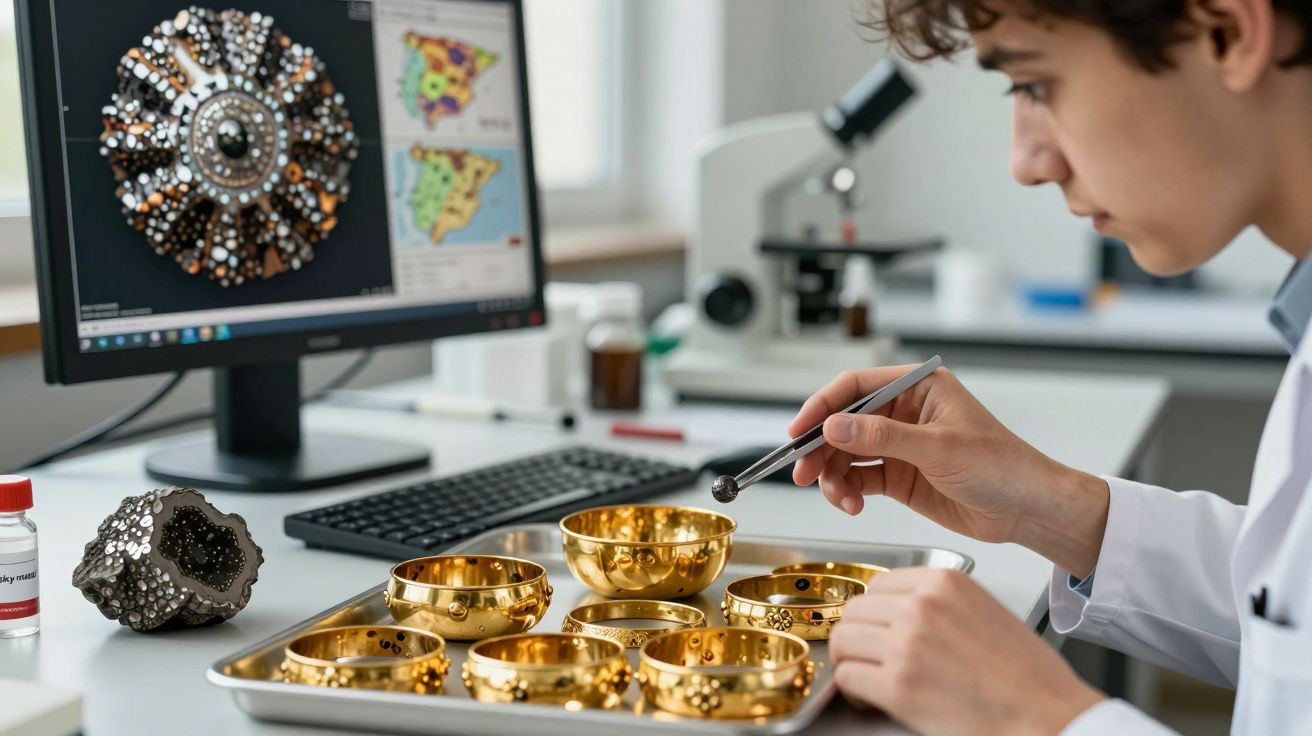
Between heavy gold, gleaming silver and ancient ornaments, two modest iron objects turned up in a 3,000-year-old hoard-pieces that puzzled researchers for decades. Fresh laboratory work now shows the metal was not dug from a mine at all: it came from outer space.
The Treasure of Villena: a hoard that reshapes Spain’s Bronze Age
The so-called Treasure of Villena was discovered by chance in 1963, when a civil engineer carrying out earthworks near the town of Villena in Alicante Province struck metal in the ground. What at first looked like “a few old bits and pieces” quickly proved to be one of the most important metal finds from the European Bronze Age.
The hoard contains 66 objects in total: chiefly spectacular gold and silver pieces, alongside amber beads and two small iron items. Dating places the deposit broadly between about 1400 and 1200 BCE-a period when bronze dominated the region and iron was, for all practical purposes, unknown.
Nearly ten kilograms of finely worked gold-and right in the middle, two tiny pieces made from a metal that quite literally fell from the sky.
Today, the collection is kept at Villena’s José María Soler Archaeological Museum. Behind glass, visitors can see bracelets, torcs, small flasks and decorative bowls, arranged to underline just how strongly late Bronze Age communities valued metal.
The puzzle of the two iron objects in the Treasure of Villena
From the outset, two pieces stood apart from everything else in the Treasure of Villena: a small iron bracelet and a hollow, hemispherical element, likely a piece of jewellery or decorative fitting. They did not resemble typical iron artefacts familiar from the later Iron Age.
Key oddities included:
- Unusually highly polished surfaces
- Striking resistance to rust and corrosion
- Fine workmanship despite the lack of an established local ironworking tradition
- No convincing link to any known regional ore sources
For a long time, catalogues included them-somewhat reluctantly-as very early experiments with iron: historically intriguing, but hard to explain. Clarity only came with a research team led by metallurgist Salvador Rovira-Llorens.
Laboratory proof: meteoritic iron, not mined iron
The researchers examined the metal using modern techniques, including mass spectrometry. The crucial evidence lay in the nickel content and specific trace elements that function like a chemical fingerprint.
The chemical signature does not match iron from the Earth. It matches iron meteorites-fragments of small celestial bodies whose cores are made of iron–nickel alloys.
The results showed:
- A clearly elevated nickel level, characteristic of iron meteorites
- Trace-element ratios not found in natural ores from the area
- Agreement with established reference samples of meteoritic iron
For the Iberian Peninsula, this is a first: these two objects are regarded as the earliest securely identified pieces made from meteoritic iron in the region-and they come from a time when large-scale working of terrestrial iron had not yet begun.
In famous company: Tutankhamun’s dagger and other “sky metals”
With this new identification, the Treasure of Villena joins a select group of celebrated meteoritic-iron finds. The best-known parallel is the dagger from the tomb of the Egyptian pharaoh Tutankhamun, whose blade is also made from metal of cosmic origin. Comparable early objects appear in the Near East and across parts of Eurasia, where rare meteorite fragments were shaped into prestige items.
The Spanish evidence indicates that Iberian Bronze Age societies, too, had access to these “stones from the sky”-either because a meteorite fell locally, or because the material arrived via long-distance exchange networks reaching westwards.
How Bronze Age craftspeople worked meteorites
The Villena iron bracelet measures about 8.5 cm in diameter. Surface studies reveal traces of intensive hammering and shaping. The hemispherical piece is almost mirror-smooth, with a consistent curvature that implies considerable technical skill.
For Bronze Age metalworkers, iron was an unfamiliar material that behaved differently from bronze. Meteoritic iron added its own distinctive traits:
- High hardness, yet still forgeable with practiced technique
- A peculiar lustre unlike bronze or silver
- Greater resistance to rust, helping the objects survive for millennia
Rather than casting it as they would bronze, craftspeople likely learned the material through repeated heating and thinning. In practice, the work was predominantly forging, not mould-based production.
Symbolism: metal that falls from the sky
No one can say whether people at the time understood that this iron came from outer space. What is certain is that meteorite falls can be dramatic-high-speed impacts, brilliant flashes, even fires-events that would not be forgotten quickly. Owning fragments of such a stone probably felt like possessing something extraordinary.
For Bronze Age elites, meteoritic iron was likely more than a rare metal-it may have carried a “supernatural” aura.
That interpretation fits the choice of objects: not a utilitarian tool, but jewellery and ornamental components. The point was status, prestige and perhaps religious meaning, rather than practical everyday use.
What the Treasure of Villena reveals about power and trade
Taken as a whole, the hoard shows how tightly wealth could be concentrated. The 66 objects can be summarised as follows:
| Material | Number of objects | Typical forms |
|---|---|---|
| Gold | 21 | Flasks, bracelets, rings, bowls |
| Silver | 27 | Jewellery, vessels, decorative pieces |
| Amber | 18 | Beads, pendants |
| Iron (meteoritic) | 2 | Bracelet, hemisphere |
The objects were clearly deposited together deliberately-buried, not accidentally lost. Many researchers interpret the hoard as a ritual act: an offering, or a symbolic concealment of wealth during a period of social change.
At the same time, the mix of materials points to far-reaching connections. Amber typically originates in more northerly parts of Europe; gold and silver presuppose specialised mining and metalworking; and meteoritic iron is rare in the extreme. Anyone capable of assembling such a collection must have been well positioned within political and economic networks.
An additional clue lies in the hoard’s composition: it is not just “valuable” in a modern sense, but carefully selected for display and meaning. The pairing of brilliant goldwork with an exotic, hard-to-source iron may have amplified the message of authority-an elite able to command both terrestrial riches and the rarest materials nature could deliver.
What meteoritic iron actually is
Meteoritic iron usually comes from so-called iron meteorites. These are chunks from the cores of small proto-planetary bodies formed early in the Solar System, later shattered by collisions. Inside those bodies, iron and nickel separated and crystallised into metal.
When such a mass passes through Earth’s atmosphere and does not burn up completely, fragments can reach the ground. Many contain:
- Iron–nickel alloys with a high nickel content
- Distinctive crystal structures that become visible when polished
- Trace elements such as cobalt in characteristic proportions
For today’s researchers, that composition is strong evidence of a cosmic origin. For Bronze Age communities, it was probably experienced as an exceptionally tough, hard “metal stone” with an unfamiliar appearance.
Why the find matters today
The Treasure of Villena contributes several key pieces to the wider picture of the European Bronze Age. It demonstrates highly advanced metalworking long before iron became a mass material. It supports the existence of complex systems of trade and exchange at the western edge of the Mediterranean. And it highlights how strongly rare materials could reinforce social hierarchies.
It also illustrates how profoundly new methods can transform old discoveries. For decades, the two iron objects sat in plain view in a museum case, yet their true origin remained unrecognised until modern analytical tools were applied. Now they are treated as crucial evidence for pinning down, more precisely in time, the earliest encounters with iron on the Iberian Peninsula.
Looking ahead, the Villena pieces also raise practical questions about conservation and display. Highly polished metal surfaces-especially those containing nickel-can react unpredictably to humidity and handling over long periods. Careful environmental control in museum cases, alongside non-invasive re-analysis as techniques improve, can help ensure that these rare “sky metal” artefacts continue to yield information without being damaged.
For museum visitors in Villena, these two unassuming pieces offer an unusual perspective. Behind the gold splendour lies not only wealth, but a direct material link to processes in the early Solar System. Standing at the display case, you are not only looking at Bronze Age jewellery-you are looking at metal that was once part of a shattered celestial body, before ending up in the hands of an unknown craftsperson in what is now Spain.




Comments
No comments yet. Be the first to comment!
Leave a Comment