
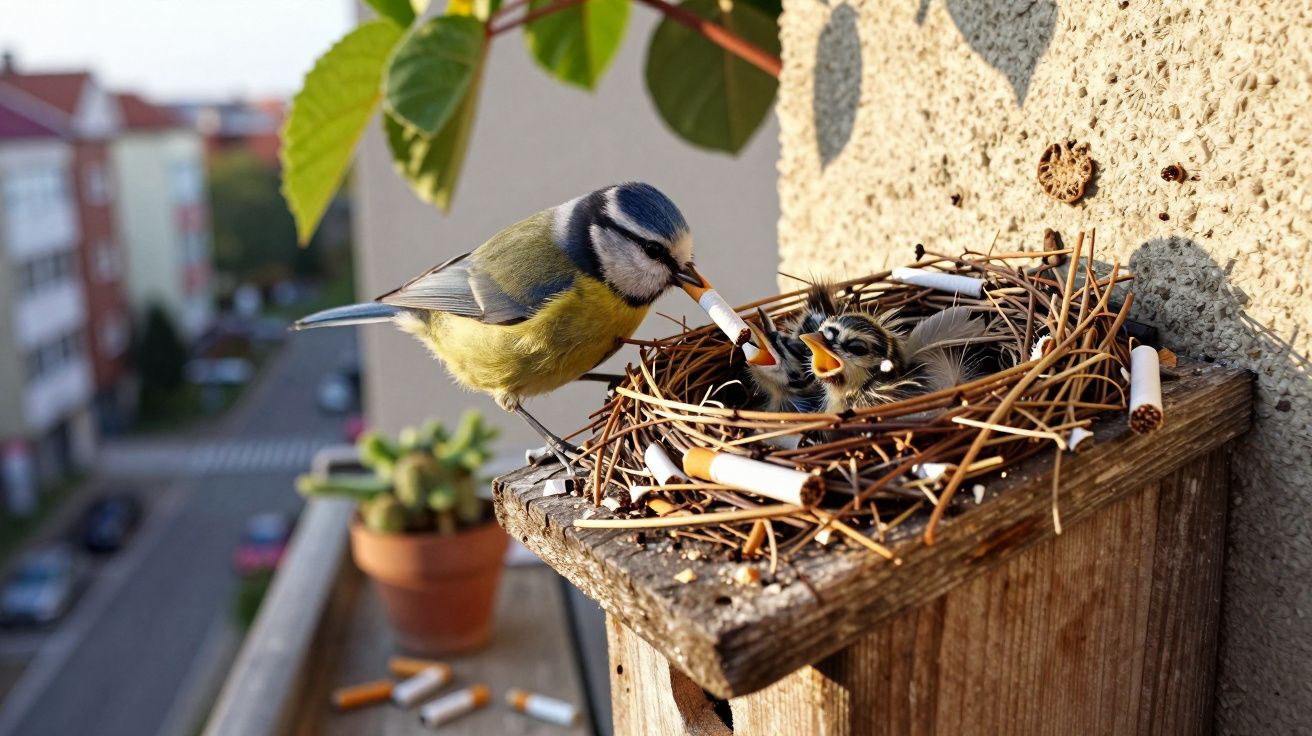
In a growing number of towns and cities, birds are increasingly incorporating cigarette filters into their nests. What first sounds like a conservationist’s nightmare turns out, according to research, to be an ambivalent form of protection: fewer parasites, but new health hazards from chemical residues.
Why birds are carrying cigarette butts into their nests
A blue tit with a cigarette butt in its beak might look like the ultimate symbol of pollution. Yet researchers in Poland and Mexico who investigated the behaviour more closely concluded that it appears to be a deliberate tactic rather than a random mistake.
A team at the University of Łódź in Poland studied blue tits living both in urban areas and in nearby woodland. The birds had begun bringing cigarette butts to their nests on a regular basis. The researchers wanted to find out whether this was mere coincidence or whether it had measurable consequences for the health of the chicks.
The suspicion: birds are using nicotine and other substances in filters as a natural weapon against parasites.
Cigarette filters contain thousands of chemical compounds, including nicotine, which can repel or kill many insects. Some birds seem to be taking advantage of this effect-whether intentionally or simply by responding to the outcome.
Study in Poland: three nest types and unexpected results for blue tits
The Łódź researchers provided blue tits with three different nest set-ups:
- a fully natural nest made from typical materials such as moss, feathers and plant debris
- a nest made from materials that had been sterilised beforehand
- a nest in which the researchers additionally placed two cigarette butts
After the chicks hatched, the scientists waited 13 days and then examined three nestlings from each nest. Among other measures, they assessed general health, parasite load and a range of blood values.
The results:
| Nest type | Chick health | Parasite load |
|---|---|---|
| Natural nest | poorest | significantly more fleas and ticks |
| Sterile nest | better | fewer parasites |
| Nest with cigarette butts | also better | fewest parasites |
Chicks raised in the natural nests performed worst overall. Nestlings from the sterilised nests-and from nests containing cigarette butts-were noticeably fitter. The standout finding was parasite control: nests with cigarette butts contained markedly fewer parasites, particularly fewer fleas and ticks.
Nests containing cigarette butts were the most parasite-free-a clear advantage for chicks, at least in the short term.
Evidence from Mexico: birds actively seek out filters
Very similar patterns have been reported by researchers led by biologist Constantino Macías García in Mexico. There, especially finches and sparrows deliberately pull cigarette filters apart, tease out small fibres, and weave them into their nests.
In Mexico City, biologists found that a single nest could contain as many as eight to ten cigarette butts. The filter fragments sit right among the chicks, in direct contact with their sensitive bodies before they have developed a proper covering of feathers.
In one experiment, scientists introduced ticks into certain nests. The birds’ response was unambiguous: females flew off and brought back additional cigarette filters, as though they were trying to reinforce a chemical “defence layer”.
The more parasites were present in the nest, the more intensely the birds searched for cigarette filters.
In many cases, chicks appeared to get a steadier start: hatching success was higher, the time taken to develop a full feather coat was shorter, and tests suggested a more robust immune response.
A toxic shield: how nicotine stops parasites
Why would cigarette filters help against parasites at all? From a biological perspective, the explanation is straightforward: nicotine is a potent neurotoxin for many insects and other small organisms. On top of that, other chemical residues left in used filters may deter parasites as well.
For birds, this chemical cocktail becomes a double-edged tool:
- Parasite numbers in the nest drop sharply.
- Fewer parasites means less blood loss and reduced stress for chicks.
- The immune system has to work less hard, leaving more energy for growth and feather development.
- At the same time, harmful substances can enter the chicks’ bodies.
In densely populated cities-where both parasite pressure and litter levels can be high-this chemical protection may offer a short-term advantage. The birds are not weighing up “good” versus “bad”; they seem to be reacting to a simple pattern: where filters are present, there is less biting, crawling nuisance.
The downside: genetic damage from chemical exposure
The Mexican studies also point to a troubling cost. Blood tests from chicks raised in nests with large amounts of cigarette debris showed indications of genetic damage. The researchers link this to chemical residues leaching from the filters.
The changes appear to affect cellular DNA. What that means over the long term is still unclear, but potential consequences include reduced lifespan, fertility issues or a persistently weakened immune system in adulthood.
Birds may benefit from chemical protection in the short term, but could pay later with invisible long-term damage.
The researchers stress that long-term data are still missing. Many songbirds do not live very long anyway, and tracking wild individuals systematically over several years is exceptionally difficult.
What this says about animals adapting to urban life
This nesting behaviour highlights just how effectively wildlife adjusts to human environments. Where birds once relied mainly on twigs, animal hair and plant fibres, they now also encounter plastic, paper-and cigarette litter.
Biologists describe this as a form of cultural adaptation: one bird stumbles upon an advantage, and others copy the behaviour. Over a few generations, an unusual nesting material can spread without any genetic change being required.
Cities thus become evolutionary testbeds. Some species learn to extract benefits from human rubbish; others fail to cope and gradually vanish from urban settings.
Opportunity for research, warning sign for policy on urban birds
For scientists, the behaviour raises new questions:
- How severe is the genetic damage caused by chemicals from filters in real-world conditions?
- Which species use cigarette remnants-and which avoid them?
- Do these effects alter urban bird populations over the long term?
For policymakers and urban planners, the message is far more direct: cigarette butts remain a major environmental problem. They end up in soil and waterways-and now, intentionally, in animal homes. The fact that birds can sometimes “use” this waste should not be seen as a mitigating factor, but as a clear warning signal.
What these findings mean for everyday life
Even if the studies offer a fascinating view into birds’ coping strategies, the most helpful human action is still to reduce toxins entering the environment. Cigarette litter is one of the most tangible examples.
If you smoke, you can at least prevent butts being dropped on pavements, in parks or along lake shores. Every discarded cigarette can become a potential building block for a bird’s nest-with the consequences described not only for wildlife, but also for soil and water quality.
For people interested in nature, the research also adds a useful detail for birdwatching in cities. If you check nest boxes or observe sparrows nesting on balconies, look out for foreign materials. Finding filter remnants can indicate high parasite pressure-and the birds’ striking, but risky, ingenuity.
How communities can reduce the problem without harming wildlife
Beyond individual behaviour, practical measures can make a measurable difference. More well-placed cigarette-bin points in parks, outside stations and near busy entrances reduce litter at the source. Regular street sweeping and targeted clean-ups around known nesting areas can also cut the amount of filter material available during the breeding season.
In the longer term, further research will show whether the short-term protection offered by toxins is a curse or a lifeline for the species affected. One conclusion already seems firm: cigarettes do not belong in the environment-even when birds attempt to make the best of humanity’s waste.






Comments
No comments yet. Be the first to comment!
Leave a Comment