
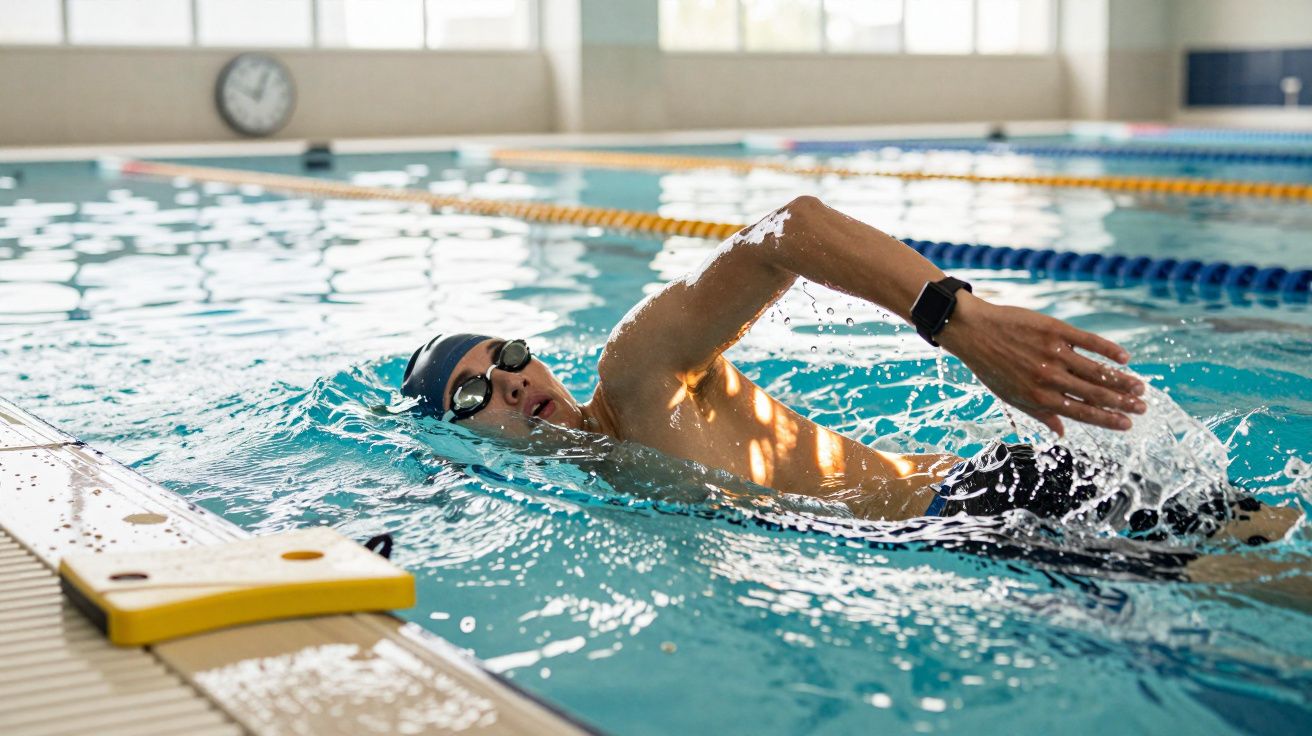
Swimming has long been seen as a quiet winner against love handles and the classic “spare tyre”: it’s kind to the joints, feels refreshing, and you rarely leave the pool completely wiped out. Still, one question comes up again and again: how long do you actually need to stay in the water for your stomach to change in a measurable way - not just in your head, but at your waistband?
Why swimming works so well for belly fat
Swimming brings together two essentials for a flatter stomach: endurance training and muscular work. Your heart and circulation ramp up, you burn energy, and at the same time your shoulders, back, legs and, crucially, your core are working throughout.
Unlike jogging or jumping, the water supports your bodyweight. That means no heavy impact through the spine and far less stress on the joints. In particular, people with back or knee issues can often train harder in the pool than they comfortably can on land.
Every stroke in the water forces your torso to stay stable - and that’s exactly when your abdominal muscles are working continuously.
There’s another benefit too: water resistance makes your muscles push against gentle drag with every movement. Over time, that helps tighten the core and make the stomach feel firmer - even if the number on the scales only drops slowly.
Why you don’t lose fat only from your stomach
Targeted fat loss from the stomach alone doesn’t work. Your body decides where it draws energy from - sometimes more from the legs, sometimes the hips, sometimes the belly. But if you consistently burn calories while also strengthening the abdominal muscles, your overall silhouette changes. The stomach looks flatter and the upper body appears more defined, even if your total weight only decreases a little.
On top of that, swimming stimulates your metabolism. After a tougher session, you keep burning more calories for a while even once you’re back on the sofa. This so-called afterburn effect boosts results over the long term.
The ideal duration: how long a swimming session should be
An experienced swim coach connected to a major sports retailer puts it plainly: if you want to work on your stomach on purpose, you can’t treat swimming like a quick splash about.
Coach’s recommendation: swim for at least 45 minutes per session - at a pace that feels clearly effortful, but still manageable.
The reasoning is simple: it takes a few minutes in the pool before your circulation is fully up and running, your heart rate rises, and your muscles are properly warm. If you then hold a steady, moderate pace, you keep burning energy without immediately hitting your limit.
How hard should your heart rate be working?
A practical rule of thumb: it’s fine to feel slightly out of breath, but you should still be able to speak in full sentences. If you’re gasping at the end of every length, you’re going too hard and are unlikely to sustain 45 minutes. If you can chat effortlessly, you can increase the pace a little.
The coach advises staying in the light-to-moderate endurance zone. That intensity tends to encourage the body to use fat stores more, rather than relying mainly on fast carbohydrates.
Which swim strokes burn how many calories?
Exact calorie burn always depends on bodyweight, technique and speed. The coach gives these guide figures for 30 minutes at moderate-to-strong intensity:
- Breaststroke: around 340 calories per 30 minutes
- Butterfly: around 380 calories per 30 minutes
If your front crawl or back crawl technique is solid, you’ll usually land in a similar range to breaststroke - sometimes a bit higher if you swim faster.
A sample workout: 45 minutes for a tighter core (swimming for belly fat)
To avoid your pool visit turning into unstructured splashing about, it helps to follow a simple plan. The coach suggests a session of roughly 45 minutes split into three blocks.
1) Warm-up: settle into the water (10 minutes)
Start calmly so your breathing and heart rate can adapt. Good options include:
- 5 minutes easy breaststroke
- 5 minutes on your back (for example back crawl), relaxed and unforced
Key point: don’t go too hard at the start. If you empty the tank during the warm-up, you’ll fade later.
2) Main set: cardio with a stomach focus (25 minutes)
This is where you raise the pace without tipping into total breathlessness. For example:
- 4–6 lengths front crawl or back crawl at a brisk pace
- 2 lengths easy swimming or kick drills with a float to catch your breath
Repeat this work–recovery pattern several times. It keeps your heart rate elevated and builds plenty of quality minutes without turning the whole session into repeated all-out sprints.
If you’re confident in the water, you can also add short sprints: swim one length as fast as you can, followed immediately by one very slow length. That challenges your cardiovascular system and your core stability at the same time.
3) Core circuit in the pool: targeted exercises (10 minutes)
Finish with a compact “stomach block” that directly targets the deep core. The coach recommends three straightforward moves you can slot in:
- Kick with a float: three rounds of 2 minutes strong kicking, with 30 seconds rest between rounds
- Front crawl with emphasised torso rotation: four slow lengths, deliberately rotating hips and upper body - this especially hits the obliques
- Knees to chest at the pool edge: hold the side, legs in the water, pull knees towards the chest - three sets of 15 reps
The difference comes from combining endurance with short abdominal intervals - not from one miracle exercise.
How many times per week makes a real difference?
If you’re aiming for a visibly flatter stomach, occasional swims won’t cut it. Two sessions per week are a strong starting point. Three sessions produce noticeably faster progress, as long as your body tolerates the load well.
| Frequency | Likely effect |
|---|---|
| 1× per week | Slightly better body feel, hardly any visible change |
| 2× per week | Clearly improved fitness, first visual changes after a few weeks |
| 3× per week | Significant tightening, noticeably flatter stomach with adjusted diet |
Consistency is the deciding factor. Train steadily for four weeks and you’ll build routine, notice easier breathing, and be able to nudge your pace upwards gradually.
Nutrition, daily habits and common mistakes
Even the best pool session can’t cancel out a consistently high-calorie diet. The coach stresses that swimming and sensible eating belong together: fewer heavily processed foods, more vegetables and protein, and a moderate approach to sugar and alcohol.
A frequent pitfall is overeating from post-swim hunger. If you follow a session with a huge fast-food meal, you wipe out a large chunk of the benefit. A smarter option is a protein-focused snack, such as cottage cheese, yoghurt with berries, an omelette, or wholegrain toast with a lean topping.
Who benefits most from swimming?
People who are overweight, have joint problems, or deal with back pain often gain a lot from swimming. They can train with intensity without overloading their joints. Beginners who feel unsure about running also tend to find the water a safer, more supportive environment.
More advanced exercisers often use swimming as a complement to strength training or running. It keeps the body moving without repeating the same stress patterns, helping reduce the risk of overuse injuries.
Technique and recovery: two extra levers for a flatter stomach
If your goal is less belly fat and a firmer core, technique matters more than most people think. Poor body position (hips dropping, head lifted too high) increases drag, making you work harder for less return. A simple cue is to keep your gaze slightly down, lengthen through the spine, and exhale steadily into the water so you can maintain rhythm rather than constantly stopping at the wall.
Recovery also plays a role in how your stomach looks and feels. Regular sleep and at least one easier day each week help keep stress hormones in check and allow your muscles to adapt. If you swim three times weekly, consider making one of those sessions gentler - you’ll often improve faster than if you push hard every time.
Other activities that tighten the stomach even more
To amplify results, add short land-based sessions on non-swim days. Helpful additions include:
- planks in different variations (front plank, side plank)
- gentle Pilates-style core work
- light bodyweight strength training two to three times per week
These sessions don’t need to be long. Just 10–15 minutes of targeted core work on two days per week can help your abdominal muscles respond more quickly to your swimming.
If you stick to the 45-minute guideline, get to the pool regularly, and don’t “reward” every session with an XXL snack, you give yourself a strong chance of having more space in the waistband of your favourite trousers over the coming months - while also stepping out of the water fitter, more mobile and more relaxed.





Comments
No comments yet. Be the first to comment!
Leave a Comment