
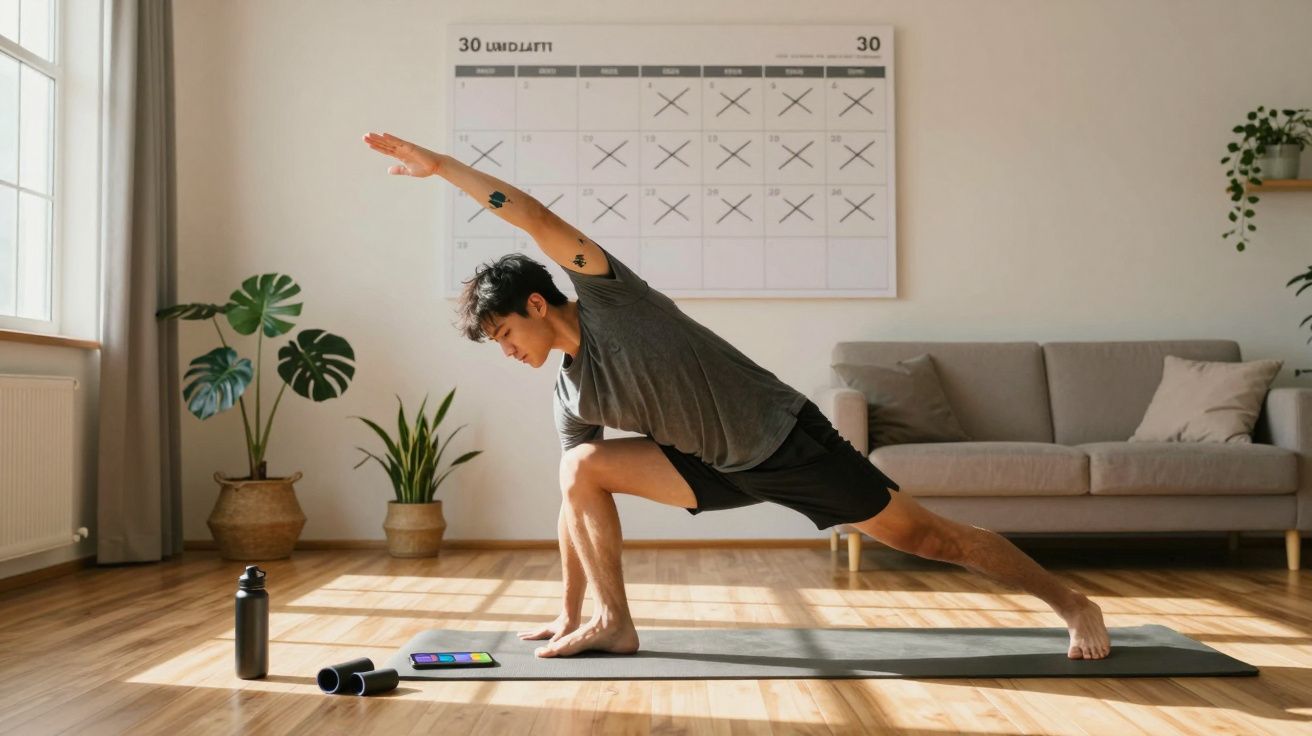
With a well-planned mini routine at home, you can feel a noticeable difference in just one month.
The pricey gym membership is still being paid, motivation is buried somewhere between overtime and the laundry basket - a familiar situation for many. That’s often when your body starts to feel heavy, your back makes itself known, and every flight of stairs becomes irritating. The good news: you don’t need machines, mirrors or a fitness studio to get back into shape. A clear 30-day plan built around 10 simple full-body exercises is enough to wake up your muscles, raise your heart rate and help you feel sporty again.
Why training at home often works better than the gym
Home workouts remove several common barriers in one go: no travel time, no hunting for parking, and no packing a gym bag. Most importantly, the biggest excuse disappears - “I don’t have time to get to the gym today.”
Consistency beats any high-intensity session. Four 20-minute sessions in your living room are better than one 90-minute gym visit a month.
The real advantage is flexibility. You can slot your workout into the part of the day that genuinely fits your life - straight after waking up, in a lunch break while working from home, or in the evening once the children are in bed. Short sessions, done regularly, add up.
A quick practical tip before you begin: set up a small “training zone” so you don’t waste time moving furniture every session. Roughly 2 m² of clear floor space, a non-slip surface (a mat or carpet), and enough room to raise your arms safely is plenty.
20 minutes to get your body moving again
A short, punchy programme can kick-start your metabolism, circulation and muscles. Three things matter most:
- Regularity: train briefly and often rather than rarely and for ages
- Movement quality: controlled reps beat rushed flailing
- Full-body focus: include legs, core, back and cardio every session
This approach can noticeably reduce classic desk-job complaints such as tight shoulders, a stiff neck and aching lower back.
A month as a reset: what 30 days of consistent training can do
Most people underestimate how quickly the body adapts. Give yourself a deliberate month and you’ll gain more than “just” a bit of soreness.
Week one: loosening the rust
In the first few days, everything can feel awkward. Your muscles complain, and your pulse seems to spike with every squat. That’s normal - your body is shifting from energy-saving mode into working mode.
For this phase, the rule is simple: slow down, learn good technique, and don’t compare yourself - especially not to the “old you” from past gym days.
Weeks two to four: routine forms, body awareness returns
If you stick with it, you’ll usually notice clear changes after two to three weeks:
- Climbing stairs feels easier and your breathing settles faster.
- Sleep becomes deeper and you wake up feeling more refreshed.
- Posture at your desk improves and your back feels less “grabby”.
- Your body feels firmer, even if the scales barely change.
After 30 days, everything won’t be “perfect”, but movement no longer feels like an alien chore - it starts to feel like a normal part of your day.
One more thing that helps many people stay on track: keep progress measures simple and non-obsessive. For example, note how long you can hold a plank, how many controlled press-ups you can do, or how you feel after taking the stairs. These small markers often show improvement sooner than body weight does.
The 10 key exercises for your 30-day plan (at home, no equipment)
This set of 10 key exercises trains legs, glutes, back, abs, shoulders and cardiovascular fitness. Everything is done at home using no equipment - just your bodyweight.
Legs and stamina: your foundation
Your leg muscles are the body’s largest “engine room”. Working them deliberately gets your heart and circulation going quickly.
- Squats: feet roughly hip- to shoulder-width apart, heels rooted to the floor. Push your hips back as if sitting on an invisible stool. Keep your chest up and eyes forward.
- Reverse lunges: step one foot back and lower the rear knee towards the floor. The front knee stays over the foot. Drive back up strongly through the front heel.
- High knees on the spot: alternate pulling each knee up as high as you can in front of you. Use your arms actively. Land softly on the balls of your feet.
- Jumping jacks: classic star jumps - jump feet out while bringing arms together overhead, then jump back in and lower arms. Ideal for warming up.
- Side “skater” jumps: jump sideways from one leg to the other with a slight forward lean. The motion resembles a speed skater and trains balance and hip stability.
Core and back: protection for your spine
A strong midsection takes pressure off your back and shoulders - especially if you spend a lot of time at a screen.
- Forearm plank: forearms on the floor, elbows under shoulders. Create a straight line from heels to head. Brace your abs and glutes; don’t let your lower back sag.
- Press-ups: start on your knees if needed. Hands slightly wider than shoulder width, elbows track slightly back. Lower your chest under control, then press up strongly.
- Mountain climbers: begin in a press-up position and alternate driving knees towards your chest. Keep it quick but controlled.
- Superman: lie on your front with arms stretched forward. Lift your upper body and legs slightly at the same time, hold briefly, then lower. Strengthens the lower back muscles.
- Glute bridge for glutes and lower back: lie on your back with feet close to your bum. Drive your hips up until your torso and thighs form a line. Squeeze your glutes firmly at the top.
How to turn the exercises into a short, effective 30-day plan
With these 10 exercises, you can build a straightforward four-week plan - no spreadsheet obsession and no fitness apps required.
Example structure for each training session
| Phase | Duration | Content |
|---|---|---|
| Warm-up | 3–5 minutes | Jumping jacks, high knees, gentle shoulder circles |
| Main section | 12–15 minutes | 10 exercises alternating, each 30–40 seconds, short rest between |
| Cool-down | 3–5 minutes | Light stretching for legs, hips, back and shoulders |
Start with three sessions per week. If you feel fitter after around ten days, increase to four or five sessions and shorten the rests.
Adjusting the workout: make it easier or progress on purpose
Not every day feels the same. The skill is adapting your session to your energy level and your joints:
- Easier options: press-ups against a wall or sofa, smaller depth in squats and lunges, slower mountain climbers.
- Harder options: lower extra slowly in squats and lunges, reduce rests between exercises, hold the forearm plank for longer.
Aim to finish feeling challenged, not wrecked. Joint pain is always a warning sign.
Your mind matters too: motivation, setbacks and everyday wins
The biggest obstacle is rarely your body - it’s the part of you that would rather stay on the sofa. There will be evenings when even five minutes of exercise feels like too much.
The “five-minute rule” for stressful days
Instead of cancelling completely, use a simple trick: commit to doing only five minutes - for example, a few squats, a short glute bridge and a bit of stretching. Often you’ll carry on once you’ve started. And if you don’t, you’ve still done something.
Those small wins build up. Along the way, you may notice you can:
- carry heavy shopping bags with less effort,
- play with children or a dog without getting out of breath so quickly,
- get out of bed in the morning without feeling as stiff.
Extra guidance: what to keep in mind
Common mistakes with home workouts
Three issues frequently lead to frustration or pain:
- Progressing too fast: going full throttle immediately can trigger overload in knees, shoulders or back.
- Skipping recovery: muscles need rest, especially at the beginning. At least one rest day per week helps.
- No technique check: practise in front of a mirror or film yourself briefly on your phone to spot obvious form errors.
Smart ways to complement training at home
This 30-day plan pairs perfectly with simple everyday habits: walking more, taking short stretch breaks at work, and standing up regularly after long sitting spells. If you feel like it, add gentle cycling, a walk or an easy jog on non-training days - it increases calorie burn and clears your head at the same time.
Step by step, that’s how an active day-to-day routine develops without any gym at all. A couple of square metres of floor space, a little consistency and a clear decision are enough to feel noticeably fitter, more alert and more stable within a month.





Comments
No comments yet. Be the first to comment!
Leave a Comment