
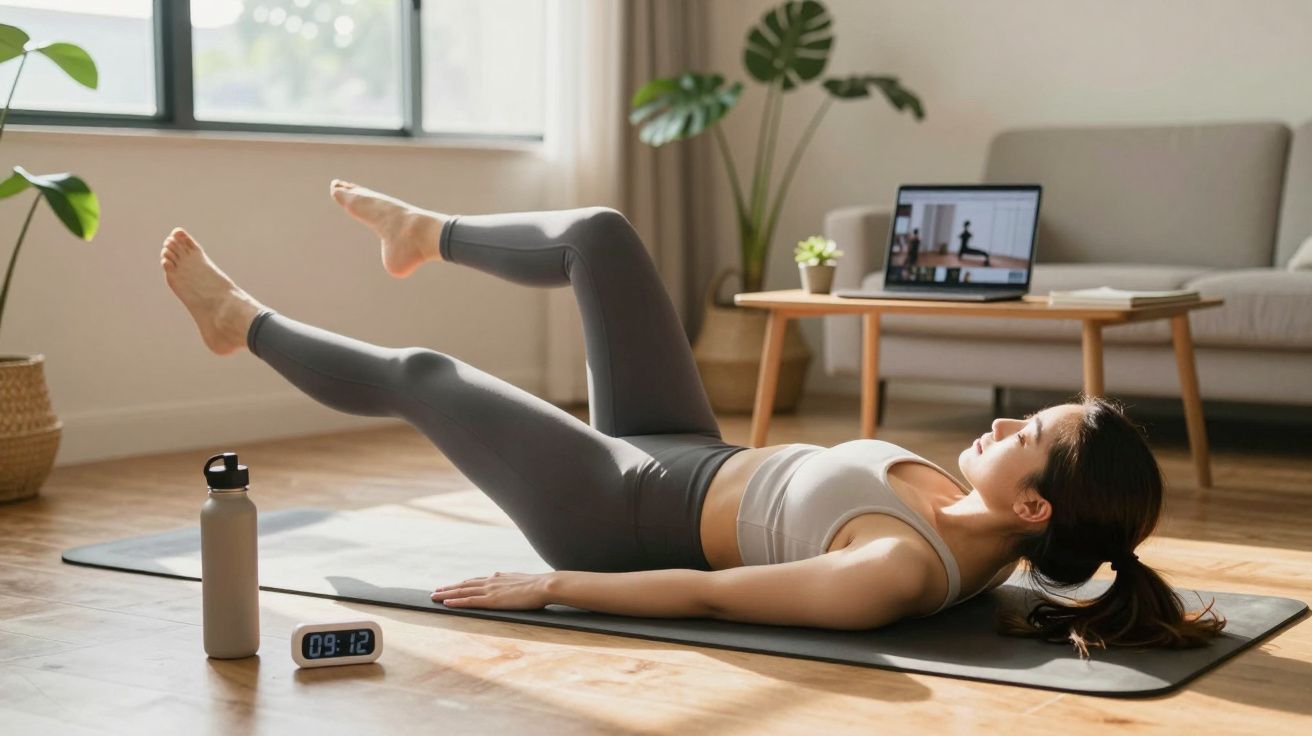
Many people grind through sit-ups and then wonder why the lower abs barely change. The issue is rarely a lack of willpower; it’s more often the wrong exercise choice. This short, Pilates-inspired routine targets exactly where classic crunches tend to miss: deep in the lower abdomen and the stabilising core muscles.
Why the lower abs are so difficult to target
The area below the navel is demanding both anatomically and functionally. It’s where the deep abdominal muscles, hip flexors and pelvic floor work together. If you only train the upper portion of the rectus abdominis, the lower abdomen can remain soft - no matter how many sit-ups you’ve logged.
Slow, targeted movements that keep the lumbar spine stable and recruit the deep muscles usually deliver more than a hundred rushed crunches.
That’s why this plan relies on small, controlled movements. The priority is muscle tension and technique rather than speed. It also makes the session ideal for a living-room workout: no jumping, no noise, and very little space required.
Pilates principles and the structure of the 10-minute workout
This 10-minute workout includes ten exercises designed for the lower abs and deep core muscles. Each move lasts 45 seconds, followed by 15 seconds of rest. If you’re new to this style of training, shorten the work intervals and extend the breaks.
- 45 seconds work - calm, precise movement
- 15 seconds rest - breathe, reset, change position
- 10 exercises in total - roughly 10 minutes of pure training time
The flow follows classic Pilates principles: a stable core, smooth breathing and controlled movement throughout.
The 10 key exercises for the lower abs and deep core muscles
1. Lowering bent legs while lying on your back
Lie on your back with the soles of your feet together and your knees opened outwards. Keep your lumbar spine firmly pressed into the mat. Slowly lower your bent legs and bring them back up. Maintain constant tension through the lower abdomen.
2. Straighten the legs and lift the hips
Staying on your back, alternate between holding long, straight legs just above the floor and gently lifting your hips towards the ceiling. No momentum and no jerking - the work should come from your abs and glutes.
3. Lower and extend one leg with a braced core
From a supine position, extend one leg up towards the ceiling and lower it under control towards the floor. Keep your abs braced and your lower back “glued” to the mat. Switch sides and repeat.
4. Seated upper-body pulse (small rocking motion)
Sit with your knees bent, lean your torso slightly back and hold a half-reclined position. From there, pulse very slightly forwards and backwards. Keep shoulders down, draw shoulder blades gently together, and brace the abs firmly.
5. Lean back further and open the legs
From the seated position, lean back a little more and extend both legs into a gentle straddle. Try not to press your heels heavily into the floor. Your abs stabilise as your torso and legs hold their positions.
6. Large vertical scissors supported on the forearms
Prop your upper body on your forearms and lengthen both legs. Perform large scissor kicks up and down. Keep your back long, neck extended, and heels hovering just above the floor.
7. Open and close the legs at a 45-degree angle
In the same forearm support, extend both legs forwards at roughly a 45° angle and open and close the thighs. Keep the lumbar spine stable and the upper body as still as possible.
8. Alternating leg reach just above the floor
Return to lying on your back: lift your head and shoulder girdle slightly and keep your gaze upwards. Alternate extending one leg long in front, just above the floor. Switch between an easier version (knee slightly bent) and a harder version (knee fully straight).
9. Alternate hip lift with leg lowering
With your legs bent and lifted, raise your hips slightly off the mat, then let your legs lower a little. Control every centimetre - no swinging and no “flinging” the legs.
10. Horizontal scissors combined with lowering the legs
To finish, combine horizontal scissor movements with a slow lowering of the legs. Keep your lumbar spine pressed into the mat throughout - that’s your safety anchor.
Getting the most out of 10 minutes: tension beats speed
Results here come from sustained tension, not rushing. When you move too quickly, it’s easy to lose control through the hips and lower back - precisely where these exercises are meant to be effective.
Slow isn’t boring in this workout - it’s effective. Every second under tension counts twice.
A few simple rules make all the difference:
- Move smoothly, without jerks or sudden pulls
- Exhale during effort, inhale as you ease off
- Never hold your breath - it only drives blood pressure up
- Keep the lumbar spine stable; don’t allow an excessive arch in the lower back
- Prefer a smaller range of motion if it keeps your technique clean
Three sessions per week work well, ideally with one rest day between. Beginners can start with 30 seconds work / 30 seconds rest, then gradually build up to the full 45/15 format.
Why this training won’t “melt” belly fat on its own
As stubborn as abdominal fat can be, the myth that you can burn fat from one specific area through targeted exercises is just as persistent. That isn’t how the body works: it decides for itself where to draw on fat stores first.
The real benefits of this programme show up elsewhere:
- the lower abdominal muscles become stronger
- the waist looks more defined as overall body fat drops
- the core stabilises better in everyday life and sport
- the back and hips feel less overloaded
If you want visibly defined abs, you’ll also need a moderate calorie deficit and regular cardio such as brisk walking, cycling, running or swimming. It’s the combination of nutrition, endurance work and targeted strength training that reveals muscle definition.
Common mistakes in lower-abs training (and how to avoid them)
Many people make this lower-abs workout harder than it needs to be - or even invite discomfort. These three pitfalls come up again and again:
Too much speed
Rushing creates momentum. The hips snap up, the lower back arches, and the abs stop doing the stabilising work.An excessive lower-back arch when lying down
The moment the lower back lifts off the mat, the lumbar spine takes over. Fix it by holding the legs slightly higher and reducing the range of motion.A tense neck
If you haul your head up with your neck muscles, you’ll quickly feel strain. Instead, look slightly upwards, keep shoulders away from ears, and lengthen the back of the neck.
What a stronger core adds beyond aesthetics
The deep core - meaning lower abs, obliques, pelvic floor and the small muscles around the spine - does far more than help you “look toned”. It supports virtually every daily movement, from tying your shoes to lifting a shopping bag.
Train this area consistently and you’ll often notice useful side effects: a more upright posture, less pulling in the lower back, and better control in sports such as running, tennis or dancing. This is particularly valuable if you sit for work, because your spine no longer has to absorb every load on its own.
A quick note on breathing and pelvic floor engagement (extra payoff)
To get more from each rep, link breathing to control: exhale gently as you brace, and feel the pelvic floor lift subtly as the lower abdomen draws in. This pairing can improve stability around the hips and lumbar spine, especially during the leg-lowering phases where the back is most likely to arch.
When to modify - and when to pause
If you feel pinching in the hip flexors, discomfort in the lumbar spine, or any sharp pain, reduce the lever (bend the knees), lift the legs higher, or shorten the range of motion. If symptoms persist, stop and seek guidance from a qualified professional - good lower-abs work should feel challenging in the muscles, not painful in the joints.
How to combine the workout sensibly at home
To create a well-rounded home programme, it’s easy to build on this 10-minute lower-abs plan. Two to three add-ons work particularly well:
- a short mobility warm-up for hips and spine (cat–cow, pelvic tilts, hip circles)
- a few minutes of light cardio afterwards, such as climbing stairs, moderate-speed jumping jacks, or a brisk walk
- on other days, a session for back, glutes and legs to keep strength balanced across the whole body
If you notice certain terms popping up repeatedly: core essentially means this midsection system - the interplay of abs, back, hips and pelvic floor. A strong core acts like an internal belt that supports every movement.
With ten focused minutes, you can noticeably strengthen that “belt”. The deciding factors are consistency, clean technique and the willingness to work slowly rather than chasing fast repetitions. That’s what makes the difference - not the rep count.


Comments
No comments yet. Be the first to comment!
Leave a Comment