
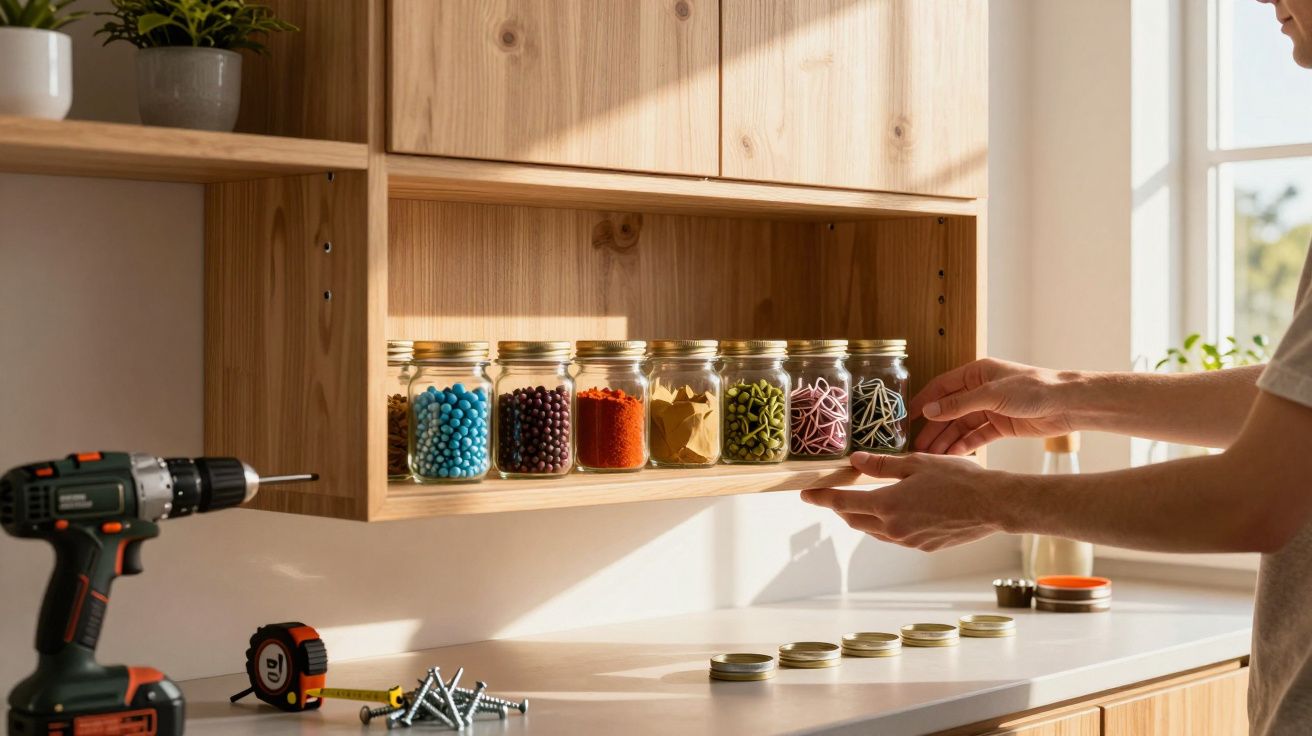
Between open spice sachets, stray rubber bands and scattered screws, many homes suffer from small-parts chaos rather than proper order. In compact kitchens and studio flats, every centimetre matters. That’s where a smart trick using recycled mini jars comes in: the unused space under cabinets becomes a rotating jar block that frees up drawers and keeps everyday odds and ends permanently under control.
How a rotating jar block turns hidden storage under cabinets into usable space
The concept is almost disarmingly simple, yet extremely effective. Small screw-top jars-such as leftover jam jars or spice jars-hang upside down from a wooden block held between two side supports. The whole unit sits under a wall cabinet, beneath a shelf, or mounted directly to a wall, and it swivels like a mini roller.
Instead of overfilled drawers, your small items hang neatly sorted and fully visible above the worktop.
Here’s how it works: the jar lids are screwed onto a long wooden strip. That strip rotates between two side pieces that form the frame, with a single metal bolt acting as the axle. With one hand you can swing the block forwards or backwards to reach any jar.
To use it, you simply grip a jar from underneath and twist it off. Once you screw it back on, it locks firmly into its lid. Nothing slides, nothing tips, and the space beneath-usually dead space-suddenly becomes valuable storage.
Materials and tools: what you’ll need for the recycled mini jars trick
You only need a manageable set of items, most of which you can pick up from a DIY shop or already have at home:
- small glass screw-top jars (e.g., jam, mustard, spice jars)
- a rectangular wooden strip to act as the rotating block
- two additional wooden pieces for the side supports
- wood screws for fixing the lids and mounting the unit
- a sturdy metal bolt or coach bolt to serve as the axle
- a drill with suitable drill bits
- sandpaper or a sanding block
- wood stain or paint (optional, for appearance and protection)
Make the side supports slightly longer than the height of your jars. That way, the block can swing freely without knocking into the surface below. Choose the length of the wooden strip so it can carry a multiple of four jars-common layouts are 12, 16 or 20 jars. The strip should be just a little wider than the lids so they sit securely, while still leaving enough space for your fingers.
Step-by-step: how to build the swinging jar shelf
1) Prepare the wood and add protection
Start by sanding every wooden surface until smooth. Lightly round off sharp edges so you don’t bump into corners or end up with splinters later. If you want, apply stain or paint so the system suits your kitchen, workshop or office. Once dry, the finish helps the wood stand up better to grease, dust and moisture.
2) Mark out the lids and screw them down
Lay the wooden strip in front of you and pencil in where each lid will sit. Keep the spacing consistent:
- leave enough room for fingers to fit comfortably between jars
- keep enough clearance from the edges so lids don’t overhang
Screw each lid into place at its marked position. One screw through the centre is often enough; if the lid metal is thin, two small screws can be more secure. The key is that every lid must be firmly fixed-if it’s loose, the jar may spin without tightening properly.
3) Fit the rotating axle
Next, drill an axle hole through both side supports. These holes can be very slightly larger than the bolt so the block rotates smoothly. Drill a matching hole through the wooden strip as well-here the bolt should fit as snugly as possible for stability.
Push the bolt through the first side support, through the wooden strip, and then through the second side support. Use nuts (and washers if needed) on both sides. Tighten the nut at the strip so it’s secure, and set the outer nuts so the block swings freely without excessive wobble.
4) Mount under a cabinet, shelf or on the wall
Before filling anything, test the assembly while it’s empty. If the rotating jar block turns smoothly and stays in position, fix the side supports to the underside of a wall cabinet, beneath a shelf board, or directly onto the wall.
Use strong screws, and for plasterboard use suitable wall plugs. Remember the combined weight of multiple filled glass jars-build and mount it more robustly than you think you’ll need. Only once everything is firmly attached should you fill the jars and twist them into their lids.
What to store in mini jars: far more than just spices
Kitchen organisation
In the kitchen, this works brilliantly mounted above the main prep area. Each jar can hold a spice blend, dried herbs, cake decorations, or dry ingredients such as sesame seeds, chia seeds or stock powder. With a quick swivel you can see everything without digging into the back of a drawer.
A handy tip: label the jar bases with a permanent marker or small stickers so you can read what’s inside from below at a glance.
Craft corner and hobby room
Anyone who sews, scrapbooks or makes jewellery knows the problem: endless tubs of beads, sequins and buttons. Mini jars make it easy to split that volume of small parts into sensible categories:
- beads sorted by colour
- buttons grouped by size or material
- sequins, rivets, eyelets and small decorative stones
Your desk stays clear, while the jars become a practical display. Because the containers are transparent, you can instantly see how much you have left.
Home office and children’s room
Over a desk, the hanging jars keep office items visible and within reach: paper clips, rubber bands, drawing pins, erasers and USB sticks stop disappearing into a messy “bits and bobs” drawer. Mounted above the workspace, it’s just one quick reach upwards to grab exactly what you need.
In a child’s room, the same system can store small collectible figures, marbles, or parts for model making or magnetic games. Colour-coding can work well here-for example, dedicating each rotating jar block to a different category.
Workshop, cellar and garage
This is where the system often shines most, because small hardware is otherwise hard to organise:
- screws sorted by length and head type
- wall plugs grouped by diameter
- nuts, washers, nails and specialist fixings
Hang the jars above a workbench or under a wall-mounted shelf so everything stays close at hand and protected from floor-level dust. If you work on projects regularly, you’ll save a surprising amount of time spent searching.
Practical tips, safety and advanced variants for the rotating jar block
Although the build is straightforward, a few details are worth keeping in mind. Glass is heavier than plastic, but it’s durable and you can see the contents instantly. If you’re dealing with a very lightweight cabinet, consider fixing a slim timber batten to the wall and mounting the unit to that instead of screwing directly into the cabinet base.
Also, avoid filling jars right up to the rim-especially with spices or dusty contents. When you unscrew and re-screw a jar, a little can spill out easily if it’s overfilled. Keep lids and threads clean so each jar locks securely into place every time.
If you enjoy tinkering, you can install two or more swinging jar shelf blocks side by side, or stagger them slightly so you can reach specific jars more easily. In rooms with high ceilings, a second row behind the first can work well-kept out of the way until you swivel it forward.
Added upgrade: smart labelling and layout planning
For an even smoother routine, plan the order of jars by frequency of use: keep daily staples near the front swing position, and occasional items towards the ends. Pair that with consistent labels (printed, handwritten, or colour-coded) so anyone in the household can put things back correctly-this is what turns a clever project into lasting organisation.
Added upgrade: cleaning and long-term maintenance
Because the jars hang upside down, occasional wipe-downs help prevent grease or dust build-up on bases and lids-particularly in kitchens and workshops. A quick monthly check to re-tighten any mounting screws and inspect the axle nuts will keep the rotating action smooth and the load safely supported.
The same principle can be adapted to other container types too: small plastic tubs with screw lids, or magnetic tins that stick to a metal strip. The idea remains the same-small parts move upwards, precious worktop and drawer space is freed, and everyday life feels noticeably less chaotic.




Comments
No comments yet. Be the first to comment!
Leave a Comment