
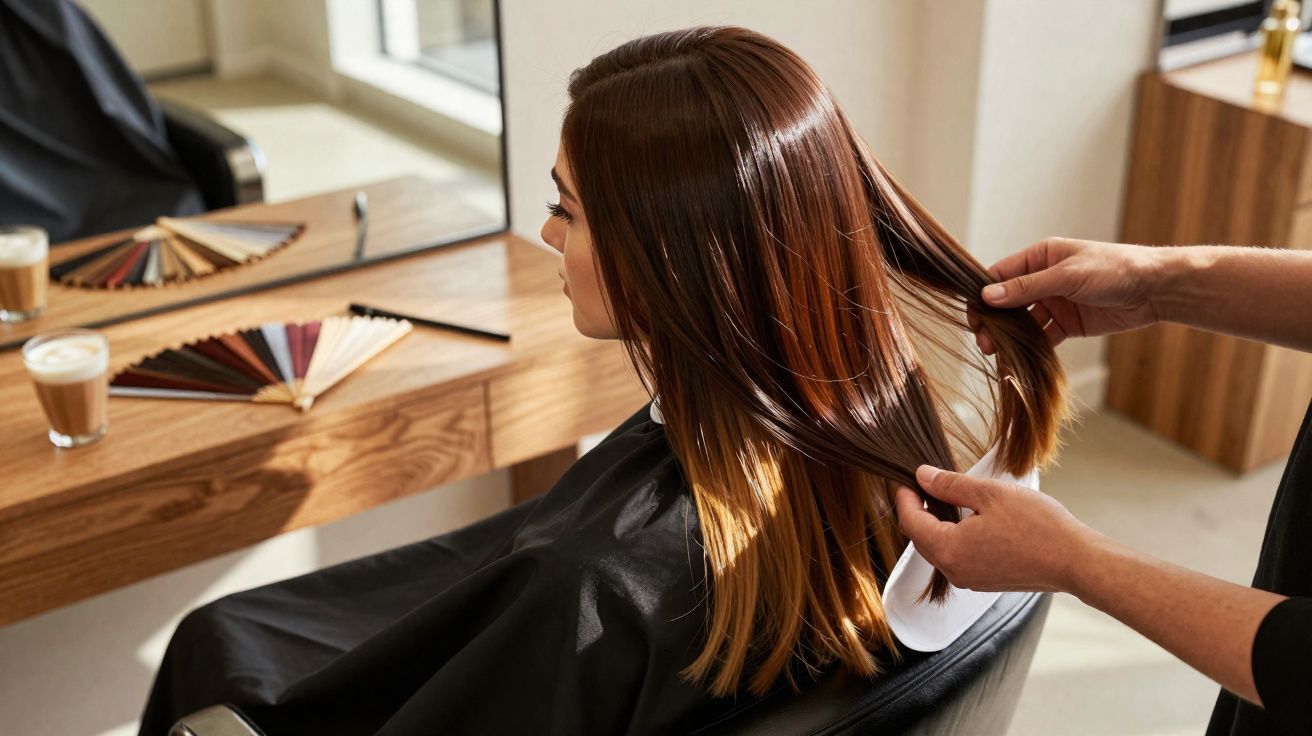
Saturday afternoon, bright salon lights, and three women file in one after another clutching the same reference: a slightly blurred Pinterest bronde from 2021. The colourist keeps it professional, but her eyes give her away. She’s weary of beige.
Outside, the street looks all steel, glass and winter grey. Inside, every head turning in the mirrors shares a different common thread: depth. Gloss. That expensive, velvety softness that only a well-done brown can give.
Bronde now feels a bit like skinny jeans: still around, just no longer the main character. On TikTok and in runway backstage chatter, colourists murmur about “molten chocolate” and “cocoa shine” as if they’re swapping a secret recipe.
The new hair obsession is brown - but not the flat, supermarket sort. Think chocolate, in all its shades.
Why chocolate hair colour is replacing bronde in 2026
Walk into any on-trend salon right now and you’ll spot the shift immediately: blonde foils are quietly surrendering space to bowls of glossy, syrup-dark brown. It’s less shouty than a platinum overhaul, yet the before-and-after can be just as striking. Features look softer. Skin reads more even. Eyes seem to pop, like someone nudged the saturation up.
Bronde had its era of sun-kissed ease. In 2026, chocolate hair color is giving people something they’re craving more: comfort, richness, and regrowth that doesn’t bring drama. Less California beach filter, more Paris café at 5 pm.
Scroll your feed and it’s everywhere: actresses trading cool balayage for “truffle brunette”, influencers declaring their “chocolate era”, and former bleach loyalists returning to brown. Colourists say rich brunette transformations made up the bulk of their winter bookings. One Paris colourist told me that four out of five major makeovers she’s doing right now are some variation of chocolate.
Most of us know the moment: when your blonde money-piece starts looking less like a glow-up and more like a dry, straw curtain. Chocolate reads as the opposite - forgiving, reflective, almost ego-nourishing.
There’s a clear logic to the wave. After years of high-maintenance lightening and relentless toning appointments, people want a colour that looks expensive without requiring a second job to keep it there. Brown pigments reflect light differently from blonde; they throw back a softer, glossier shine that reads as “healthy” even through phone cameras.
And where bronde can sometimes drain certain complexions, chocolate tones can be micro-tailored: a hint of gold for warmer undertones, a touch of espresso for cooler ones, a whisper of red for olive skin. Bronde was a vibe. Chocolate is a wardrobe.
A quieter reason the trend is sticking: chocolate shades are adaptable to real life. If you spend most days in office lighting, grey weather, or winter daylight, those nuanced browns keep dimension without needing constant brightening to look “done”.
The most beautiful chocolate hair colour shades to ask for in 2026
The trick in 2026 is not walking in and saying, “Just brown, please.” Go in with taste words rather than technical ones. Tell your colourist: “I want something like 70% dark chocolate, 30% milk,” or “I want my hair to look like iced mocha in daylight.” That sort of language opens doors quickly.
For a reliably flattering option, ask about “glossy milk chocolate” with ultra-soft, almost invisible highlights around the face. You keep depth at the root, but the lengths catch light the way the sun would - only more polished.
If you’ve been heavily blonde and you’re worried about going “too dark”, try “chocolate syrup balayage”. Your root stays close to your natural base, while liquid ribbons of mid-chocolate are painted through the mid-lengths and ends. It still reads brunette, but with movement and dimension.
In a London salon, I met a client who’d been platinum for eight years. She left with a “hazelnut chocolate melt”: soft beige at the roots that gradually melted into deeper cocoa at the ends. A week later she texted her colourist that strangers were asking what skincare she’d changed - nothing had shifted except her hair.
For bolder tastes, “black cocoa” is the new near-black. It’s deeper and richer than a standard off-the-shelf black, with subtle warm or cool reflects so it doesn’t sit flat. On the softer, warmer side, “cinnamon brownie” is everywhere: a deep brown base with diffused cinnamon and caramel lights that only show when the sun hits.
There’s also a growing crush on “mousse au chocolat” - a fluffy, airy brown created with a translucent glaze rather than harsh lines. It’s ideal if you want a tint of chocolate without a dramatic jump. The names might sound like a dessert menu, but that’s precisely the point: they instantly communicate texture, depth, and shine in a way shade numbers never do.
One more shade family to consider if you want something modern but discreet: “cocoa shine” brunettes with a sheer, reflective top layer. It’s less about visible highlights and more about that light-catching surface that makes hair look newly healthy.
How to talk to your stylist about chocolate hair colour (and avoid flat, sad brown)
Start by bringing three to five reference photos, not twenty. Pick women with a similar natural base and similar skin tone to you; that’s your realistic playing field. Then share how you actually wear your hair: always tied up, always straightened, air-dried most days. The best chocolate shades are designed around how hair moves in real life - not just how it looks in a perfect blow-dry.
Use words like “dimensional”, “translucent”, “shimmery”, “espresso”, “mocha”, “praline”. Colourists work in light and undertone, and those words give them something useful to build with.
The biggest brown-hair trap is waking up the next day feeling… weighed down. Too dark. Too dull. Too single-block. That usually happens when undertone is skipped in the consultation. If your skin flushes easily, an ultra-warm chocolate can make redness look louder. If you’re very cool-toned, an ultra-ashy brown can tip greenish under certain lighting.
Be honest about maintenance. No one really lives in the salon chair. If every 10 weeks is your limit, say so. That pushes your colourist to keep your natural base, stretch the root, and place the chocolate where it will grow out softly.
“My favourite chocolate in 2026 isn’t one exact shade,” explains Berlin colourist Jana K. “It’s the one that looks like your hair could have grown that way, but with a built-in highlighter filter.”
- Ask for a shadow root so regrowth stays seamless rather than sharply lined.
- Tell them what lighting you live in: strong sun, office fluorescents, or cloud cover most of the year.
- Request a gloss or glaze at the end to seal in shine and nuance.
- Plan a quick tonal refresh every 6–8 weeks instead of full colour every time.
- Keep one or two ultra-fine lighter pieces around the face if you’re nervous about going fully dark.
An extra tip many people miss: ask how your chosen chocolate will read next to your everyday wardrobe and makeup. If you live in black, navy and grey, a cooler espresso can look intentional; if you wear camel, cream and warm neutrals, a milkier or cinnamon-leaning chocolate often looks more harmonious.
Keeping your chocolate rich, not rusty
Here’s what nobody advertises: brown can fade just as badly as blonde - it simply fails differently. Depending on your water and styling habits, it can go brassy, flat, or oddly reddish. Treat your chocolate like a favourite leather bag: gentle cleaning, no harsh scrubbing, and regular polishing.
Switch to a sulphate-free, colour-safe shampoo and turn the water temperature down. Hot showers feel brilliant, but they rinse out tone and gloss faster than you think.
Heat styling is another quiet thief. If you straighten or curl often, apply a thermal protectant - ideally one with a bit of shine. Think of it as a topcoat for your pigment. If you can, extend wash days by one or two and lean on sleek buns or loose braids on in-between days instead of reaching for shampoo again.
Some brunettes swear by a once-a-week colour-depositing mask in a chocolate or espresso tone. Used lightly, it boosts richness without sending you back to the salon every month.
Colourists also rate a clear or tinted gloss every few weeks: quick, less aggressive than full dye, and brilliant for refreshing the reflective surface of the hair. That’s what keeps chocolate looking “expensive”, not like a basic box colour that’s been hanging on since autumn.
If you swim often or you live with very hard water, ask about a shower filter or a protective oil before you get in the pool. Small changes like that can be the difference between luminous cocoa and dull, rusty brown by the end of summer.
Chocolate hair as a mood: what this trend really says about 2026
The rise of chocolate hair in 2026 feels like more than a seasonal switch. After years of icy blondes and heavy filters, there’s a quiet appetite for warmth and softness - hair that doesn’t beg for attention, but still makes you look pulled together on a random Tuesday morning.
Chocolate hits that sweet spot: noticeable enough to earn compliments, discreet enough to feel like you.
The most interesting stories colourists share aren’t about dramatic transformations. They’re about clients who say they feel “more grounded”, “less fragile”, “more like an adult” after returning to brunette. Not for everyone, obviously - but often enough that it keeps coming up. Hair colour isn’t therapy, but it does shape the face you offer the world every day.
Maybe that’s why these nuanced browns resonate right now. They don’t delete your bleach phases or your bronde seasons; they simply layer a new chapter over them - calmer, richer, and more intentional.
Next time you’re scrolling hair inspiration or you pass a salon window, notice where your gaze lands: on the intricate beige balayage… or on that head of velvet, glossy chocolate that looks like it belongs in a perfume advert. Trends will move on again, as they always do. For this moment, though, 2026 belongs to brown - in all its subtle, delicious shades - and the question has shifted from “Will I go chocolate?” to “Which chocolate am I, really?”
| Key point | Detail | Value for the reader |
|---|---|---|
| Choose nuanced chocolate | Pick specific shades like milk chocolate, black cocoa, or cinnamon brownie rather than generic “brown” | You’re far more likely to leave the salon with a flattering, dimensional result |
| Speak your stylist’s language | Use mood and “flavour” words, plus reference photos close to your natural base | Helps the colourist understand your vision and adapt it to your real-life hair |
| Protect the richness | Sulphate-free care, cooler water, glosses, and occasional colour masks | Keeps chocolate hair shiny and expensive-looking for longer between appointments |
FAQ:
Which chocolate shade suits fair skin best?
Light “milk chocolate” or “mousse au chocolat” with soft, cool reflects tends to work beautifully - especially with a few subtle face-framing highlights to keep everything airy.Will chocolate hair make me look older?
Not if it has dimension and the undertone suits your skin. Harsh, flat dark browns can harden features, but multi-tonal chocolate often does the opposite and softens the face.Can I go chocolate from bleached blonde in one visit?
You can get close, but very light hair often needs filling (re-pigmenting) and sometimes a second appointment so the brown doesn’t fade patchy or turn khaki.Is chocolate hair high maintenance?
Usually less than blonde: regrowth lines look softer, and many people can stretch appointments by topping up with glosses and colour masks rather than doing full re-colouring.What should I tell my stylist if I’m scared it will look too dark?
Ask for a “soft chocolate melt” with a translucent glaze and clear dimension, and request that your natural root plus a couple of lighter pieces around the face stay untouched.


Comments
No comments yet. Be the first to comment!
Leave a Comment