

The woman standing in front of you on the Tube doesn’t touch her hair once. No anxious smoothing, no last‑second bun rescue, no emergency claw clip fished out of the bottom of a big bag. Her haircut does the heavy lifting. It settles back into place after her scarf, after the wind on the platform, after being pressed flat by a rucksack. You can tell she didn’t spend 40 minutes at the mirror. More like five. Possibly less. And yet she still looks ready for a meeting, a date, and an unplanned selfie in flattering daylight.
Some haircuts let you have a life.
Others charge you for every blow‑dry you skip.
Why the collarbone bob (lob) is the five‑minute haircut that quietly does everything
There’s a particular style you clock only after you’ve been looking at it for a moment. It isn’t loud. It doesn’t scream “fresh from the salon with perfect lighting”. It’s just… right, even when the day is already running 20 minutes behind.
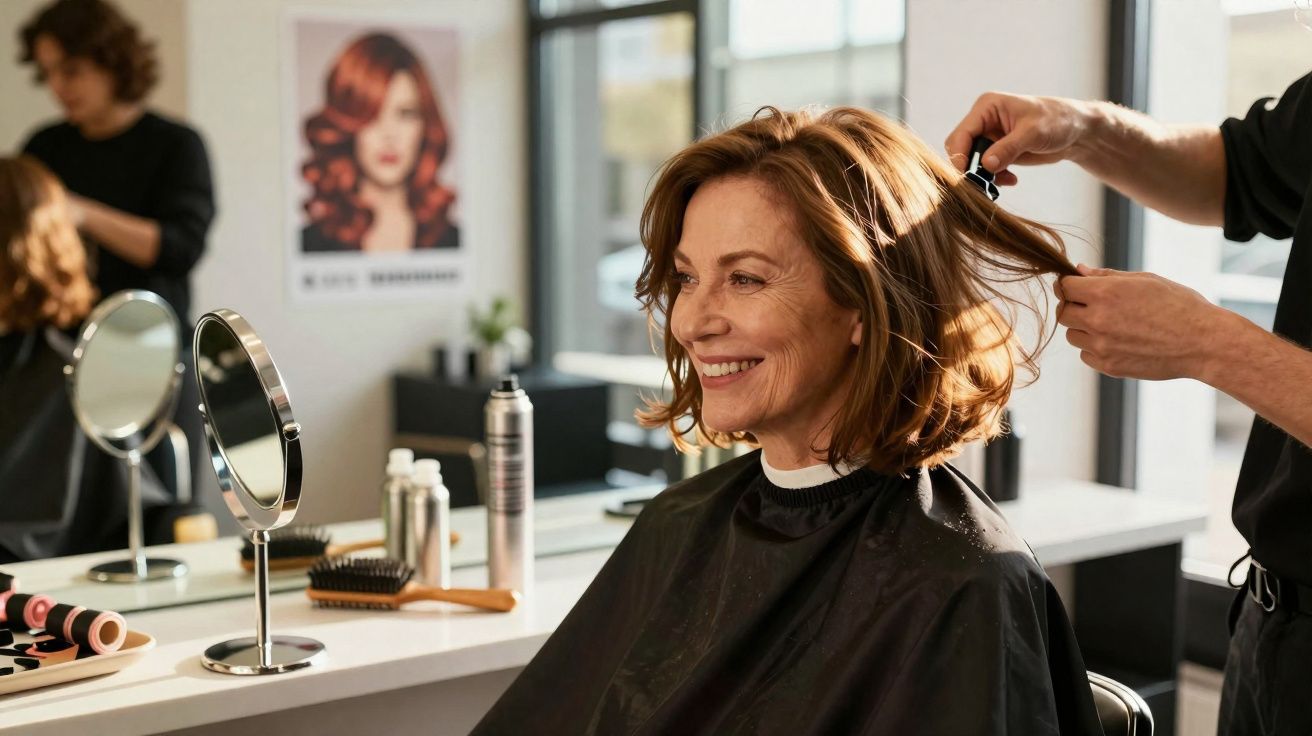
Most often, it lands somewhere between the jawline and the collarbone. The ends are softly blunt (not wispy), and the layers are so subtle you hardly notice them-until you see how the hair moves. The shape looks clean, almost minimalist. The trick is that it works with your natural texture instead of trying to wrestle it into obedience.
This is the haircut that lets you off on mornings when you’ve got nothing left.
Picture a refined long bob: the “lived‑in” lob all over Pinterest, but somehow more believable on actual humans. A friend of mine, Emma, chopped her waist‑length hair into a collarbone lob last year. She’s got two children, a commute, and absolutely no patience for round brushes.
Her instruction at the salon couldn’t have been clearer: “I want to look like I made an effort, even when I definitely didn’t.” Her stylist kept the base slightly blunt, sitting just above the shoulders, then added barely‑there internal layers so it wouldn’t form that triangular, bulky shape. Now she rough‑dries for about three minutes, pushes the front away from her face with her fingers, and leaves the house. People at work keep asking which styling tool she’s bought.
She hasn’t. She’s bought a smarter cut.
There’s a straightforward reason this five‑minute haircut reads as polished so quickly. Collarbone length has enough weight to fall smoothly, but not so much that it drags your features down or takes ages to dry. The ends will tuck under or flip out with the smallest hint from a brush-or even just your hands.
And those “invisible” layers aren’t the chunky, choppy kind. They simply take out bulk where your hair tends to balloon, and prevent it from collapsing where it goes flat. You get built‑in shape: lift where you want it, ease where you don’t. Because the line follows your neck and jaw, your face can look more defined even on low‑energy days.
That’s the understated strength of a cut designed for real mornings, not salon lighting.
How to style it in under five minutes (without pretending)
This is the routine people with effortless hair rarely spell out. Start by towel‑drying gently, then work a coin‑sized amount of lightweight cream or serum through your mid‑lengths and ends. Don’t yank at it, and don’t rub your hair aggressively with a towel-nothing creates frizz faster than rough handling before you’ve even begun.
Tip your head upside down and blast‑dry for about two minutes, keeping the dryer moving. You’re not aiming for perfection; you’re just lifting that heavy dampness at the roots. Flip back up, use your fingers to sweep the front pieces away from your face, then give them another 30 seconds with the dryer. Done-before your coffee has even had time to go lukewarm.
The main mistake is trying to make this cut be something else. People go too hard with the round brush, clamp it poker‑straight, or pile on products that promise “glass hair” but deliver stiff, helmet‑like shine. Then they decide the haircut “doesn’t work”.
In reality, hardly anyone sticks to a 10‑step styling routine every day-especially on weekdays that begin with a barrage of notifications. If you’ve ever stood there, already late, obsessing over one rogue front section with straighteners, you know how quickly it spirals. This haircut is meant to end that cycle, not turn your morning into another performance.
“A good cut should look about 80% finished the moment the hair is dry,” says London stylist Ana L., who has quietly moved half her clients into some version of the collarbone bob. “The last 20% is personality-how much bend, how much shine, how ‘undone’ you want it.”
- Ask for a collarbone‑length base that’s softly blunt, not razor‑thin at the ends.
- Request soft internal layers that reduce bulk, rather than obvious stepped layers.
- Keep the front slightly longer than the back to create a subtle, face‑framing angle.
- Bring reference photos showing hair that matches your texture-not only your fantasy celebrity version.
- Leave the salon with a five‑minute routine you’ve actually practised once while you’re still in the chair.
The quiet confidence of hair that doesn’t fall apart
Once you’ve had a genuinely low‑maintenance haircut, it’s difficult to return to high‑effort hair. You suddenly notice how much headspace bad hair steals: plans you drop because your blow‑dry collapses in the rain, photos you avoid because your ends look frazzled, that automatic feeling of being slightly behind when your hair refuses to cooperate.
A cut that behaves in five minutes won’t transform your life. What it does do is remove a small daily friction-and those tiny frictions are often what tip us from “I’ve got this” into “I can’t deal with one more thing”.
You may even find it changes your whole getting‑ready rhythm. Less time wrestling tools can mean more time for earrings, lipstick, or for doing absolutely nothing at all. Maybe you dry it halfway and let it finish off in the car, oddly relaxed about it. Maybe you catch your reflection in a shop window at 4 p.m. and realise… it still looks fine.
That’s the real luxury here: not high‑maintenance glamour, but a dependable baseline of “presentable” that makes last‑minute dinners, Zoom calls, or photos feel possible-without the silent internal panic.
The truth is, hair doesn’t have to become a daily project to look like you care. It simply needs a haircut that understands your reality: the snoozed alarm, the packed diary, the days when your energy is on the floor with yesterday’s outfit.
If your current haircut only looks good after a 40‑minute ritual, the issue may not be that you’re “lazy” or “bad at hair”. It may just be the haircut-and that can be fixed. A proper chat with a stylist, a photo of the right lob, and a small shift towards a length and layers that support you rather than fight you.
The most polished thing about you might end up being the thing you spend the least time on.
One practical note: if you want this five‑minute haircut to stay genuinely easy, book maintenance trims often enough to keep the softly blunt edge clean. When the line grows out too long or the ends thin, you’ll find yourself reaching for more heat and more product-exactly what this collarbone bob (lob) is meant to save you from.
It’s also worth asking your stylist to tailor the internal layers to your density (fine hair needs restraint; thick hair benefits from strategic bulk removal). The goal isn’t a dramatic layer pattern-it’s a shape that air‑dries and quick‑dries with minimal fuss, while still looking intentional.
| Key point | Detail | Value for the reader |
|---|---|---|
| Five‑minute‑friendly length | Collarbone to just‑above‑shoulder lob with a softly blunt edge | Faster drying, falls into shape without intensive styling |
| Invisible structure | Light internal layers and slightly longer front pieces | Built‑in movement and face framing that still looks polished when you’re rushed |
| Simple routine | Two‑minute rough dry, light product, fingers to set the front | A consistent “put‑together” look without complicated tools or daily effort |
FAQ
- Question 1: Will this haircut work if my hair is naturally wavy or frizzy?
- Question 2: How often should I trim a lob to keep it looking sharp but still low‑maintenance?
- Question 3: Can I still put this haircut into a ponytail or clip for workouts?
- Question 4: What should I say to my stylist so they understand the “five‑minute” goal?
- Question 5: Do I need expensive tools for this, or will a basic hairdryer be enough?





Comments
No comments yet. Be the first to comment!
Leave a Comment