
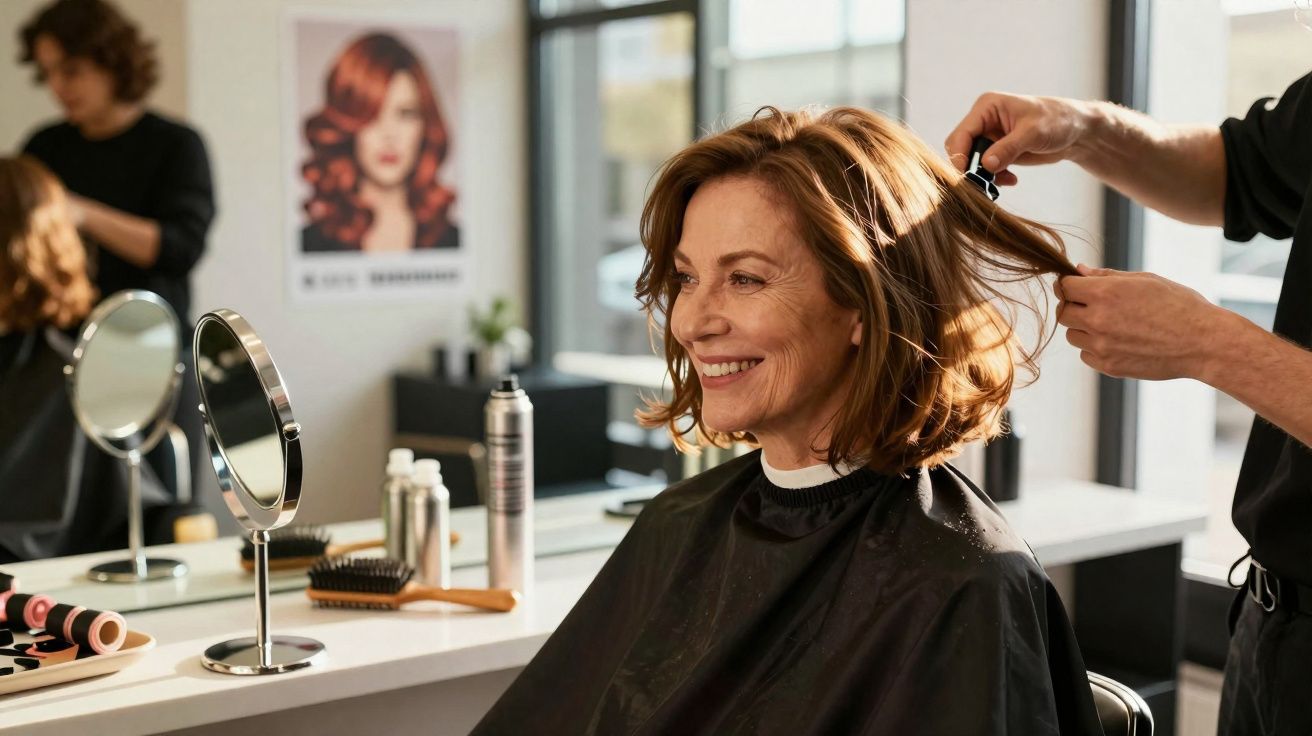
“Granny hair isn’t about age,” my hairdresser contact told me.
In the chair, the woman studied her reflection the way you stare at an old photograph of someone you nearly recognise. Her colour had just been refreshed, her skin looked bright… and yet the mirror was insisting she looked “older” than she felt.
Her hair, however, was immaculately arranged into a rounded, rigid blow‑dry - the sort of perfectly set shape her mum used to request.
Behind her stood the stylist - mid‑40s, a tattoo just visible beneath her sleeve - who tipped her head and chose her words carefully. “Can I be honest?” she said. “Your hair isn’t doing you any favours. It’s reading a bit… granny style.”
The phrase landed in the air. Not cruel. Just accurate.
The client laughed, half mortified. “So what actually makes hair look ‘granny’, then?”
The hairdresser smiled. “Five things I wish women would stop doing after 50.”
What followed was blunt, useful… and oddly freeing.
1. The helmet hair blow‑dry that never moves
“Helmet hair” is the ultra‑fixed, rounded blow‑dry that stays exactly where it’s put - even if you step into a gust of wind. Every curl matches, the hair is sprayed into obedience, and the fringe is rolled under like a curtain.
Head‑on, it can look “done”. Side‑on, it can add a decade in a heartbeat.
After 50, facial features often soften. When the hair becomes too stiff and too circular, it can make the face look heavier and more fatigued. Instead of flattering your expression, it can flatten it. The hairdresser’s view was simple: movement reads youthful; rigidity reads instant ageing.
A dead giveaway? If you’re afraid to touch your hair because it might “ruin the shape”, you’re probably in helmet territory.
One London hairdresser I interviewed called it “wedding guest hair… but for Monday to Sunday”. She described a 62‑year‑old client who came in every Friday for the same round‑brush blow‑dry: lots of height at the crown, ends curled under, and enough spray to stop it moving. It was the sort of look that signalled status in the 1980s.
The client’s frustration was that she looked older than her colleagues, despite exercising and wearing modern clothes. After a long conversation, the stylist took down the crown volume, added soft layers, and stopped turning the ends under. They dried it with more airflow and less tension, then worked in a small amount of cream for pliability.
The result was startling: same woman, same colour - but suddenly she looked like someone who owns a yoga mat, not a set of hot rollers.
Why does helmet hair age you? Because hard shapes spotlight every line. A fixed, rounded silhouette creates a “frame” that doesn’t match how we actually talk, smile or move. It also broadcasts “high maintenance” in an old‑fashioned way.
You don’t need to go full messy beach hair to look current. A sleek blow‑dry can still feel modern if the ends are a touch freer, the top isn’t inflated, and the finish is touchable rather than lacquered. Hair that shifts with your face brings your expressions back to life.
Think less “TV newsreader, 1997”, and more “French woman leaving a café after one coffee too many” - polished, but not helmeted.
2. The hard, dark block colour that drains your face
Another common ageing pitfall after 50 is clinging to the intense, single‑tone dark brown or black you wore at 30. On a small phone screen it can look striking; in real life it often creates a severe contrast against lighter skin and silvery regrowth.
Hairdressers see the same pattern repeatedly: women worry about looking “washed out”, so they deepen the shade. The irony is that heavy depth can do the opposite of flattering. The more solid and dark the block colour, the more it can emphasise fine lines, shadows, and under‑eye circles.
The stylist I spoke to calls it “shoe‑polish colour” - flat, overly opaque, with no light bouncing through. Her rule: once you’re past 50, multi‑tonal colour is usually kinder than monochrome.
She told me about Marta, 58, who arrived with box‑dyed black hair and a weary look. “I look like I’m wearing a wig,” Marta said - and she wasn’t wrong. The colour was so dense it sat on her head like a hat.
Rather than pushing her straight to blonde, the stylist lifted her base by only one or two levels, then added very fine, soft highlights around the face. A few cooler strands near the temples were chosen specifically to melt into Marta’s natural silver. The overall impression stayed dark - just with dimension and glow.
Three months later, Marta sent a selfie. Same haircut, same clothes, yet her cheekbones seemed more defined and her eyes looked brighter. No filler. Simply less block and more nuance.
The reasoning is straightforward. As we age, skin contrast often softens. Keeping hair at the deep, high‑contrast level of your teens can look harsher next to gentler undertones. Strong, solid dark shades also make every grey regrowth line feel louder and more urgent.
Shifting to a slightly lighter base, then adding micro‑highlights or lowlights, doesn’t mean “going blonde”. It means letting light move through the hair - like built‑in soft focus, particularly around the face.
And yes, stepping away from box dye can feel unnerving. That monthly bathroom routine can feel like control. But colour that’s too strong is like wearing the wrong foundation: people clock the mismatch before they properly see you.
A quick extra note on hair after 50: density, shine and heat matter more than ever
One factor people rarely connect to “granny hair” is hair quality. After 50, many women notice changes in density, porosity, and shine - and that can make overly set styling or heavy colour look even harsher.
If your hair is getting finer, prioritising heat protection, a gloss or toner, and moisture‑supporting products can be as transformative as any cut. It’s not about chasing perfection; it’s about making the hair look healthy enough that you don’t need to freeze it into place.
3. The tight perm and over‑set curls
The third granny‑style trap is the tight, uniform perm - curled within an inch of its life. For some women, that perm has been part of their look since their twenties. But when hair is finer or more fragile, a hard perm can look crispy and time‑stamped.
Small, identical curls with no variation can visually shrink the face. They create volume in the least flattering direction - outwards - rather than lifting up or shaping around the cheekbones. That balloon effect can overpower delicate features and make the overall silhouette feel shorter in mirrors and in photographs.
The hairdresser’s rule was blunt: if your curls form perfect little springs all the way round, it may be time to rethink.
She shared a story that was almost too familiar. A 65‑year‑old retired teacher came in proudly announcing she got her perm “every six months, without fail”. The curls were tiny and consistent, sprayed into a dense, frizzy halo.
She wasn’t willing to abandon curls - so the hairdresser suggested a modern compromise: a looser wave perm with larger rods, plus a haircut that removed heaviness from the ends. They switched to far more hydrating products and let the hair air‑dry rather than setting it under a hood dryer.
When the client returned eight weeks later for a trim, friends had been asking if she’d “done something” to her face. She hadn’t. The curls were simply larger, softer, less frizzy - less “poodle”, more “soft cloud”.
The mechanics are simple. Tight curls reflect light in ways that exaggerate frizz and uneven texture. They also shorten the visual length of the hair by pulling it upwards. On a 25‑year‑old, that can feel playful. On a 60‑year‑old, it can slip into caricature if the cut and products aren’t spot on.
Looser waves, cut with gentle layers, sit closer to the head and create lift around the mid‑face. Hydration becomes non‑negotiable here: dry, perm‑stressed curls will nearly always read older. Softness - in shape and in touch - is your strongest ally.
And honestly: nobody styles perfectly every day. But even small changes in how you dry, hydrate, and define curls can move you a long way away from “granny” territory.
4. The short, boxy crop that’s all corners and no softness
There’s a very specific short haircut you spot in waiting rooms and supermarket queues: clipped tight at the back, squared off at the sides, possibly with a thick fringe that sits like a solid block. Is it practical? Absolutely. Is it always the most flattering choice after 50? Not necessarily.
A boxy crop can sharpen the jawline in an unhelpful way, draw attention to jowls, and make the neck look broader. It also leaves little room for what makes modern short hair look current: softness and movement. The hairdresser told me she often has to “unbox” cuts - shaping in curve, texture, and a fringe that doesn’t resemble a Lego piece.
Short hair can look incredible after 50. The issue isn’t the length; it’s the geometry.
I watched a 70‑year‑old woman sit down on a rainy Tuesday with exactly that squared‑off cut. She kept patting the back of her head and explained she wanted it “really short and tidy - same as always”. Her stylist didn’t argue. Instead, she asked, “How do you want to feel when you look in the mirror?”
They kept the back short for easy upkeep. But the sides were tapered instead of chopped straight, with a slight swing towards the cheekbones. The heavy fringe was turned into something softer and lightly piecey, so it could be worn to the side rather than stuck in place.
At the end, she put on her glasses and blinked - genuinely surprised. The length was basically the same, but the school‑mistress outline had vanished. She suddenly looked like the kind of grandmother who’d book a flight with a backpack.
The “maths” is subtle: sharp corners and straight lines at the jaw create a strong frame that draws attention to fullness or sagging. Soft edges, tiny flicks, and even a micro‑fringe interrupt that effect.
The best salon language here isn’t “short back and sides”. Ask instead for: “tapered”, “piecey”, “soft around the ears”, “movement through the top”. A modern crop nearly always has some variation in length, even if it reads simple at first glance.
And to be clear: you’re allowed to want easy hair, not a daily project. The aim isn’t more effort - it’s a smarter shape that suits your face now, not the one from your staff ID photo in 1995.
As one stylist put it: “I’ve seen 30‑year‑olds with granny cuts and 75‑year‑olds with rock‑star bobs. It’s whether your hair looks like a choice you’re making today, or a habit you never questioned.”
- Ask your stylist for one small update at each visit, rather than a dramatic overhaul.
- Bring screenshots of hair on women your age - not teenagers on TikTok.
- Focus on how the hair moves, not how it sits in a perfectly still photo.
5. The set look: rollers, heavy hairspray and frozen fringes
Then there’s the classic salon routine: rollers, hood dryer, backcombing, spray - and repeat. You leave feeling taller and slightly shellacked, as if you’re on your way to a wedding in a 1992 magazine.
For special occasions, it can still be great fun. As an everyday look, it can lock you into a visual time warp. Set hair - particularly with a frozen fringe - creates distance between who you are and how the world around you actually looks. It signals “out of date” before you’ve even said a word.
Most of us have experienced that jolt of catching ourselves in a shop window and thinking, “Surely that can’t be what other people see.” A set finish can make that disconnect worse.
One client told her hairdresser she felt “dressed up and old” every time she left the salon. The ritual had barely changed in 20 years: the same rollers, the same hot dryer, the same cloud of hairspray that made her cough. She went along with it because it was familiar.
This time, the hairdresser suggested a round‑brush blow‑dry finished with a lightweight cream instead. No rollers. The fringe was smoothed but kept flexible - not sprayed into a half‑moon. The ends were bent slightly, not curled into uniform perfection.
She left the salon touching her hair every few minutes, half shocked it was still behaving. The best part? Her husband didn’t say “new haircut”. He simply said she looked “less stiff” - and younger. That tiny change, letting hair behave like hair again, did the heavy lifting.
Physically, too much product weighs hair down and creates the shiny, lacquered surface we associate with older styles. Mentally, the roller‑and‑spray routine belongs to an era of weekly salon sets - not a life that might include work, travel, grandchildren, and late‑night Netflix.
None of this requires chaos. A well‑cut blow‑dry holds its shape. A small amount of flexible spray or mousse can keep things where you want them without building a hard, glassy shell.
Hair that moves - hair you can run your fingers through - quietly says: I’m present, I’m current, I’m not stuck in a time capsule. And in truth, that’s what “looking younger” often comes down to.
A new way to think about hair after 50 (and avoiding granny hair)
The hairdresser’s list of granny‑style habits isn’t meant as a rulebook to shame anyone. It’s more like a mirror held up to routines that may no longer match who you are. Helmet hair blow‑dries, block colour, tight perms, boxy crops, and the set look all share the same flaw: they resist movement, light, and softness.
Ageing hasn’t taken those things away. Some long‑standing hair routines have.
Your face evolves, your lifestyle shifts, your sense of self changes. Hair that once felt comforting can quietly turn into a costume - something you wear because you always have, not because it belongs to your life now.
Letting go of that costume isn’t really about chasing youth. It’s about catching up with yourself.
There’s also something quietly radical about walking into a salon and saying: “I’m not trying to look like a ‘good 60‑year‑old’. I want to look like me.” The best stylists respond to that - not to a celebrity photo, but to a sentence about how you want to feel when you catch your reflection brushing your teeth at 7am.
You don’t have to change everything overnight. Maybe you soften the fringe, lighten the block colour by half a shade, or add a single new layer around the cheekbones. Small steps away from “set” and towards “alive”.
Hair won’t make you younger. It can, however, stop adding years that don’t belong to you - and that steady, everyday confidence (in a supermarket queue, on a video call, in a family photo) is worth far more than any trend.
A practical add‑on: what to ask for at your next appointment
If you want to avoid granny hair without losing yourself, start with a consultation that focuses on your day‑to‑day reality. Tell your stylist how often you style, how much time you have in the morning, and whether you want your hair to air‑dry well.
A good plan after 50 often combines: a cut that creates natural movement, a colour approach that lets light in (without harsh regrowth lines), and styling that keeps the hair flexible - so it looks modern even on low‑effort days.
| Key point | What it means in practice | Why it helps you |
|---|---|---|
| Avoid rigid shapes | Say no to helmet hair blow‑dries, stiff sets, and frozen fringes | Reduces the “instant ageing” effect and brings movement back around the face |
| Soften colour and texture | Ease off very dark block colour, loosen tight perms, and hydrate curls properly | Adds light, softness, and a natural “soft focus” effect |
| Choose gentle, modern polish | Request textured cuts, softer outlines, and controlled (not inflated) volume | Helps you look aligned with your real age without feeling disguised or caricatured |
FAQ
Is it “wrong” to keep my classic set or perm after 50?
Not at all - you can wear whatever you enjoy. Hairdressers simply notice that very rigid sets and tight perms often add years, so if you want a fresher result they’ll usually recommend a softer, more up‑to‑date version.Do I need to go shorter as I get older?
No. Many women over 50 look brilliant with longer hair. What matters most is healthy ends plus some layering and movement - the length itself isn’t the deciding factor.How do I explain to my stylist that I want to avoid “granny hair”?
Speak in “feeling” words: ask for movement, softness, and lightness, and mention that you’d like to avoid stiff shapes or a heavy, helmet‑like finish.What if my hair is very fine and I depend on spray and rollers?
Ask about modern volumising options (including root‑lift sprays) and a cut designed to create volume without needing a hard, sprayed‑on shell.Can I still wear my hair dark if I love it?
Yes. Consider softening the effect with very fine highlights or a slightly lighter tone around the face, so the contrast with your skin doesn’t look too harsh.




Comments
No comments yet. Be the first to comment!
Leave a Comment