
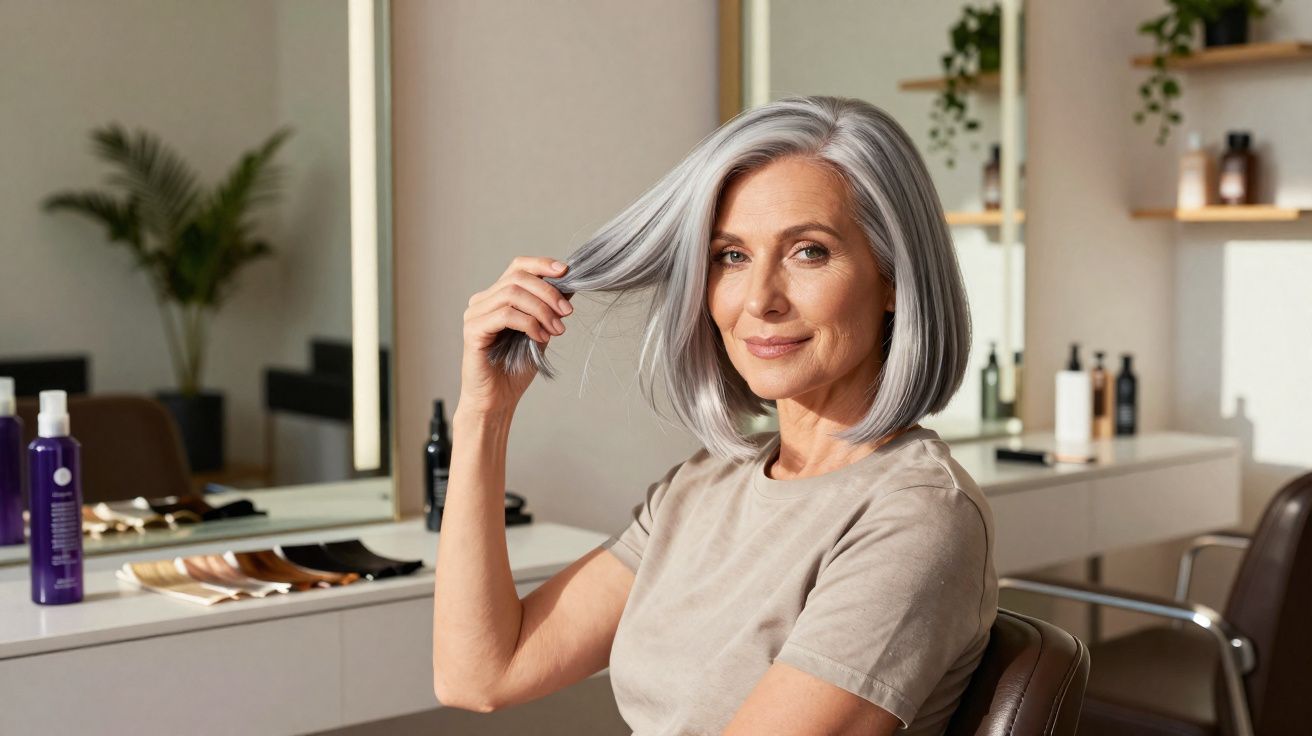
Grey hair is no longer something to conceal. Treated well, it becomes a feature you can refine, illuminate and wear with confidence.
As more people over 50 allow their natural salt-and-pepper pattern to grow through, stylists are quietly changing how grey hair is cut, toned and looked after. The aim isn’t to remove the silver; it’s to make it glossier, smoother and more flattering around the face-without signing up to all-over permanent colour.
Grey hair is trending-yet nobody wants “flat” grey
Across Europe and the US, stylists report the same request: clients want to enhance their natural grey hair rather than cover it. Still, many people are caught off guard when their first fully grey or salt-and-pepper cut looks a little dry, dull or slightly yellow.
As we age, hair doesn’t only lose pigment; it often loses moisture and lipids too. That’s why white strands can feel more coarse and appear less reflective than younger hair.
Modern grey hair is about contrast, shine and movement-not about acting as though you never went grey.
Rather than trying to rewind time with dense, opaque colour, the most up-to-date approaches rely on small, clever adjustments: partial lightening, gentle glosses, more strategic cutting, and a care routine that supports softness and shine.
Three salon techniques that make salt-and-pepper hair look more youthful
Grey blending for salt-and-pepper hair: softening the divide between old colour and new grey
Grey blending has become salon shorthand for a gentler, more gradual route into natural silver. The principle is straightforward: soften the boundary between pigmented lengths and white regrowth so it stops reading as a stark “root line”.
In practical terms, a colourist will typically:
- lighten a handful of strands through the mid-lengths and ends to break up dense, older colour
- apply cooler or neutral tones with a gloss to bring everything closer to your existing grey
- keep the contrast subtle, so old dye can grow out without a dramatic “bar” at the roots
For someone in their 50s or 60s with brighter white at the temples and deeper hair through the back, grey blending can make the mix look purposeful rather than accidental. The added dimension also creates movement, which can instantly lift the face visually.
Grey blending doesn’t disguise your grey; it makes the in-between stage look chic rather than “mid-regrowth”.
Smoky silver: a cooler, metallic polish for naturally white hair
If your hair is already largely white, smoky silver is often the easiest way to upgrade the overall effect. Think crisp, cool tones paired with soft charcoal shadows-almost like a subtle smoky eye, but for hair.
This approach commonly includes:
- neutralising yellow or brassy areas with a cool toner
- layering a sheer wash of silver or steel tones to create a metallic sheen
- leaving a few darker strands as they are, so the finish doesn’t look flat or uniform
Stylists favour smoky silver because it can suit a wide spread of skin tones, from very fair through to deep. The deeper anthracite accents help frame the face and prevent the hair from washing you out, which can happen with plain white.
A smoky silver finish is often simpler to maintain than classic blonde, and it looks deliberate rather than “just grey”.
Face-framing highlights: quick brightness around the complexion
If you’d rather avoid a full-head service, face-framing highlights are a lower-commitment option that can transform salt-and-pepper hair in one appointment.
The method is simple: the colourist lightly brightens and tones only the pieces around the face. That controlled band of light works like built-in illumination for your features.
On grey hair, these highlights are usually kept cool and soft, so they melt into existing silver rather than looking stripy. They can:
- warm up a complexion that’s looking tired
- draw attention to the eyes and cheekbones
- make even a simple cut appear styled with minimal effort
Face-framing highlights are a strategic tweak: the overall look stays natural, but your face suddenly appears more well-rested.
The 2025 haircut that flatters grey hair most
Colour techniques can only do so much if the cut fights against them. With grey hair, experts increasingly favour layered shapes over blunt, weighty lines.
Layers create movement and help natural light bounce off silvery strands, making grey hair catch the eye. They also break up any solid blocks of darker hair, which can visually pull the face downward.
Right now, stylists repeatedly point to three particularly flattering options for salt-and-pepper hair:
| Cut | Why it works on grey |
|---|---|
| Layered bob | Soft layers show off every grey nuance and avoid a “helmet” effect. |
| Textured pixie | Short, choppy pieces create a sporty, lively feel and emphasise metallic shine. |
| Mid-length with curtain fringe | The fringe frames the eyes, while long layers prevent the hair looking flat. |
What tends to age a face isn’t grey hair itself-it’s a heavy, uniform shape. A stiff, one-length bob with no movement, for example, can come across as severe. A softer outline with a touch of lift at the crown typically reads fresher.
Movement is often more rejuvenating than colour: a layered grey cut can look younger than a flat, dyed one.
Care rituals that restore shine and softness
Grey hair frequently needs more protection than coloured hair, not less. Without natural pigments, the fibre can be more exposed and more reactive to sunlight, pollution and heat styling.
For that reason, stylists usually steer people towards hydration and repair, rather than relying on heavy styling products that weigh the hair down.
Key ingredients that support grey hair
- Ceramides: help seal the cuticle and reduce frizz and roughness.
- Keratin: reinforces fragile strands and helps limit breakage through mid-lengths and ends.
- Hyaluronic acid: boosts moisture so grey hair looks supple rather than wiry.
- UV filters: help prevent yellowing and dullness caused by sun exposure.
A realistic routine for someone with salt-and-pepper hair in their 50s might be:
- a gentle, hydrating shampoo two or three times a week
- a nourishing conditioner at every wash, focusing on lengths and ends
- a weekly mask featuring strengthening or moisturising actives
- a leave-in spray or cream before blow-drying to shield against heat and pollution
- an occasional purple or blue shampoo to cancel yellow tinges (not every wash)
Think of grey hair like fine cashmere: it can look luxurious, but only if you look after it properly.
One extra consideration that often gets overlooked is water quality. In hard-water areas, mineral build-up can make grey hair appear dull or slightly brassy. A clarifying wash now and then, or a shower filter, can help your shine products work as intended.
Another small upgrade is heat discipline. Grey hair can be more prone to surface roughness, so keeping tools at a moderate temperature and using a heat protectant consistently can make the difference between “silvery” and “straw-like” in day-to-day styling.
How to talk to your stylist about your grey goals
Many people still sit down in the chair and say, “Do whatever you think,” then walk out feeling a bit underwhelmed. With grey hair, being specific helps.
Here are a few terms you may hear in the salon:
- Gloss / glaze: a sheer, semi-permanent colour that boosts shine and adjusts tone without heavy coverage.
- Toner: a product used after lightening to cancel unwanted warmth or yellow tones.
- Lowlights: darker strands added back in to create depth when hair has become too uniformly white.
- Balayage: hand-painted lightening designed to look soft and naturally grown in.
A useful way to brief your stylist is to describe the outcome you want to feel, not only the shade. For example: “I want my grey to look brighter and more polished, but I don’t want to hide it,” or “I’d like less contrast at the roots while my old colour grows out.”
Real-life scenarios: moving from fully dyed to proud salt-and-pepper
Picture someone who has coloured their hair dark brown for decades and now gets a solid white band at the roots every four weeks. Rather than doing one more all-over dye, a stylist may recommend grey blending: introducing a few lighter pieces through the older colour, applying a cool gloss to unify the tones, and choosing a layered cut that makes the mix look intentional.
Now consider someone who is already mostly white but feels washed out. They might opt for smoky silver once or twice a year. Those cool, metallic tones give the hair presence without the commitment of high-maintenance blonding. Combined with a textured pixie, the overall effect can feel sharp and fashion-forward rather than like “giving up” on colour.
These routes come with additional benefits: fewer harsh chemicals on the scalp, fewer urgent root appointments, and a calmer relationship with ageing. The main drawback is usually dryness if lightening is pushed too far, which is why stylists emphasise gradual changes and strong aftercare.
Letting grey show doesn’t mean skipping the salon. It means using the salon differently-for polish, not disguise.
If you’re considering the switch, the most achievable path is often a series of small changes over the course of a year: a smarter cut, a richer routine, then subtle colour techniques that respect the natural pattern of your salt-and-pepper hair. Step by step, the grey you once tried to hide can become the feature people notice-and compliment-first.






Comments
No comments yet. Be the first to comment!
Leave a Comment