
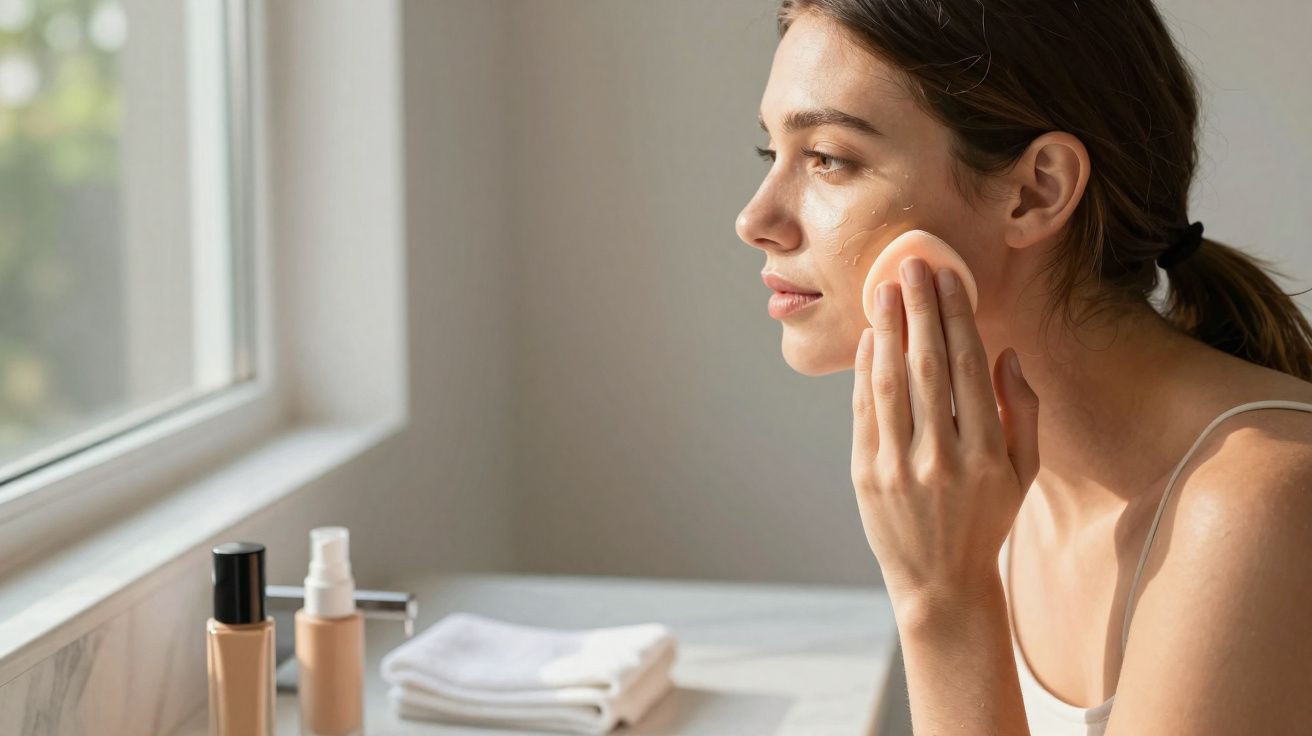
The mirror is brutally honest this morning. Your foundation looks… patchy. It gathers on your forehead, sits blotchy around your nose, and your cheeks suddenly feel drier than any skin-analysis report has ever suggested. You lean in closer, pat at it with your fingertips, frown at your reflection. Naturally, it only looks worse. So you put on a beauty influencer, try “hack number 27”, and still-nothing. And in your head, the same question keeps looping: is it me, is it my skin, or is it one tiny step I’m getting wrong?
Why your foundation looks patchy-even when you’re “doing everything right”
We’ve all been there. You’ve taken your time: moisturiser applied carefully, beauty sponge dampened, a decent-quality foundation chosen. Yet the finish still looks uneven. Fine lines seem more obvious, the product clings around the mouth, and in a few areas your skin looks almost “bare”, as if the foundation has vanished. It feels oddly unfair-like your face is politely saying, “Nice try, but no.”
A friend of mine who works as a make-up artist in a studio once told me how often clients flop into her chair with exactly this complaint. They’re convinced they’ve nailed the perfect routine: primer, foundation, powder, setting spray-the full works. Then she shows me the before photos: foundation applied straight after skincare with no pause, faint brush streaks left behind. Two hours later, the product has worn off like a badly painted manicure. Most people assume the answer is more coverage-when piling on more only makes the patchiness more obvious.
When foundation looks uneven, it’s usually not the products themselves-it’s what happens between them. Skincare that’s still wet, SPF that hasn’t quite settled, too much pressure during application. The textures slide over each other instead of bonding. Your complexion turns into a kind of slip-and-slide made of cream, serum, and pigment. The unromantic truth is that make-up always follows physics. The good news is that a tiny tweak in technique can turn that slippery surface into a smooth, reliable base.
The small foundation technique that changes everything: press, don’t wipe
The real game-changer is almost boringly simple: press your foundation into the skin instead of wiping it across. No rubbing, no swirling, no pushing it back and forth. Just gentle pressing-patting, stamping, and lightly anchoring the product in place. Whether you use fingers, a sponge, or a brush, the principle stays the same: tap and press (often from the outer face inward) rather than “painting” over the skin. That’s how the foundation meshes with slightly dewy skincare instead of sitting on top like a separate layer.
You’ll hear professionals call this “stippling” or “Press & Roll”. In real life, it simply means working in small areas. One cheek first, then the other, then forehead, chin, and nose. Put one pump of foundation on the back of your hand, pick up a tiny amount, and work it in with light, steady pressure. You’ll notice the product starts to look like it’s part of your skin rather than something leaving tracks behind. Suddenly, even medium coverage reads like a genuinely good skin day-not a mask trying to hide everything at all costs.
Let’s be realistic: almost nobody has 20 calm minutes every morning to do their base in total peace. And you don’t need that. This press technique might take about 60 seconds longer than your usual wiping motion, but the difference in the mirror is significant. You’ll use less product, it settles less into lines, and up close the complexion looks far more even. With higher-coverage formulas and on more mature skin in particular, this tiny switch is often the difference between “I can tell you’re wearing foundation” and “Your skin looks really good today.”
How to use the press technique daily (no new product cupboard required)
The simple order is: skincare, a short pause, then press. After your usual moisturiser and sunscreen, wait 2–5 minutes-until the surface no longer looks visibly shiny and instead feels supple. Then take a small amount of foundation (less than you think you need) and roughly place it with fingers or a brush only where you want more coverage. From that point, the technique becomes the main event: using a damp sponge or clean fingertips, press the foundation into the skin as if you’re gently “sealing” it in.
Instead of sweeping over the face, pat in small, controlled movements. At transition areas-down the neck, around the ears, along the hairline-work only with whatever is left on your sponge or fingers. Don’t add more; just blend. Harsh edges soften on their own this way. If you like, finish by lightly pressing a thin tissue over the face to lift any excess. This micro “blotting” makes foundation look more even and weightless without stealing its coverage.
Many of us apply too much foundation in one go because we’re worried every shadow will show through. The payback is usually worst on dry areas: around the nose, the nasolabial folds, and the forehead. If you notice foundation collecting in those spots, it’s often a sign of too much product and not enough pressing. Rather than loading up again, go back in with a clean sponge (no extra foundation) and press over those areas to reset the product. The patchiness smooths out without wiping everything away. At first it can feel like you’re doing “too little”-until your reflection proves otherwise.
Two often-missed extras that make patchiness worse (and how to avoid them)
Even with great technique, two everyday details can sabotage your finish. First: tool cleanliness. A sponge or brush that’s picked up old product, skincare residue, or setting spray can cause foundation to apply unevenly and cling in odd places. Washing tools regularly-and letting them dry properly-makes the press technique noticeably more effective.
Second: product compatibility. If you’re mixing a silicone-heavy primer with a very watery SPF or a foundation that doesn’t play well with your base, you can get pilling or separation that looks like instant patchiness. You don’t necessarily need to replace anything; simply letting each layer settle and pressing (not wiping) often solves it. If it still balls up or flakes, the formulas may not agree on your skin.
“Most people think they need a new concealer, when what they really need is 30 extra seconds of press time,” a make-up artist once laughed to me, while creating perfectly even skin with barely any product.
- Less product, more technique: Work in thin layers and press each layer in gently.
- Dewy textures need a moment: Give skincare and sunscreen time to settle before foundation goes on.
- One tool is enough: Fingers, brush, or sponge-the pressure matters more than the gadget.
- Leave problem areas until last: Use leftover product for the sides of the nose, chin, and forehead, not a full fresh load.
- Blot instead of layering: Control shine and patchiness with a tissue or sponge rather than building a third layer.
When foundation looks like skin-not like a mask
There’s something genuinely freeing about realising it wasn’t you, and it wasn’t your skin-it was a tiny movement in the bathroom. The mirror becomes less of a negotiation when you’re not constantly trying to fix your foundation. And you get that quiet “effortless” effect, even though you’ve been very deliberate. That’s the point where make-up stops feeling like armour and starts behaving more like a filter you can switch on or off whenever you choose.
What’s interesting is the mental shift this technique can create. When you stop pushing foundation around and start pressing it in, you automatically treat your skin with more awareness. You notice texture: where it’s drier, where it’s smoother, where a breakout is brewing. And almost by accident, the repeated press motion becomes a tiny face massage that changes how the day begins-less rushed, less like a battle with your own reflection.
And the next time a friend says-half exasperated-that their foundation has gone patchy again, you don’t need a lecture or a long routine. Just one line: “Try pressing it in instead of wiping it.” Good techniques spread quickly when they genuinely work. This one has all the qualities of a quiet beauty secret: practical, unfussy, and designed for real mornings that you’d like to feel a little easier.
| Key point | Detail | Benefit for the reader |
|---|---|---|
| Press technique instead of wiping | Press foundation gently into the skin rather than rubbing or shifting it | More even complexion, fewer patches, less mask-like finish |
| Work in thin layers | Use less product, apply by zone, blend edges with leftover product | More natural look, better wear time, saves product |
| Pause between skincare and make-up | Wait 2–5 minutes until skincare has settled | Prevents slipping, improves how foundation bonds to the skin |
FAQ
Question 1: Does the press technique work with very light, runny foundation?
Yes. Lightweight formulas often benefit even more from pressing because they fuse with the skin rather than sitting on the surface. You’ll typically get better wear and more even coverage.Question 2: What’s best-sponge, fingers, or brush?
The tool matters less than the motion. Many people find a slightly damp sponge easiest because it naturally encourages tapping. Fingers warm the product, while brushes can work well but often require a bit more practice to press (rather than sweep).Question 3: Can I build more coverage with this technique?
Yes. After the first pass, press a second thin layer only where you want extra coverage-such as on redness. Even full coverage can look relatively natural when it’s built in pressed layers.Question 4: Do I need to change my primer if my foundation looks patchy?
Not necessarily. Often it’s enough to let primer and foundation settle briefly and then apply using pressing motions. If it still pills or flakes, the formulas or ingredients may not be compatible.Question 5: Does it help with very dry, flaky skin?
It helps foundation collect less in dry patches. For truly flaky skin, you’ll also need solid skincare and gentle exfoliation-then the press technique prevents you from highlighting flakes even more.


Comments
No comments yet. Be the first to comment!
Leave a Comment