
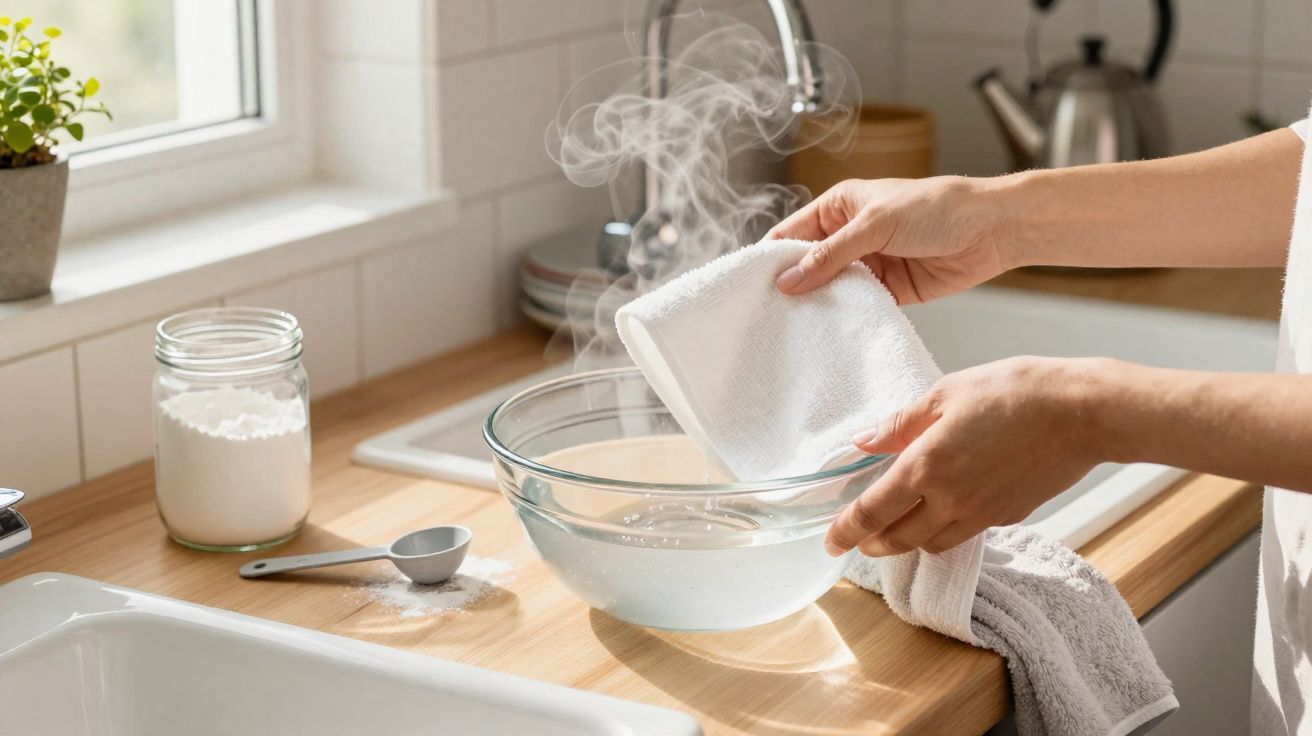
Fat smears, tomato splashes, a dull grey haze: in many kitchens, even freshly washed kitchen towels can look tired and grubby.
A nearly forgotten classic brings them back to a brilliantly clean life.
When the weather turns colder, the kitchen works overtime: stews, bakes, roasts and sauces. Delicious for the family, relentless for textiles. Kitchen towels turn grey, stop smelling fresh and look neglected even after a “proper” wash with a heavy-duty detergent. Between harsh chlorine bleach and pricey specialist products, there is a third option: an unassuming white powder that used to be a staple in utility rooms-and is now making a surprisingly strong comeback.
Sodium percarbonate (Percarbonate): the oxygen bleach that makes chlorine look dated
The product is sodium percarbonate, usually sold simply as percarbonate or oxygen bleach. It looks almost too plain to be effective: a white, slightly granular, odourless powder with no flashy claims on the label. Yet it can return many kitchen towels to a whiteness that feels close to day one.
Unlike traditional chlorine bleach, percarbonate is generally much kinder to cotton fibres. It is essentially a solid form of hydrogen peroxide. Once dissolved in water, it releases active oxygen, which breaks down colour pigments and organic residues without wrecking the fabric structure.
Active oxygen lifts fat, coffee, tomato and tea from fibres-deep within the weave, not just on the surface.
Another advantage is environmental: sodium percarbonate breaks down into water, oxygen and soda (sodium carbonate), rather than leaving behind problematic residues in wastewater like many modern “special” cleaners can.
Why kitchen towels stay grey even with heavy-duty detergent
Many households rely on strong detergents containing optical brighteners. These work by tricking the eye: they leave a faint bluish film on the textile that makes greying look less obvious. The underlying grime often remains partly embedded in the fibres.
Percarbonate works differently. It:
- breaks down pigments in coffee, tea and red-wine stains,
- loosens fats and sauce residues,
- reduces odours by removing the conditions bacteria thrive on,
- tackles the chalky grey film that builds up over repeated washes, especially in hard-water areas.
Kitchen towels are hit by a difficult combination of grease, starch, tomato sauce, spices and limescale. Standard detergents can quickly meet their match with older, dried-in stains. This is where oxygen bleach earns its reputation-provided it is used correctly.
No heat, no result: how active oxygen actually works
A common mistake is tipping the powder into the drum and running a 30 °C quick wash. In that scenario, much of the potential is wasted.
Percarbonate is largely sluggish in cold or lukewarm water. From around 40 °C it starts releasing oxygen properly, and at about 60 °C the reaction reaches full strength. Heat helps the granules dissolve completely and lets active oxygen spread evenly through the water.
Hot water plus active oxygen acts like a deep-cleansing bath for kitchen towels-just an invisible one.
During the reaction, oxygen oxidises organic dirt-in plain terms, it chemically breaks it down until it can detach from fibres and rinse away. As a bonus, the fabric ends up more hygienic, because many germs struggle under these conditions.
Step-by-step: how to turn grey kitchen towels white again with sodium percarbonate
1) Soak first-don’t just hope the wash will fix it
The most effective approach is a hot soak before the towels go into the washing machine. This gives percarbonate time to work at full strength.
| Step | What to do |
|---|---|
| 1 | Shake out loose debris and rinse the towels briefly with hot water. |
| 2 | Fill a large bowl or bucket with very hot water (at least 40 °C, ideally 60 °C for white cotton). |
| 3 | Add 1–2 tablespoons of sodium percarbonate per litre of water and stir thoroughly (a wooden spoon is fine) until no granules remain. |
| 4 | Submerge kitchen towels immediately so they are treated from the start of the reaction. |
| 5 | Soak for at least 2 hours; for heavy soiling 4–6 hours or overnight. |
| 6 | Wring out, then machine-wash with your usual detergent. |
2) How much percarbonate is sensible?
Dose according to how bad the greying and staining is:
- lightly greyed towels: 1 tablespoon per litre of water
- old grease and tomato stains: 2 tablespoons per litre
- to boost a machine wash: 1–2 tablespoons into the main-wash compartment (only for programmes 40 °C and above)
With a severely greyed set of kitchen towels, the difference is often obvious after one treatment. A second round can be worthwhile if the towels have been washed at 30 °C for years.
3) Getting the best result in hard-water areas (extra tip)
If you live in a hard-water region, limescale can bind dirt to fibres and contribute to that dull “grey veil”. Percarbonate helps, but you may get a more consistent result by keeping your wash routine limescale-aware: use the correct detergent dose for your water hardness and avoid under-dosing on heavily soiled loads. Clean towels benefit most when detergent, temperature and oxygen bleach are working together rather than fighting the same build-up repeatedly.
Where percarbonate is a no-go-and where it excels
Despite the benefits, sodium percarbonate is not suitable for every textile. Delicate materials can be damaged.
- Not suitable for: wool, silk, cashmere and other animal fibres-the alkaline pH and oxidation can attack the protein structure.
- Use with caution on: intensely coloured fabrics with uncertain colourfastness. Always test on an inconspicuous area first.
- Ideal for: white cotton and linen towels, tea towels with well-fixed colours, napkins, tablecloths and robust cleaning cloths.
Percarbonate is one of the toughest opponents of kitchen grime-but only when the fabric itself can take it.
Safety: a strong product, straightforward rules
In dry form, percarbonate can irritate skin and eyes. Use basic household gloves, avoid breathing in dust, and don’t hover your face directly over the bowl while mixing.
Be careful when combining “household remedies”. With percarbonate, avoid the following:
- do not use it together with vinegar or citric acid in closed containers,
- always dissolve the powder in water first, then add textiles,
- do not prepare mixtures in airtight vessels-pressure can build up.
Handled with these simple rules, oxygen bleach is a reliable, predictable cleaner that has lasted for decades because it simply works.
Storage (extra tip)
Keep sodium percarbonate dry and tightly sealed, ideally in a cool cupboard. Moisture and heat can reduce its effectiveness over time. Store it away from children and clearly labelled, especially if you decant it into a plain container.
Why this “old” method is worth bringing back
Many people only realise how crowded their cleaning cupboard has become when they actually look: degreasers, stain salts, laundry sanitiser, special white-wash boosters, separate bathroom and kitchen sprays. A surprising amount of that can be replaced with a few basics-of which percarbonate is one of the most versatile.
It particularly suits people who:
- can wash laundry at higher temperatures,
- don’t want to accept permanently grey kitchen towels,
- can do without strong fragrances and coloured additives if the result is genuinely clean,
- want a more environmentally friendly alternative to harsh chlorine bleach.
Beyond kitchen towels, sodium percarbonate can help brighten white bed linen, flannels, fabric handkerchiefs or sports towels that need to look and smell fresher. For single stubborn stains, a small concentrated soak in a bowl-treating only the affected area-often makes more sense than repeatedly washing the whole item.
For many first-time users, the surprise is the gap between “washed but still a bit grubby” and “properly clean”. With kitchen towels that are handled several times a day and frequently come into contact with food, that improvement is not only cosmetic-it is also a clear hygiene win.




Comments
No comments yet. Be the first to comment!
Leave a Comment