
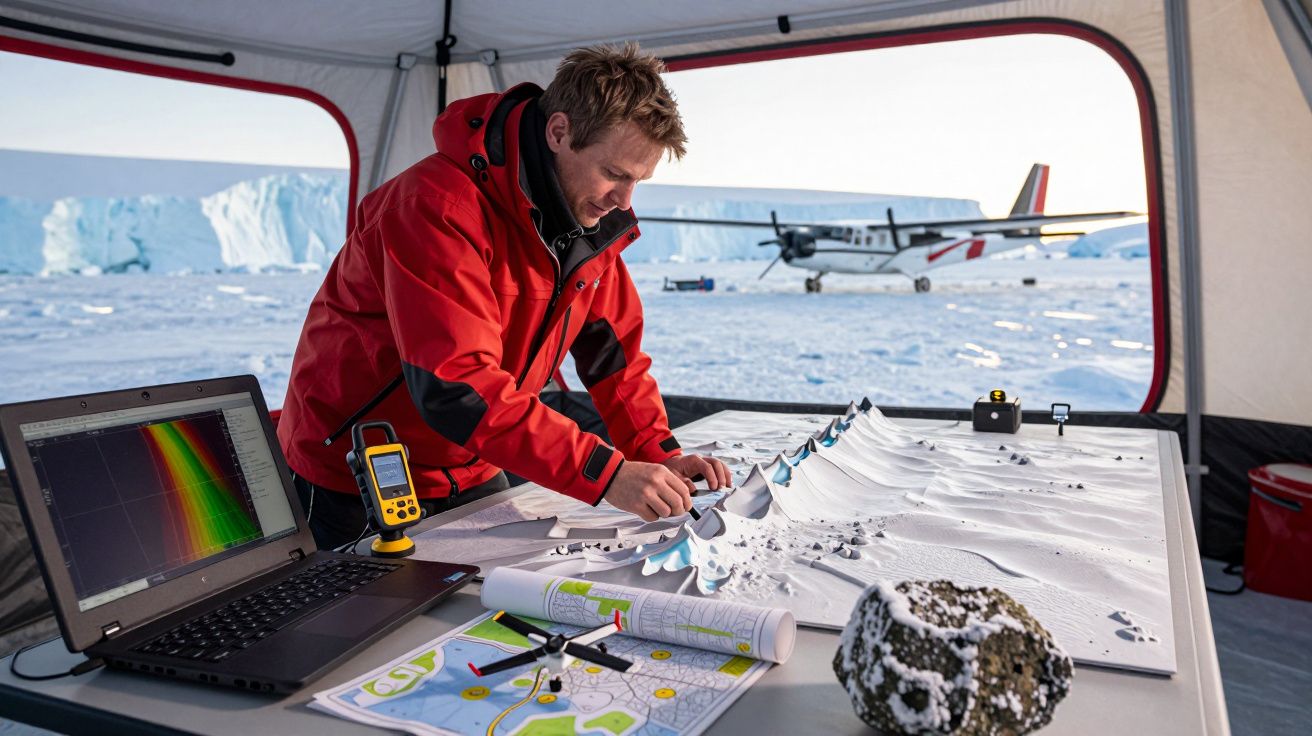
Far below Antarctica’s ice, a vast rock body hidden from view is changing how researchers interpret ancient terrain - and how they forecast the sea-level rise that will shape our coasts in decades to come.
What began as a handful of isolated pale-pink stones sitting on wind-scoured ridgelines has become one of the decade’s most compelling Antarctic investigations, weaving together aircraft gravity surveys, Jurassic geology and the future of shorelines worldwide.
A granite massif hidden beneath Pine Island Glacier
In the remote Hudson Mountains of West Antarctica, scientists repeatedly came across boulders that seemed out of place. Against the backdrop of dark volcanic peaks, these blocks of light, pinkish granite looked like visitors from another landscape. Their make-up resembled granite found in regions such as Brittany in France, rather than anything expected in the immediate area.
That mismatch hinted at a deeper origin. By radiometrically dating microscopic mineral grains trapped within the granite, geologists established an age of roughly 175 million years, placing the rocks firmly in the Jurassic period. Back then, dinosaurs lived on greener continents and Antarctica formed part of the supercontinent Gondwana.
The puzzle was location. These Jurassic granite fragments now sit high on present-day Antarctic ridges with no obvious granite outcrop nearby. Something must have transported them - and the key evidence arrived from above.
Airborne gravimetry: how the British Antarctic Survey effectively “weighed” the bedrock
To chart the concealed geology beneath the ice sheet, the British Antarctic Survey operates research aircraft fitted with gravimeters. These sensors detect tiny variations in Earth’s gravitational field as the aircraft passes over different rock types and structures.
When flights crossed the Pine Island Glacier region, the measurements revealed an unusually strong and unexpected gravity anomaly. The gravitational pull was slightly higher than anticipated, pointing to a very large, comparatively dense mass embedded beneath the ice.
With field samples and exceptionally precise gravity data considered together, researchers identified a buried granite massif almost 100 kilometres long and up to 7 kilometres thick, lying beneath one of Antarctica’s most rapidly changing glaciers.
By combining airborne gravity results with radar-derived ice-thickness mapping, the team could outline the massif’s geometry. The body sits under hundreds of metres of ice beneath Pine Island Glacier - often described as an inverted Mont Blanc locked under the ice - within one of the most closely monitored outlets of the West Antarctic Ice Sheet.
From a subglacial granite massif to “stray” boulders on volcanic ridges
Once the massif was mapped, the surface evidence fell into place. The pink boulders’ chemistry closely matched what would be expected from the newly identified granite body, and the ages aligned as well. These were not exotic stones delivered by some long-vanished current; they were pieces of the buried granite itself, wrenched free and carried away.
The transport process is harsh but straightforward. Glaciers behave like slow, powerful conveyor belts: as ice moves, it scrapes, plucks and grinds the underlying bedrock, producing everything from large blocks to fine rock flour. During the last glacial maximum around 20,000 years ago, Pine Island Glacier was thicker and spread further than it does today, extending across areas that are now exposed as peaks.
Beneath that heavier ice cover, the glacier appears to have torn fragments from the granite massif. As the climate warmed and the ice thinned and retreated, those granite blocks were left behind on nearby volcanic ridges - clues scattered across a huge geological scene.
Glaciers as long-memory bulldozers
For climate scientists, these displaced boulders function like durable archives. Once their source is identified, they provide evidence of where the glacier travelled, how thick it was, and how strongly it eroded the ground - information that cannot be measured directly in the modern environment.
When a boulder can be traced back to a buried origin, it helps reconstruct former ice thickness, flow routes and erosion rates that are otherwise invisible today.
Recreating this long-term picture matters because glaciers respond to atmospheric warming and ocean change over centuries. Knowing how Pine Island Glacier behaved under past conditions provides constraints for how it may behave as today’s thinning continues. If the glacier once flowed across the granite with a particular thickness and speed, present-day change can be judged against that baseline.
The study underlines that glaciers can:
- remove huge volumes of rock through abrasion and plucking
- carry that debris tens to hundreds of kilometres
- deposit it as the ice edge withdraws, leaving isolated “erratic” boulders
- preserve evidence of past ice extent and thickness through the erratics’ locations and compositions
This “geological memory” is valuable because it allows researchers to test and improve ice-flow models used to estimate how rapidly ice sheets could shrink.
A further line of evidence often paired with erratics is cosmogenic exposure dating: by measuring isotopes produced when rock surfaces are exposed to cosmic rays, scientists can estimate how long a boulder has sat ice-free. When used alongside chemistry and geophysics, exposure ages can help time the retreat of the ice margin and refine reconstructions of how Pine Island Glacier changed after the last glacial maximum.
Why the Pine Island Glacier granite massif matters for sea-level rise
Pine Island Glacier sits at the heart of sea-level research. Together with its neighbour Thwaites Glacier, it funnels ice from a large portion of the West Antarctic Ice Sheet into the Amundsen Sea. Satellite observations over recent decades show that ice loss in this sector is accelerating.
What lies beneath the glacier is not a minor detail: bed shape and bed composition strongly influence how ice moves. Hard, irregular bedrock can act like a brake, while smoother ground - particularly if covered by sediments - can enable faster sliding, especially where meltwater lubricates the base.
The newly mapped granite massif alters the inferred subglacial landscape across a roughly 100-kilometre stretch. Compared with softer sedimentary layers or some volcanic rocks, dense granite can affect glacier behaviour in distinct ways:
| Property | Granite massif | Softer or sedimentary bed |
|---|---|---|
| Resistance to erosion | High; wears down slowly | Lower; erodes more quickly |
| Surface roughness | Can produce ridges and bumps | More readily smoothed |
| Effect on ice flow | May slow or divert flow locally | Can permit faster sliding |
| Impact on subglacial water | Tends to channel meltwater along specific routes | Encourages broader, more diffuse flow |
These contrasts feed directly into computer simulations. To model Pine Island’s future, researchers need to know where the ice is more likely to grip, where it could accelerate, and how subglacial meltwater may travel beneath the glacier. Mapping the granite massif changes those inputs in a way that can materially affect projected outcomes.
An additional, closely related factor is heat. While the massif itself is not presented as a heat source, different geological settings can be associated with different patterns of geothermal heat and water routing beneath the ice. Because basal water pressure can control sliding, better knowledge of subglacial geology helps researchers narrow down not just “what the bed is made of”, but how the bed may behave as conditions change.
From Gondwana’s breakup to today’s coastal risk
There is a direct human consequence to this geological discovery. As the West Antarctic Ice Sheet loses mass, global sea level rises, and the way Pine Island Glacier responds to warmer air and ocean waters will influence whether coastlines face tens of centimetres of rise or substantially more over the coming centuries.
The risk is not merely theoretical. Where ice rests on retrograde slopes - beds that deepen inland - retreat can set off self-reinforcing instability. If the grounding line (the point where the glacier lifts off the bed and begins to float) moves beyond certain thresholds, ice loss can speed up.
Improving our understanding of what lies beneath Pine Island Glacier reduces uncertainty in sea-level projections, giving coastal planners a firmer basis than broad assumptions.
Places already grappling with flood risk - including cities such as New York, Mumbai, Lagos and Shanghai, and low-lying regions such as Bangladesh or US Gulf Coast states - depend on credible projections for the coming decades. The same applies in the UK, where decisions about coastal adaptation and long-lived infrastructure matter from the Thames Estuary to low-lying sections of the east coast. Once a specialist topic, subglacial geology now informs flood-defence design, insurance exposure, and long-term planning.
Ice-sheet archaeology: how the study was assembled
This work blends disciplines that rarely intersect outside polar research. Teams travelled across exposed, windswept ridges - skiing and hiking to reach sites where the unusual granite blocks lay - and collected samples. In laboratories, specialists used isotopic techniques to date the rocks. Geophysicists then processed years of airborne gravity measurements, while modellers explored how alternative bed shapes influence ice flow.
Some of the effort developed through the International Thwaites Glacier Collaboration, a major UK–US research programme. While Thwaites Glacier often dominates headlines, Pine Island Glacier lies immediately adjacent, connected by shared ice dynamics and comparable vulnerabilities.
By aligning rock chemistry, rock age and sample locations with the gravity anomaly, the team linked surface erratics to a source concealed kilometres beneath the ice. This combined approach - often summarised as “erratics plus geophysics” - offers a practical template for investigating other hidden structures across Antarctica.
A continent still full of buried stories beneath Antarctica’s ice
Researchers often remark that some parts of Mars are mapped more clearly than the ground beneath Antarctica’s ice. Radar and gravity surveys can reveal broad forms, yet many finer details remain uncertain. Each new dataset sharpens a small portion of the subglacial map - and occasionally exposes something as striking as a granite body of this scale.
Discoveries like this also highlight a recurring tension in Antarctic science. On one hand is the sheer fascination of uncovering a mountain-like mass locked away since the age of dinosaurs. On the other is the pressing need to determine whether key glaciers might contribute 10, 20 or 40 centimetres of sea-level rise by 2100.
Subglacial geology is where these threads meet. A Jurassic granite body formed as Gondwana began to break apart can now help tune the models that underpin modern policy documents. Ancient tectonic history ends up influencing today’s discussions about flood mitigation and coastal zoning.
What comes next beneath the ice
The Pine Island Glacier findings will encourage researchers to investigate other gravity anomalies scattered across Antarctica. Some may indicate buried volcanic systems; others may mark concealed basins filled with sediments or water-rich layers that could promote rapid sliding.
Future campaigns are likely to combine an even wider toolset: fleets of smaller aircraft or drones, improved satellite gravimetry, seismic measurements through the ice, and machine-learning techniques capable of detecting structure within vast, noisy datasets. With each step, blind spots in the subglacial map should shrink.
For anyone far from polar regions, the practical lesson is how sensitive some ice margins can be. A few degrees of ocean warming near Antarctica, or wind changes that push warmer water beneath floating ice shelves, can alter stresses at the grounding line. Once tipping points are crossed, bed relief and buried massifs can help determine whether ice loss stabilises or accelerates.
The Pine Island granite massif story also offers a broader way to think about climate risk: many of the processes that govern Earth’s response to warming remain out of sight - beneath ice sheets, in the deep ocean, or locked into permafrost. Surface observations capture only part of the system. Long-term planning improves when these hidden layers - from buried mountains to subglacial lakes - are brought into focus, one careful field season and one precisely measured flight at a time.






Comments
No comments yet. Be the first to comment!
Leave a Comment