
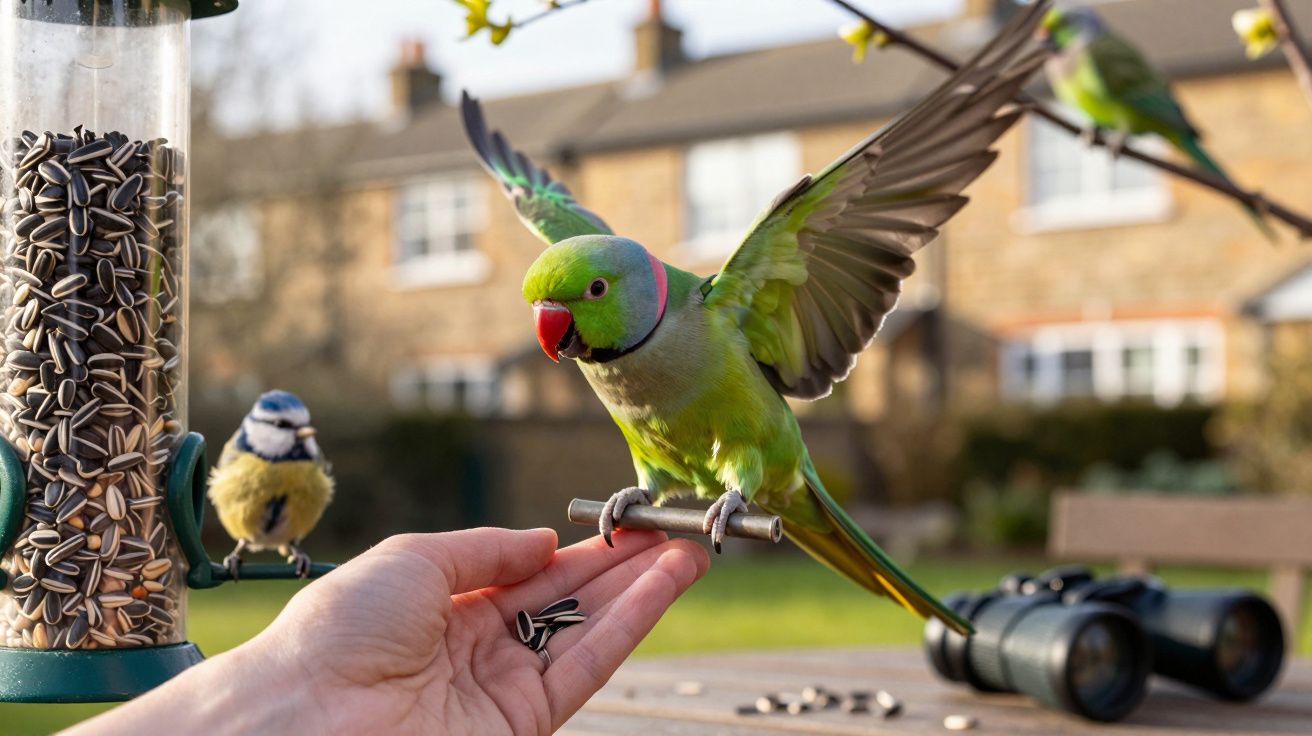
Lime-green streaks skim across the rooftops, their wingbeats briefly silhouetted against London’s washed-out sky. In a small square in south-west London, dog walkers slow down, phones hovering half-drawn, as a barrage of rasping cries overwhelms the city’s usual background drone. The birds drop into the plane trees like bright, plastic leaves thrown into the branches, gnawing at buds, letting husks fall, and bickering at full volume.
Someone nearby grumbles that they “never saw these when I was growing up”. Another person jokes that it’s “a little slice of Delhi in SW15”. A third gestures at a bird feeder now smothered in parrots and sighs about the blue tits that have vanished. Ring‑necked parakeets are striking, brazen, and utterly impossible to tune out.
And then, inevitably, a question lands in the air - one that still doesn’t have a simple, settled answer.
The quiet invasion in plain sight
If you live anywhere close to a British city, chances are you’ll hear them before you spot them: a sharp, almost metallic screech that slices through morning coffee and noise-cancelling headphones alike. Ring‑necked parakeets have long since stopped being a quirky London curiosity; they’re moving into suburbs, villages, motorway service stations and parks, from Birmingham to Brighton.
They’re as colourful as pick-and-mix sweets and just as irresistible to photograph, which makes them feel more like a postcard feature than an ecological worry. But their spread hasn’t been slow or subtle. In only a few decades, small feral clusters have turned into dense roosts numbering in the thousands. They are not slipping quietly into the scenery.
They are taking it over, loudly.
Back in the 1970s, the UK’s entire ring‑necked parakeet population was thought to be only a few hundred birds, largely concentrated around a handful of Thames-side parks. By the early 2000s, estimates had climbed beyond 5,000. Today, bird surveys put the figure comfortably above 30,000, and some ornithologists suspect the true number could be nearer 50,000 - or even higher.
Their range now stretches far beyond the early London and Surrey strongholds. Sightings and records extend across the Home Counties, through the Midlands, along the south coast, and into parts of northern England. Roosts of several thousand birds have appeared near golf courses, city parks and even business estates - a green tide settling into trees lit by car-park lamps as dusk falls.
On a crisp winter evening near one of these roosts, it can feel like watching an aerial rush hour: wave after wave funnels in, circles, and then drops in sudden clouds onto a small stand of tall trees.
Ecologists aren’t baffled by their success. Ring‑necked parakeets are classic generalists: they eat seeds, fruit, buds, garden nuts, and they’ll happily raid orchards too. They nest in tree cavities - the same premium “housing” many native birds depend on. They cope with cold far better than many people expected, tolerate the constant clamour of urban life, and rapidly learn where food is reliable. Bird feeders, compost heaps and overgrown hedges become an all-year buffet.
Once numbers build past a tipping point, the growth accelerates. Large, raucous roosts draw in more birds, offering protection in a crowd and a steady exchange of information about where to feed. Climate warming also nudges the balance in their favour: milder winters and longer seasons make survival and breeding easier. Put plainly, Britain’s towns and cities have handed them exactly the messy, calorie-rich, low-predator conditions in which they flourish.
What looks novel and exotic against a grey skyline is, from an ecological perspective, a textbook example of an invasive species finding an opening and expanding into it.
What ring‑necked parakeets in London and beyond mean for “native” wildlife
There’s also a practical side to how this story unfolds: the more people accept parakeets as part of the everyday backdrop, the less likely anyone is to notice the small shifts happening beneath the spectacle. Changes in who gets access to nest holes, who reaches feeders first, and how urban green spaces are managed tend to be gradual - until they suddenly feel obvious.
At the same time, it’s worth recognising why the debate is so charged. These birds are not a distant conservation headline; they are visible, noisy and often feeding a few metres from someone’s kitchen window. That closeness turns policy questions into personal ones.
How to live with a very loud neighbour
For many householders, the first flashpoint is the garden. A couple of parakeets on the feeder can feel like a novelty. A flock of twenty can demolish a fat ball in minutes and intimidate smaller visitors into keeping away. A straightforward tweak is to swap open trays and large perches for caged feeders with small access points. These still allow tits, finches and sparrows to feed, while making it far harder for larger parrots to monopolise everything.
It can also help to move feeders around the garden rather than creating a single, dependable “canteen”. Distributing food among shrubs and smaller trees gives timid native birds cover. Some people reduce sunflower hearts and use more mixed seed, which parakeets tend to find slightly less tempting. None of this is a perfect solution, but it can nudge the balance.
In reality, a big part of the task is managing your expectations as much as managing the birds.
Noise can be as stressful as empty feeders. Roosts close to homes can mean droppings on cars, stained pavements, and a dawn “chorus” that resembles a fire alarm more than gentle birdsong. Councils sometimes look at pruning roost trees or using sound deterrents to disperse birds, but that often just relocates the issue to a neighbouring street.
Gardeners complain about shredded blossom and nipped-off buds. Conservation volunteers worry, more quietly, about parakeets taking over nest boxes in nature reserves. On an individual level, fascination and irritation can sit side by side: one moment you’re filming them; the next you’re guiltily searching “are parakeets bad for British birds”.
On a particularly grim morning, they can feel less like wildlife and more like the upstairs neighbour who’s discovered drum and bass at 3 am.
There’s a deeper ambivalence too. Many people feel an instinctive tenderness towards them: they were once pets, they’re beautiful, and their colour can feel like a small act of defiance against brickwork and cloud. Wildlife charities often tread carefully, trying to balance scientific concerns with public affection. Control measures - including culling or oiling eggs - can be legal in certain circumstances, but in many communities they are socially unacceptable.
As one urban ecologist put it to me over a lukewarm coffee in a park café:
“We’ve made the ideal habitat, we’ve fed them in our gardens, and then we act astonished when they do well. The real question isn’t ‘how do we get rid of parakeets?’ It’s ‘what do we want urban nature to become?’”
Underneath the emotion, a handful of practical suggestions come up repeatedly among experts and councils:
- Protect the best nesting cavities for native species by providing targeted nest boxes.
- Reduce large-scale feeding close to sensitive nature reserves.
- Map and monitor major roosts before they reach a crisis point.
Let’s be honest: hardly anyone does this consistently day in, day out. Even so, small changes in how parks, gardens and town centres are managed can slow the drift from eye-catching spectacle to ecological imbalance.
A colourful symptom of something bigger
Stand beneath a parakeet roost at dusk and it’s difficult not to feel more than one thing at once: awe, annoyance, curiosity, even a flicker of guilt. Their presence is a loud reminder that our sense of “native” nature is not fixed; it shifts with trade, climate and human habits. The rapid rise of ring‑necked parakeets is not only a story about birds. It’s also about what happens when cages open, flights arrive, winters soften and gardens become dense with calories.
On a very human level, they force a decision: are they pests to be controlled, neighbours to be tolerated, or new residents of an ecosystem that is already changing? Each position comes with compromises, and none feels entirely comfortable. We talk about rewilding as though we’re directing it. Then a flock of parrots streaks across the sky and changes the plot.
Back on that small London square, the dog walkers eventually carry on. Feeders will be topped up again; complaints will be half-muttered and half-laughed off. Children will keep pointing skywards, delighted. Conservationists will continue to count - quietly, methodically. And perhaps, on a winter evening when the air turns green with wings, you’ll find yourself wondering who is really invading whom: the birds in our cities, or us in their fast-changing world.
| Key point | Detail | Why it matters to you |
|---|---|---|
| Parakeet numbers are booming | From a few hundred birds in the 1970s to tens of thousands today across much of England | Explains why you suddenly see and hear them so often |
| Impact is mixed and still emerging | Competition for nesting sites and food with native species, alongside public affection and tourist appeal | Helps make sense of why they can feel both “good” and “bad” at once |
| Small actions can reshape coexistence | Smarter garden feeding, targeted support for native birds, improved local monitoring | Offers practical options beyond simply complaining or feeling helpless |
FAQ
- Are ring‑necked parakeets officially classed as invasive in the UK? Yes. They are listed under UK invasive species regulations, meaning certain controls can be legally used, especially where native wildlife or agriculture needs protection.
- Do parakeets really harm native British birds? Studies indicate they compete for nest holes and food - particularly affecting species such as nuthatches and starlings - but researchers are still working out the full long-term impact.
- Where did the UK’s parakeets originally come from? The most likely source is escaped or released cage birds during the 20th century, with multiple small releases adding up rather than one dramatic incident.
- Is it legal to feed ring‑necked parakeets in my garden? Feeding them is not banned, although wildlife groups increasingly recommend more selective feeding that favours smaller native birds instead.
- Will climate change make the parakeet problem worse? Milder winters and longer growing seasons are expected to benefit parakeets, potentially allowing their numbers and range to expand further across the UK.






Comments
No comments yet. Be the first to comment!
Leave a Comment