
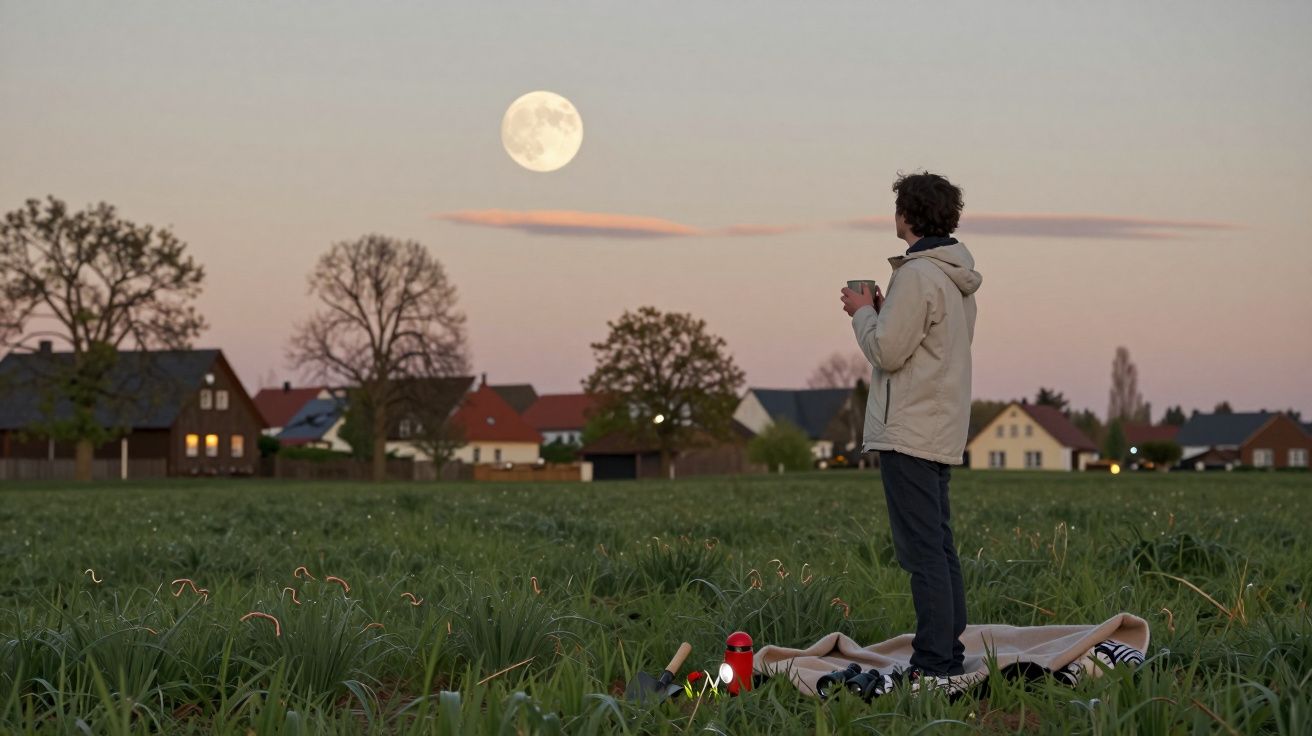
The first full moon of early spring is almost here again, bringing with it an oddly named tradition and a quietly optimistic nudge that the seasons are turning.
On the evening of 3 March, sky-watchers will see a crisp, bright full Moon lifting above the horizon. This one has a distinctly seasonal flavour: the worm moon, a name that ties the Moon’s monthly rhythm to the first signs of life returning to the soil - and, this year, to a dramatic lunar eclipse taking place thousands of miles away.
Worm moon: what it is and why it has that name
In straightforward astronomical terms, the worm moon is simply March’s full moon. There is nothing physically special about it: a full moon happens when the Moon sits opposite the Sun in our sky, so the lunar face we see is fully illuminated.
What is unusual is the wording. The name doesn’t come from modern astronomy at all, but from long-standing naming traditions in North America. Many Indigenous communities linked each month’s full moon to the seasonal changes they observed around them.
The worm moon signals the point when the ground begins to soften, worms return, and winter finally starts to loosen its hold.
As late winter gives way to early spring, the thaw encourages earthworms to move up through the warming soil. That churning helps loosen the ground, provides food for birds, and historically marked an important shift for wildlife and for people working the land. The full moon associated with that change became known as the worm moon.
So there is no extra gravitational pull, no promise of unusual brightness, and no secret cosmic “energy” attached to the date. Its importance is seasonal and cultural, rather than scientific.
When to see the worm moon on 3 March (and how to get the best view)
On Tuesday 3 March, the full Moon rises in the early evening. Across mid‑northern latitudes the pattern is similar, with local times varying by location; in central Europe, for example, moonrise is roughly 18:30, while the UK is typically about an hour earlier.
For the most striking view, aim for the minutes immediately after moonrise, while the Moon is still low.
Near the horizon, the worm moon can look enormous - not because it has grown, but due to a trick of perception known as the Moon illusion.
When the Moon appears close to distant reference points - trees, rooftops, hills, cranes, tower blocks - our brain judges its scale differently. The Moon is the same size in photographs, but in person it can feel far larger and more dramatic right after it clears the horizon.
Simple tips for watching the worm moon
- Choose a place with an open view towards the eastern horizon, away from tall buildings and dense tree lines.
- Head out 15–20 minutes before your local moonrise so your eyes can adjust to the fading daylight.
- Use binoculars if you have them: even a budget pair can reveal craters and the darker lunar maria (“seas”).
- Take a photo with a building, tree or landmark in the foreground to underline the Moon illusion and give a sense of scale.
A practical note: if you want timing that’s accurate to the minute for your street or garden, check a reputable weather app, the Met Office site, or an astronomy almanac for local moonrise and cloud cover. A thin band of low cloud on the horizon can delay the “first sighting” even if the Moon has technically risen.
Why astronomers don’t treat the name as “scientific”
Planetarium staff and professional astronomers are often asked whether the worm moon has any distinctive physical qualities. The answer is uncomplicated: it doesn’t.
March’s full moon follows the same kind of orbit and reflects the same sunlight as any other full moon. The Moon’s brightness and apparent size do vary a little through the year because its orbit isn’t a perfect circle - but that variation has nothing to do with worms or thawing ground.
The worm moon is a cultural label, not an astronomical category. It tells a story about Earth at least as much as it tells a story about the Moon.
For scientists, the phrase is a reminder that humans have studied the sky for millennia, connecting what they saw above with what was happening underfoot. For farmers and gardeners, the association still carries a practical hint: a full moon linked with softening soil is a prompt to start thinking about ground conditions, seed plans and the approaching growing season.
While Europe gets the worm moon, others see a blood moon
This year’s March full moon comes with an extra twist - but only for certain parts of the world. Before the worm moon rises for much of Europe, a total lunar eclipse will be visible elsewhere.
In a total lunar eclipse, the Earth moves directly between the Sun and the Moon. Earth’s shadow sweeps across the lunar surface until the Moon is fully covered. Rather than vanishing, the Moon often turns a coppery red, which is why people call it a blood moon.
On 3 March, western North America and eastern Russia see the blood moon. Most of Europe only gets the bright, fully lit worm moon after the eclipse has finished.
It all comes down to timing. Totality happens while the Moon is still below the horizon for large areas of Europe, so by the time it rises the eclipse has ended and the Moon looks like a standard full moon again.
If you’re outside the eclipse-viewing region, astronomy organisations and online observatories typically provide live streams, letting you watch the slow dimming - and the eerie red glow - in real time.
Worm moon vs blood moon: what’s the difference?
| Term | What it describes | Cause |
|---|---|---|
| Worm moon | Traditional name for the March full moon | Seasonal signs such as thawing soil and the return of worms |
| Blood moon | Informal term for a total lunar eclipse | Earth’s shadow plus sunlight filtered through Earth’s atmosphere tinting the Moon red |
A quieter sign that spring is close
Beyond the nicknames, the March full moon arrives at a turning point in the year. In the northern hemisphere, daylight is stretching quickly, and the Sun climbs higher at midday with each passing week.
Astronomical spring begins at the March equinox, usually around 20 March, when day and night are close to equal length. The worm moon typically arrives a little earlier, acting as a soft announcement. Even if snow showers still appear and frosts still sting, the natural world has already started to shift.
The worm moon’s message is understated: pay attention to the ground as well as the sky, because both are changing together.
Birds begin working the soil for insects and worms. Gardeners notice beds starting to loosen and winter mulches lifting as the ground breathes again. In older rural practice, this full moon often aligned with planning the first work of the year - long before tractors, satellite forecasts and phone apps took over.
One related point that often goes unmentioned: a bright full moon can also change the night-time landscape in practical ways. In darker rural areas it may improve visibility for an evening walk, while in towns its impact can be muted by light pollution - making a trip to a park, hill, beach or open countryside all the more rewarding.
How to turn the worm moon into a small ritual
For many of us, modern routines have largely broken the old link between lunar phases and everyday life. The worm moon is an easy excuse to rebuild that connection, even briefly.
On 3 March, a simple plan can help you join the dots between sky and soil:
- Take a short walk before or after moonrise and look for thaw signals: soft mud, fresh shoots, shifting birdsong.
- Watch the Moon climb and note how it often changes colour - from orange near the horizon to a whiter tone as it rises higher.
- If you have children, use the moment to explain how worms, birds and healthy soil fit into the wider story of spring.
For photographers, the worm moon is a dependable subject. Place a friend, a tree, a church spire or a city landmark in the foreground and wait for the Moon to rise behind it. A tripod and short exposure times help keep the lunar disc crisp - and the “supersized Moon” effect comes courtesy of perception, not camera tricks.
Key terms worth understanding
A few concepts come up repeatedly around this full moon. They may sound technical, but they’re simple once you put a name to them.
Moon illusion: A psychological effect that makes the Moon appear larger near the horizon than when it is high overhead. The Moon’s true size and distance do not change enough to account for the effect; instead, your brain recalibrates scale when it has buildings, trees and skylines as reference points.
Lunar eclipse: A lunar eclipse can only happen at full moon, when the Sun, Earth and Moon line up. With perfect alignment, Earth’s shadow fully covers the Moon (a total eclipse). With slightly imperfect alignment, only part of the Moon darkens (a partial eclipse). Unlike a solar eclipse, a lunar eclipse is safe to watch with the naked eye.
Equinox: Around 20 March, Earth’s tilt aligns so the Sun sits directly above the equator. Day and night are roughly the same length, and in the northern hemisphere this marks the official start of astronomical spring.
Viewed through these ideas, the worm moon shows how closely seasonal change, celestial geometry and human culture intertwine. The name may be a little unglamorous, but on 3 March it neatly links thawing soil, a shadowed Moon on the far side of the planet, and the familiar bright disc rising over your own local horizon.






Comments
No comments yet. Be the first to comment!
Leave a Comment