
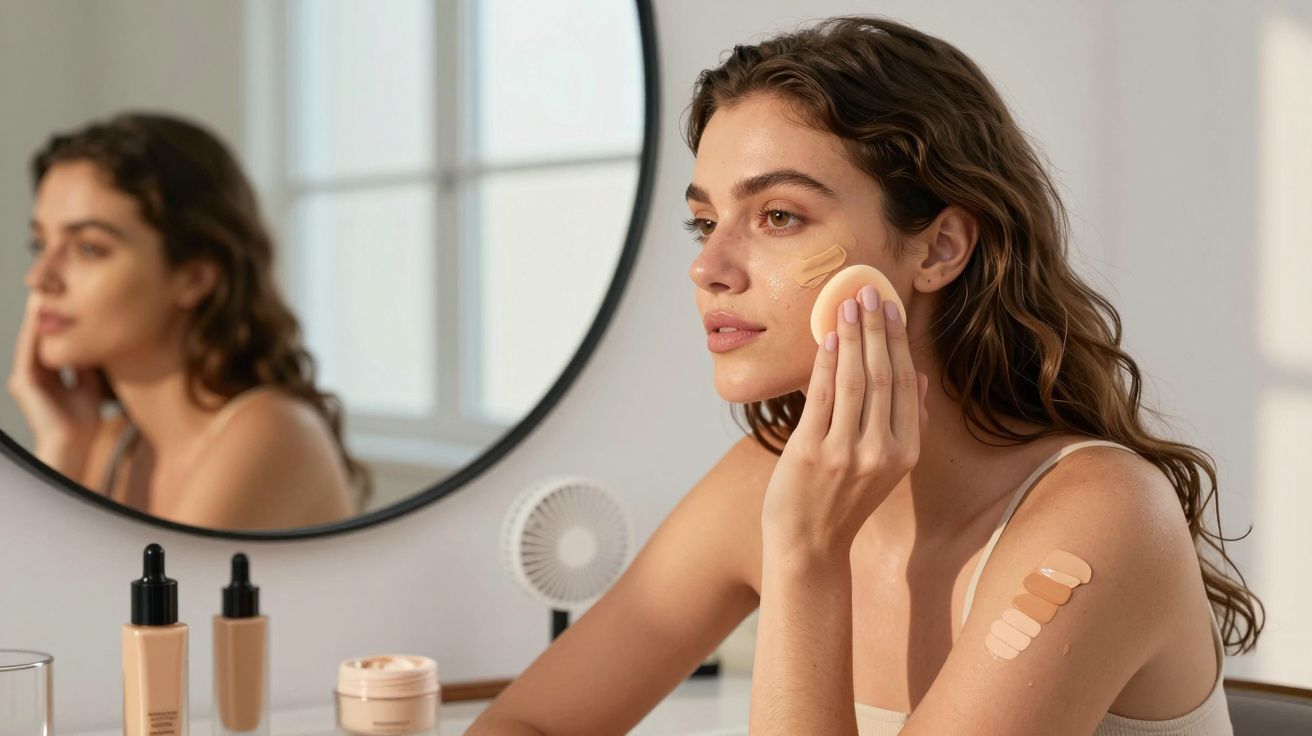
Often, the problem isn’t the product itself - it’s choosing the wrong type of make-up.
A truly flawless complexion should look like you simply have great skin, not like you’re wearing lots of make-up. That’s exactly where foundation can let you down in everyday life: patchiness, dry areas, a shiny T-zone, or a heavy, mask-like result. If you pick the right formula for your skin type and apply it with intention, a small amount of product can make you look noticeably fresher and more youthful.
Which Foundation type really makes skin look better
The key principle is simple: the best foundation is almost invisible. It should fuse with the skin, soften unevenness and still allow texture, freckles and natural freshness to show through.
The foundation that genuinely flatters the complexion is usually lightweight, flexible, easy to blend and suited to your own skin type.
A modern “skin-like” finish is most often created by these features:
- Light to medium coverage: Redness and blemishes look toned down, but the skin doesn’t appear “sealed in”.
- Liquid or creamy texture: It sits as a thin veil and moves with facial expression rather than cracking or caking.
- Skincare-minded ingredients: Hydrating agents, soothing components or anti-ageing elements improve comfort and wear.
- A flexible finish: Not extremely matte and not greasy-shiny - instead, a natural, lively look.
Day-to-day, the most reliable options are often products that do make-up and skincare at once: they even out the complexion without triggering new issues such as dehydration, excess shine or emphasised fine lines.
A note on shade matching (often missed)
Even the most flattering formula will look “off” if the colour is wrong. Test foundation along the jawline and check it in natural daylight (not only under bathroom lighting). In the UK climate - where skin tone can shift with seasons and heating can dehydrate skin - it’s worth rechecking your match a couple of times a year.
Which Foundation you’re better off avoiding if you want a beautiful complexion
Choosing well matters - but knowing what to leave on the shelf is just as important. Many make-up artists agree that overly rigid, heavy-coverage and very powdery formulas can be risky.
A foundation that highlights fine lines, makes pores stand out or leaves skin looking dull instantly removes freshness and can make the face appear older.
These are commonly problematic:
- Very heavy, full-coverage formulas: They can create a fast “mask effect” and tend to settle into lines and pores.
- Thick mousse textures: They may feel soft, but can visually “freeze” expression and draw attention to dry patches.
- Dry, strongly mattifying powder foundations: Particularly on mature, dry or sensitive skin, they can look flat, make lines more visible and drain the face of vitality.
Reaching for these to “cover everything” often backfires: irregularities can appear more obvious because the foundation shifts, separates or flakes as the day goes on.
The right texture for every skin type (Foundation guidance)
Normal to combination skin: the most flexible territory
If your skin is fairly straightforward, you can wear almost any texture. That gives you options - but it can also tempt you into overdoing it.
- Liquid foundation: Great for gently evening out the complexion; easy to build in thin layers without looking thick.
- Compact or powder foundation: Handy for topping up and for mild shine, as long as it isn’t formulated too dry.
- Finish to suit the day: A subtle glow when skin looks a bit dull; a soft semi-matte for everyday office wear.
A useful rule: reduce shine only where it actually bothers you - usually forehead, nose and chin - rather than flattening the entire face into matte.
Dry skin: hydration comes before coverage
If you’re prone to dryness, you’ll usually do best with a foundation that behaves more like skincare with pigment. Harsh powder particles or heavily mattifying formulas can quickly cause tightness and make flaky areas obvious.
Liquid or creamy foundations with plenty of hydration and gentle oils can make dry skin look smoother and fresher immediately.
What tends to work well:
- Liquid or creamy textures with hyaluronic acid, glycerin or plant oils.
- Light coverage, supported by targeted concealer on redness or post-blemish marks.
- Very little powder, if any - at most, a touch on the T-zone.
Trying to disguise dryness with high coverage usually does the opposite: every line and every flake becomes more noticeable.
Oily skin: mattify without suffocating the skin
Shine, enlarged pores and quick oil breakthrough can push you towards ultra-matt products. They may help in the short term, but over time they can stress the skin and make the finish look heavy.
Better choices include:
- Oil-free, lightweight liquid foundations that meld with the skin rather than sitting on top.
- Mattifying but finely milled powder used only where shine appears.
- Mineral powder that absorbs excess sebum without completely clogging the look of pores.
A completely flat, “dead-matte” finish can look dated and unnatural. A controlled, natural matte effect - with a little life left on the cheeks - tends to be far more flattering.
Mature skin: less powder, more lightness
As skin changes with age, it often becomes thinner, less firm and drier. Foundation shouldn’t amplify those shifts - it should visually smooth and soften.
On mature skin, professionals almost always reach for lightweight liquid textures and avoid thick mousse or powder foundations.
Most flattering here are:
- Very fine liquid formulas with skincare benefits and gentle light reflection.
- Medium, buildable coverage rather than trying to “pack on” full coverage immediately.
- Powder used sparingly, only on areas that truly become shiny.
Dry, high-coverage products can settle into fine lines and sharpen expression lines. A hint of radiance, by contrast, can make the face look instantly more awake.
Prep matters more than people think (a practical addition)
A “second skin” result starts before foundation. After moisturiser, give skincare a few minutes to settle so pigment doesn’t slip. If you use SPF (and you should), let it set too; piling foundation on immediately can encourage pilling. A light, compatible primer can help with longevity, but it’s not mandatory - the right moisturiser for your skin type often does most of the work.
More than make-up: Foundation as a skincare building block
Modern formulas go far beyond simply “painting over” the skin. Many now include:
- Hydrating ingredients such as hyaluronic acid to visually soften tiny dehydration lines.
- Anti-ageing ingredients such as peptides or antioxidants.
- UV filters that add an extra layer of everyday protection.
These products don’t replace a proper skincare routine or a dedicated sunscreen, but they can support the skin throughout the day while making the complexion look more even and healthier.
Application: how to create a “second skin” effect with Foundation
Even the best foundation can look unnatural if it’s applied like a mask. Technique is a huge part of the final result.
- Use less product: Dispense a small amount onto the back of your hand or a palette.
- Work from the centre outwards: Start around the nose, cheeks and centre of the forehead, then blend towards the edges.
- Choose tools to suit your preference:
- Fingers for a natural, sheer finish.
- A brush for precise, even distribution.
- A damp sponge for the softest transitions.
- Cover strategically rather than everywhere: Tap concealer only where needed instead of layering foundation all over.
- Use powder only in targeted areas: A light dusting over the T-zone is usually enough; don’t set areas that aren’t shiny.
If, at the end, you still look obviously “made up” in the mirror, press a slightly damp sponge over the skin to lift excess product and let more natural skin show through again.
Mistakes that make the complexion look older
A few common pitfalls show up in almost every make-up routine:
- The wrong undertone: Too yellow or too pink can make skin look unwell or patchy.
- Too much product around the eyes: This emphasises fine lines and makes the eyes look tired.
- No blend into the neck: A visible edge looks instantly artificial.
- Too much powder across the entire face: It removes freshness and leaves skin looking dull.
If you apply in thin layers and check how your skin looks in daylight between steps, the result typically looks far more polished - whether you’re using a high street or luxury product.
Why “coverage” and “finish” are so important
Many people focus on shade alone when choosing foundation. Two characteristics matter just as much: coverage and finish.
- Coverage describes how much of the skin’s natural look remains visible. Light coverage lets freckles and some redness show through; high coverage hides almost everything.
- Finish describes the surface effect on the skin: glowy, natural, semi-matte or strongly mattifying.
If you’re prone to blemishes, that doesn’t automatically mean you need maximum coverage. Often, light to medium coverage paired with targeted concealer is enough - and it looks much more natural while still calming the overall appearance of the complexion.
A lightly radiant finish can lift dull, tired-looking faces, but on very oily skin it can read as “too much” quite quickly. Semi-matte formulas sit in the middle and, for many skin types, are the most dependable option for everyday wear.




Comments
No comments yet. Be the first to comment!
Leave a Comment