
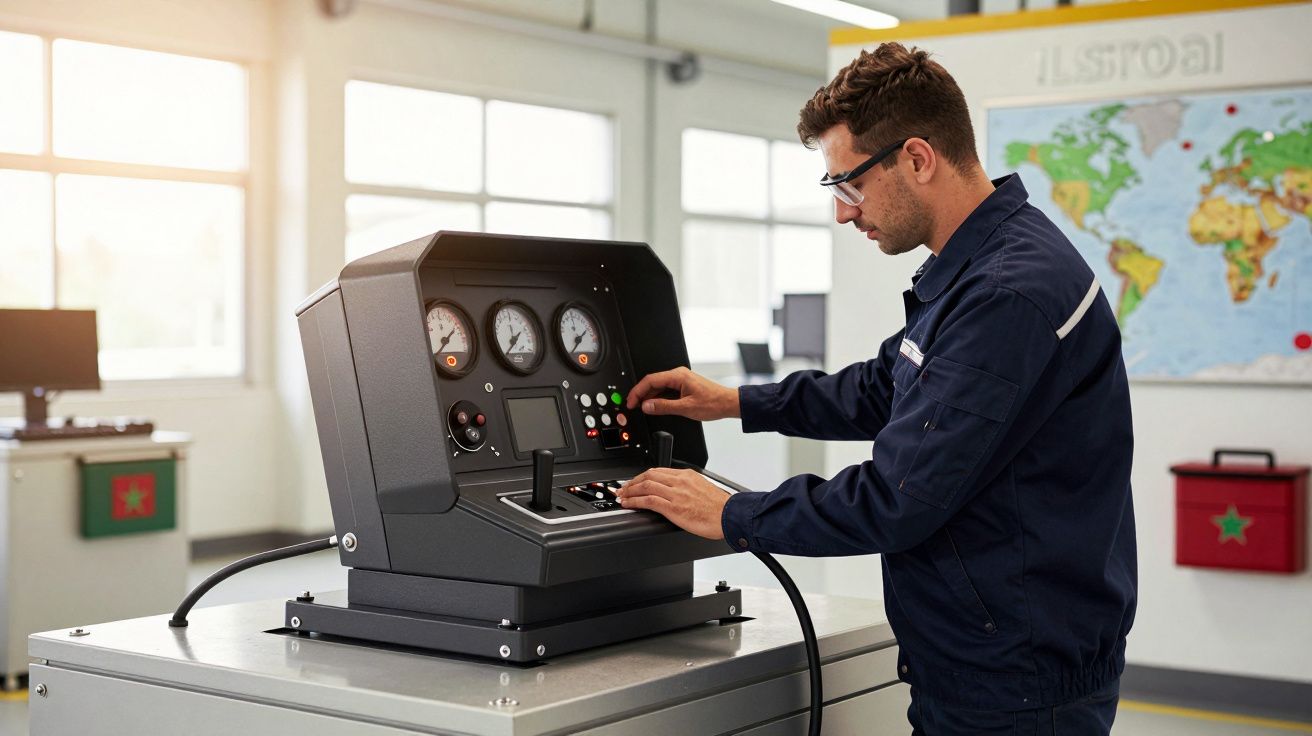
The city of Fez-long associated in visitors’ minds with its historic medina and the famous leather tanneries-has taken on a very different craft: manufacturing high‑precision rail electronics for Alstom, one of the world’s largest transport groups.
Fez lands a world first for Alstom train driving desks
Alstom has selected its Fez facility in Morocco to host the group’s first worldwide production line devoted exclusively to train driving desks. The programme represents an investment of about 100 million Moroccan dirhams (around €9 million) and elevates a site once seen as regional into a pivotal node on Alstom’s industrial map.
A driving desk is far more than a stylish dashboard full of screens. It functions as the train’s operational nerve centre, bringing together braking, traction, signalling, power management, climate control, and a growing stack of digital systems. In practice, every driver instruction is routed through a tight assembly of electronics, software and precision mechanical parts.
Train driving desks manufactured in Fez will be fitted to Alstom fleets on several continents, serving everything from high‑speed corridors to metro systems.
Creating a single global hub for such a critical subsystem is an unmistakable message: Alstom is placing trust in the Moroccan site to deliver technology that directly affects safety, reliability, and customer expectations across numerous countries-each governed by its own rules and certification regimes.
From component plant to strategic hub
Fez moves up the value chain
The Fez factory is building on existing capability rather than starting anew. Since 2020, it has been producing Mitrac™ rail transformers, equipment used to adjust voltage between overhead lines and on‑board systems. Those units already supply power for dozens of Prima locomotives, hundreds of Citadis trams operating in Rabat and Casablanca, and Avelia Euroduplex high‑speed trains running on the Tangier–Casablanca route.
With the addition of the driving‑desk line, Alstom is also doubling transformer capacity and establishing a local engineering office. This team will develop bespoke solutions, tailor products to regional standards, and provide project support for Alstom’s AMECA region (Africa, Middle East, Central Asia).
Fez is evolving from a straightforward manufacturing site into a technical base that unites design, production, testing and support.
That evolution is significant for Morocco’s industrial positioning. Instead of focusing mainly on assembling imported kits, specialists in Fez will contribute to requirements definition, software integration, and validation processes-work that has traditionally remained concentrated in long‑established European centres.
An additional implication is supply-chain capability: as Fez takes ownership of more complex modules, it can drive broader adoption of traceability, configuration control and documentation discipline across local suppliers-requirements that are non‑negotiable in safety‑critical rail systems.
Jobs, skills and long‑term presence
Alstom anticipates that the expansion will generate more than 200 direct jobs in Fez, including roles in:
- electronic and mechanical engineering
- precision assembly and wiring
- quality testing and certification
- technical support and industrial methods
Across Morocco, the group already employs around 1,400 people. Since 2020, total investment is approaching 200 million dirhams, and Fez is now described internally as strategically comparable to certain European sites that have historically dominated Alstom’s core activities.
Company leaders characterise the model as a form of shared industrial sovereignty: Alstom retains control over key components, while Morocco secures know‑how, higher value‑added employment, and a stronger position in the global supply chain.
Morocco’s wider industrial pivot
A magnet for heavy hitters
Alstom’s move aligns with a broader transformation in Morocco’s economy. Over roughly the last decade, the country has strengthened its role as a manufacturing bridge between Europe and Africa, supported by better infrastructure, trade arrangements and targeted industrial policy.
Recent announcements illustrate that the industrial base is diversifying steadily:
- BYD (China) is preparing a battery gigafactory in the Tanger Med area, with planned investment of more than 12 billion dirhams to supply electric‑vehicle batteries to Europe.
- STMicroelectronics is expanding its Bouskoura site near Casablanca to manufacture power semiconductors for electric and hybrid cars, with an estimated budget of 3 billion dirhams.
- Phosphate group OCP is investing over 130 billion dirhams in renewable power, green hydrogen, and low‑carbon fertilisers by 2027.
- The Moroccan aerospace cluster around Nouaceur is scaling up composite parts, engine components, and wiring harnesses for organisations including Safran, Boeing and Collins Aerospace.
- The Xlinks–Aman energy project plans to deliver green electricity from Morocco to the UK via a 3,800‑km undersea cable, with total costs exceeding 230 billion dirhams.
Within this context, adding rail equipment manufacturing gives Morocco another industrial lever. The combination of automotive, aerospace, electronics, chemicals-and now rail systems-creates practical cross‑sector synergies: precision machining, embedded software, power electronics, and test and validation capacity can serve multiple industries simultaneously.
From assembly line to innovation platform
For many years, multinationals tended to use Morocco largely as an assembly base, helped by comparatively lower labour costs and proximity to European markets. That pattern is changing. Initiatives such as Alstom’s in Fez bring in engineering work, prototype activities, and collaborative R&D with local universities and technical institutes.
This shift can reshape the talent pipeline. Engineers who previously felt compelled to pursue careers in Paris, Montreal, or the Gulf can now see credible pathways at home, building international careers from Casablanca, Rabat or Fez. At the same time, the presence of demanding customers encourages local suppliers to raise quality systems and meet tougher certification requirements.
One further benefit is resilience: as more engineering and test capability is anchored locally, Morocco can move from being a capacity provider to becoming a problem‑solving partner-particularly valuable when projects require rapid design adjustments or field support.
Alstom’s global strategy and Fez’s new role
Busy order book, diversified footprint
The Fez expansion is happening as Alstom benefits from strong global demand. Recent contracts include metro trains for Chicago, RER NG cars for the Paris region, new trams for Melbourne, an extension of the automated metro in Riyadh, and regional Coradia trains for the Netherlands, along with locomotive deals for Ukrainian Railways.
Alstom’s order backlog now exceeds €90 billion, supported by governments shifting travel from road and air towards rail as part of their decarbonisation agendas. Following the acquisition of Bombardier Transportation, Alstom operates major facilities across nearly every continent, often with clear site specialisations.
| Country | City | Main focus | Estimated staff |
|---|---|---|---|
| France | La Rochelle | High‑speed trains, Citadis trams | ~1,200 |
| Germany | Kassel | Traxx electric and hybrid locomotives | ~1,000 |
| India | Sricity | Metros for domestic and export markets | ~900 |
| United States | Hornell (NY) | High‑speed trains, refurbishments | ~900 |
| Morocco | Fez | Mitrac™ transformers, driving desks, engineering | ~500 (growing) |
Within this network, Fez is set to become the reference site for driving desks, shipping equipment to other Alstom plants where full trains are assembled. This approach reduces duplication, concentrates expertise and can accelerate development cycles for new rolling‑stock platforms.
Why centralise such a critical component in Morocco?
At first glance, concentrating a safety‑related subsystem in a single facility could appear to increase exposure. For Alstom, however, the decision reflects a combination of cost efficiency, logistics, and talent availability.
Morocco’s appeal is not limited to wages. Export routes are strengthened by ports-especially Tanger Med-supporting shipments to Europe, the Middle East and the Americas. Fibre‑optic connectivity and convenient time zones also make collaboration with European design offices more straightforward. In addition, engineering schools supply graduates who are accustomed to multilingual professional environments, able to work with documentation in French and English and to navigate international standards.
Fez sits at a crossroads where geography, skills and industrial policy align with Alstom’s need for a dependable, scalable hub.
To limit operational risk, Alstom can still retain backup expertise at other sites and mirror software repositories across regions. Even so, the physical manufacturing and final testing of driving desks will run through Fez-placing Morocco firmly within Alstom’s core business rather than on its fringes.
What this means for rail technology and local ecosystems
Shifting technology closer to emerging markets
Placing advanced rail component production in North Africa changes the picture for emerging markets. Countries in West and Central Africa, and across the broader AMECA region, can engage with a nearby hub rather than depending solely on European or Asian plants. That closeness can speed up after‑sales support and, over time, encourage greater regional alignment on standards.
The Fez facility will also be under pressure to keep pace with fast‑moving rail technology, including digital signalling such as ETCS Level 2 and beyond, data logging, predictive maintenance tools and strengthened cyber‑security layers. Driving desks are becoming increasingly software‑heavy, and customers frequently request tailored cab layouts, languages and ergonomics to suit local driver preferences and operating rules.
As a result, teams in Morocco will need ongoing upskilling. That may translate into joint training centres, formal certification pathways, and specialist laboratories for vibration, heat, electromagnetic compatibility, and safety testing.
Risks, opportunities and knock‑on effects
The approach also brings clear risks. Relying heavily on one site for a core subsystem can expose Alstom to political friction, supply interruptions or local infrastructure challenges. To counter this, the company is likely to keep alternative sources for certain parts and maintain detailed business‑continuity plans.
For Morocco, the key challenge is avoiding a middle‑income trap in which the country supplies skilled labour but fails to develop home‑grown champions. A practical route forward would be nurturing local SMEs that provide components, software modules or testing services to Alstom-then apply those capabilities across other industries.
The Fez case also prompts a wider policy debate in Europe, the UK and North America: how to maintain competitiveness in rail and clean‑mobility industries as production expands towards cost‑efficient partners such as Morocco. Some will argue for stricter localisation rules in public procurement. Others will view these hubs as part of a resilient, diversified supply chain that remains within a broadly aligned geopolitical sphere.
For the moment, what is built and validated in Fez will shape more than Morocco’s industrial future. It will influence how train drivers-from Chicago to Riyadh-interact with their cabs, and how passengers experience reliability on services promoted as the backbone of low‑carbon transport.






Comments
No comments yet. Be the first to comment!
Leave a Comment