
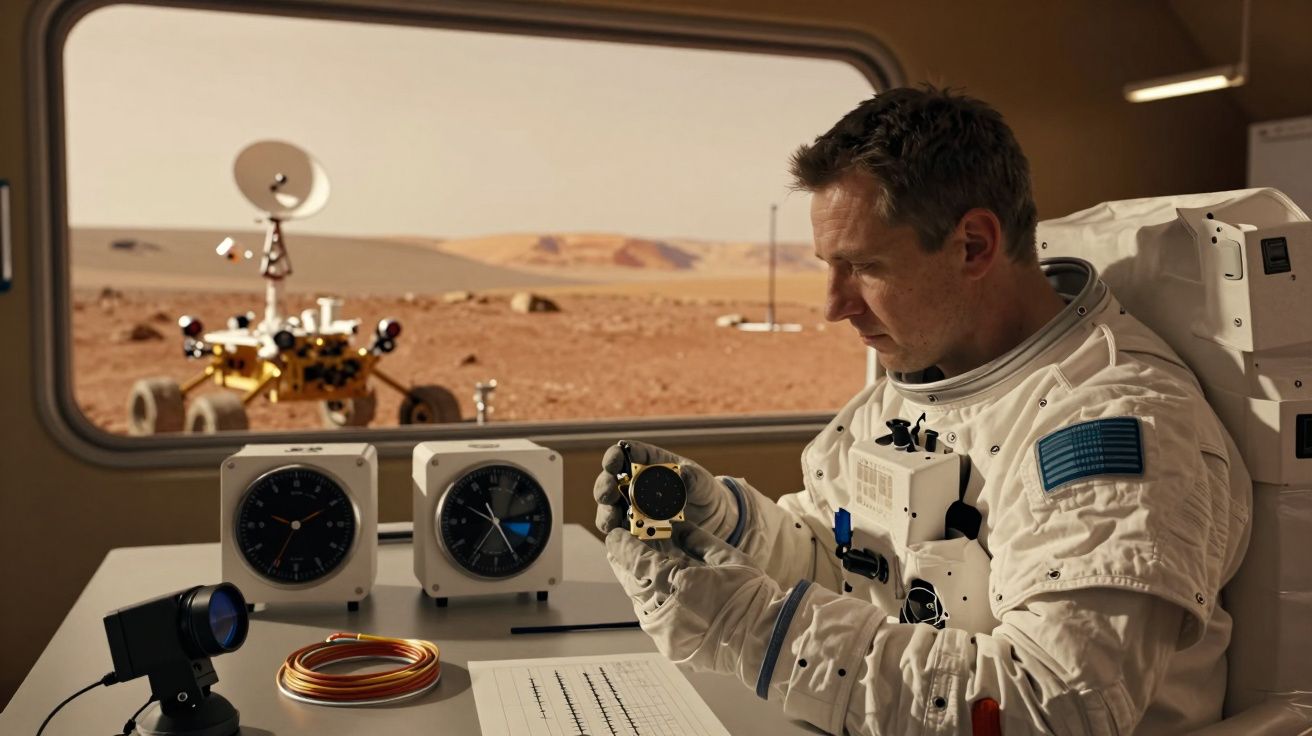
Far from Earth, even something as ordinary as a ticking second begins to drift out of step - and the knock-on effects are serious enough that engineers cannot afford to overlook them.
As plans for Mars travel shift from science fiction to mission architecture, researchers have now pinned down a fine detail that Albert Einstein set out more than a century ago: time does not pass at exactly the same rate everywhere. On Mars, the mismatch is small but persistent, and it is shaping up to be a decisive factor for navigation, communications, and long-duration human operations on the red planet.
From Einstein’s general relativity to a practical Mars time problem
On Earth, the second is realised with extraordinary accuracy using atomic clocks. That steadiness underpins systems as varied as satellite navigation, financial trading, and electricity networks.
Einstein’s general relativity, however, tells us that clock rates are not universal. Gravity and motion affect spacetime itself, so clocks at different locations - or travelling at different speeds - will not remain perfectly aligned.
In simple terms, stronger gravity makes clocks run a little more slowly, while weaker gravity allows them to run a little faster. On top of that, high speed shifts the tick rate as described by special relativity. In everyday life the effect is too small to notice, but it is measurable and, in precision engineering, unavoidable.
We already account for these shifts in Earth’s GPS: satellite clocks operate higher up (where gravity is weaker) and at orbital speed, so their timekeeping must be continually corrected against clocks on the ground.
Once you move away from Earth, “one second” stops being a single shared, absolute unit and becomes something that depends on the local environment.
Until recently, Mars lacked the same mission-ready level of precision. Physicists expected a difference, but they did not have a robust figure for its size - or for how it changes as Mars moves along its orbit.
What the NIST team measured about Mars time
Scientists at the US National Institute of Standards and Technology (NIST) developed a high-fidelity relativistic model of the Mars–Earth–Moon–Sun system. Using Einstein’s equations alongside precise orbital data, they calculated how clocks should diverge across worlds.
Their conclusion is straightforward: a clock on the Martian surface does not remain synchronised with an equivalent clock on Earth. On average, a surface clock on Mars runs faster.
Related reads
- A cleaning trick using everyday items to refresh washing-machine door seals
- A comforting, creamy meal idea for low-effort days
- “I feel emotionally tired but not sad”: what psychology says about this under-discussed state
- The major in-car device some drivers risk fines for not having
- A skywatching highlight: an evening when Mars is easy to spot with the naked eye
- A DIY hot-water setup producing around 3,000 litres per day without electricity, oil, or gas
- A kitchen hack involving salt and washing-up liquid
- Archaeologists uncover a mosaic linking the history of Rome and Ancient Egypt
Key findings from the model include:
- A clock on Mars gains about 477 microseconds per day compared with Earth.
- That offset is not constant: it shifts by as much as 226 microseconds depending on where Mars is in its elongated orbit (a variation of roughly ±113 microseconds around the average).
- The Sun’s gravity drives most of the effect, while Earth and the Moon add smaller corrections.
An extra 477 microseconds is under half a millisecond, which sounds negligible. The issue is that the discrepancy accumulates.
Over a 50-year stay on Mars, a person’s local clock would end up showing roughly nine seconds more than an equivalent span measured on Earth. That would not make anyone visibly age faster - but for technology that depends on timing down to nanoseconds, it is a significant divergence.
Tiny day-by-day offsets can grow into mission-scale timing errors, enough to push robots, spacecraft, and communications out of tolerance.
Why Mars time can make or break navigation and GPS-style systems
Navigation in the modern sense is, at heart, a timing problem. On Earth, GPS receivers calculate position by comparing signal travel times from multiple satellites. A timing error of 1 microsecond can translate into a location error of hundreds of metres.
If future interplanetary navigation and communications demand similarly strict timing, a Mars–Earth drift of hundreds of microseconds per day becomes untenable very quickly. Within days or weeks, estimates of where a rover is located - or where a spacecraft should aim a high-gain antenna - could wander beyond safe limits.
The risk is particularly acute for:
- Autonomous rovers operating with minimal real-time human input.
- Orbiters acting as relays between Mars and Earth, where communication opportunities can be narrow.
- Landing sequences, where timing slip-ups can mean missing the intended landing ellipse.
Because GPS already relies on relativistic corrections in Earth orbit, the NIST results indicate that any future “GPS for Mars” will need comparable corrections - not only within Mars’ local environment, but also when time is compared and exchanged between planets.
Engineers now have to build a timing network that stays coherent across worlds living under slightly different gravitational conditions.
Building a multi-planet clock network: Mars Coordinated Time, TAI and UTC
The study points towards an operational future where each major Solar System body keeps its own precisely defined time scale, all connected through a shared relativistic framework.
Earth already uses International Atomic Time (TAI) as a reference, packaged into civil standards such as UTC. Mars may ultimately adopt its own equivalent - often referred to in technical discussion as Mars Coordinated Time.
To make that practical, several components are likely to be required:
- Highly stable atomic clocks on Martian surface installations and in orbit.
- Relativistic models that update continuously to reflect changing gravitational conditions along Mars’ orbit.
- Conversion protocols that translate between Earth time and Mars time without introducing hidden accumulated errors.
- Backup approaches for re-synchronisation after outages, such as when a base or satellite temporarily loses contact.
Designers must also decide how to anchor Martian time geographically. Selecting a reference point - for example, a prime meridian close to a long-term landing site - would echo the role Greenwich plays in Earth’s timekeeping.
What this means for astronauts on the ground
Technical time scales are only half the story; human routines are the other. A permanent settlement on Mars would almost certainly follow a local clock and calendar based on the Martian day - the sol - which lasts about 24 hours and 39 minutes.
That could mean residents live by a sol-based timetable, while software and communications systems continuously convert local schedules into Earth time for calls, data transfers, and mission planning.
Future Martian residents may find themselves juggling three clocks: local sol time, Mars relativistic time, and Earth time back home.
Mission teams have already tasted this complexity. During rover operations, engineers on Earth have sometimes worked “on Mars time” for months, shifting their working day to match the daylight cycle at the landing site. Adding relativistic offsets makes the bookkeeping harder again, even if most of it is handled behind the scenes.
Key numbers behind Mars time
| Quantity | Approximate value | Why it matters |
|---|---|---|
| Daily offset on Mars | +477 microseconds versus Earth | The baseline difference every timing system must accommodate |
| Variation through orbit | ±113 microseconds (226 microseconds total range) | Corrections must change as Mars moves along its orbit |
| Human stay of 50 years | About 9 extra seconds on Mars | Shows how tiny effects accumulate over long durations |
| Typical GPS accuracy need | ~0.1 microsecond | Highlights how large the Mars–Earth offset is in comparison |
What “time runs differently” actually means: time dilation without the mystique
For non-specialists, terms such as “time dilation” can sound like science fiction. In reality, what matters here is rigorous accounting.
General relativity says mass curves spacetime. A clock deeper in a gravitational well - nearer a planet’s centre - ticks more slowly than one positioned further out. Motion adds an additional shift (from special relativity), changing the rate again for fast-moving clocks.
Engineers do not need to picture curved spacetime to work with it. They apply well-tested equations that forecast how a clock at a given place and speed will drift. What NIST has done is apply those equations to Mars with greater completeness and accuracy, producing figures suitable for real mission design.
For planners, the message is uncomplicated: there is no single universal “master time” that works everywhere. Instead, there are local times that must be reconciled using physics.
Risks, benefits, and what comes next
If these timing differences are ignored, small errors will quietly grow: trajectories will skew, signal arrival times may be interpreted incorrectly, and synchronisation between orbiters, landers, and surface assets could degrade until a critical moment exposes the problem.
The upside is equally clear. A solid relativistic timing framework enables new capabilities: swarms of autonomous rovers coordinating with tight precision, Martian telescopes timestamping observations so they can be compared directly with Earth-based instruments, and crewed spacecraft receiving rapid navigation updates during demanding orbital manoeuvres.
Two additional practical considerations are likely to emerge as Mars timekeeping matures. First, mission rules and safety cases will need explicit definitions for which time scale governs which decisions - for example, whether a landing sequence is driven by a local Mars time scale or by an Earth-referenced standard. Second, hardware procurement and certification may need shared standards so that clocks, radios, and onboard software from different agencies remain interoperable across the same relativistic reference frame.
The same approach will not stop at Mars. Lunar habitats, asteroid resource missions, and probes operating around Jupiter’s moons will each experience their own subtly shifted clock rates. Any future “Solar System internet” will ultimately depend on a coherent, fully relativistic timing architecture.
For now, the refined confirmation of Einstein’s prediction in the Martian context is a practical reminder: the universe does not adjust itself to human units. Before sending crews and large robot fleets across tens of millions of kilometres, agencies must agree on something deceptively simple - what, precisely, they mean by “now”.






Comments
No comments yet. Be the first to comment!
Leave a Comment