
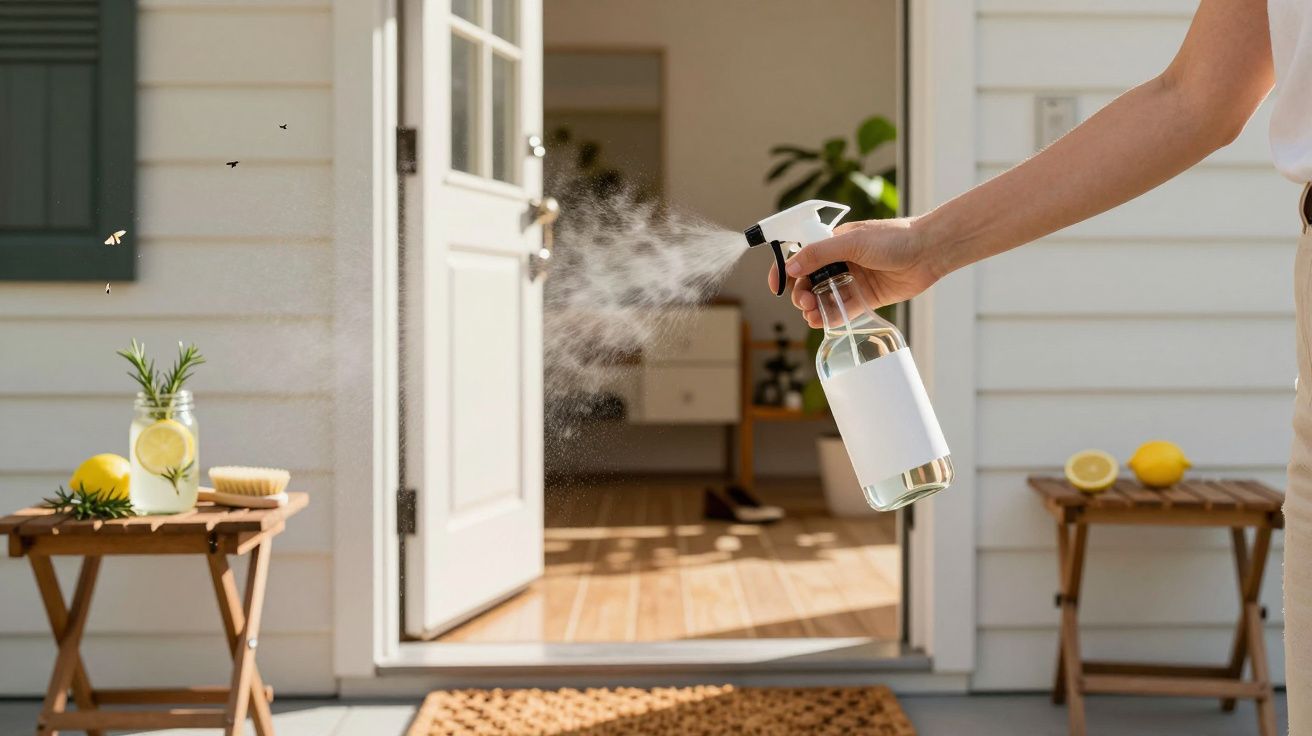
What began as a rather traditional cleaning tip has lately evolved into an unusual blend of pest prevention, odour control and even a form of “energy cleansing” carried out at the front door.
Why are people spraying white vinegar at the front door?
For decades, white vinegar has been a quiet workhorse in many kitchens, brought out to tackle things like ovens, kettles and bathroom tiles. More recently, it has moved from being a behind-the-scenes cleaner to something people use openly at the entrance-spritzed in the very spot where visitors (and the day’s dirt) first arrive.
Supporters of spraying vinegar at the front door usually point to three benefits:
- It helps deter insects at a key entry point.
- It can neutralise unpleasant smells around the doorway.
- It offers a simple, eco-conscious alternative to harsher repellents and fragranced sprays.
Some people also treat it as a small, repeated ritual-an easy way to “reset” how the home feels when they walk in.
Used at the front door, vinegar can function like a budget-friendly barrier: it discourages pests, freshens the air and marks a “clean slate” as you come inside.
How vinegar acts as a natural barrier against insects
In practical terms, the most noticeable impact is often on minor household pests. The sharp, acidic odour of vinegar is off-putting to many insects, and they frequently avoid spaces where the smell lingers.
Insects that commonly avoid vinegar (front door hotspots)
- Ants - They rely on scent trails to travel; vinegar can disrupt those routes and make the area less appealing.
- Spiders - Although they can be helpful predators, many people would rather not encounter them at the entrance; vinegar may discourage them from settling nearby.
- Cockroaches - Because they are sensitive to strong smells, they often keep away from places treated repeatedly.
This is why the doorstep and hallway are such common targets: they are the main “gateway” where insects can slip indoors via tiny gaps and edges around the frame.
The front door is a strategic first line of defence: treating it with vinegar can reduce the number of bugs that ever get inside.
How to use vinegar at the entrance
The approach is simple and typically costs very little compared with branded insect repellents or plug-in fragrance devices.
Basic spray recipe (white vinegar mix)
| Ingredient | Suggested ratio | Notes |
|---|---|---|
| White vinegar | 1 part | Choose plain distilled vinegar, not “cleaning vinegar” that contains added agents. |
| Water | 1–2 parts | More water means a milder smell and a lower risk on delicate finishes. |
| Optional: a few drops of essential oil | Per 250 ml of mixture | Lavender, lemon or eucalyptus can soften the vinegar scent. |
Tip the ingredients into a clean spray bottle. Give it a quick shake before each use-especially if you include essential oils, as they can separate.
Where to spray around the front door
Natural-cleaning specialists tend to suggest concentrating on places where insects are most likely to pass, hide or follow edges:
- Along the door frame, particularly the lower sections.
- On the floor just outside and just inside the threshold, as long as the surface can handle mild acidity.
- Into small cracks and gaps near the frame, where ants and similar pests often squeeze through.
- Along skirting boards and into darker corners near the entrance.
Always patch-test first in an inconspicuous area-especially if you have natural stone, untreated timber or fragile finishes. Vinegar can etch marble and, over time, may damage certain varnishes.
Front-door vinegar as an “energy cleaner” (white vinegar ritual)
Beyond its physical effects, vinegar has gained a second identity in some households: an “energy cleaner” for the home. In feng shui and other harmonising traditions, entrances are sometimes described as places where heavy or stagnant feelings collect-where the outside world meets the private interior.
From that perspective, the front door is not just timber, metal and locks; it becomes a symbolic filter. A quick spray on the frame or threshold is treated as a small act of renewal-like clearing yesterday’s atmosphere so the home feels lighter.
In household rituals, a vinegar spray can be viewed as rinsing away the emotional residue of the previous day before anyone walks further in.
Even if you do not subscribe to “energy” language, many people still value the psychological effect: pausing to spray, wipe and straighten the entrance can feel like a deliberate mental reset after work, school or a stressful commute.
Odours, cleanliness and why the entrance matters
The area by the front door often takes the brunt of everyday life: wet shoes, pet odours, cigarette smoke drifting in from outside, cooking smells from neighbours, and even damp in older communal hallways.
Vinegar is widely used because it can neutralise odours rather than simply cover them up. Its acidity reacts with certain molecules linked to bad smells-particularly those associated with smoke and cooking fats. A light, diluted spray near the entrance can help prevent that stale, shut-in smell that sometimes greets you the moment you open the door.
Some household surveys in German-speaking countries report people using vinegar at the entrance for several overlapping reasons-odour control, insect deterrence and environmental motivations. This mirrors a broader shift away from heavy chemical aerosols and towards multipurpose, biodegradable products.
Environmental and health angles of using white vinegar
Compared with many commercial sprays, white vinegar has an uncomplicated ingredient profile. It breaks down readily and typically does not leave persistent residues in the air or on surfaces.
For households with children, pets or allergies, that can be a persuasive point. Plug-in fragrances and many insect sprays may rely on synthetic perfumes or insecticides that can irritate sensitive lungs or skin. Vinegar does smell strong at first, but the odour usually fades as it dries.
However, it is not suitable for everyone. People with asthma or fragrance sensitivity can find the initial smell harsh. Better ventilation, a slightly higher water ratio and using fewer sprays at a time can make it more tolerable.
Potential risks and limits of spraying vinegar at the front door
Like any home remedy, it comes with practical boundaries:
- Surface damage - Avoid undiluted vinegar on marble, limestone, unsealed grout or waxed floors, as etching and dull patches can develop.
- Serious infestations - Vinegar might discourage the odd ant or cockroach, but it is not a substitute for professional pest control when there are clear signs of an infestation.
- Metal fittings - Heavy, prolonged use around certain metals (such as untreated brass hardware) can encourage corrosion.
- Overpowering smell - In a small, poorly ventilated hallway, start with a weaker mixture and fewer sprays.
Vinegar spray works best as a supporting habit-part cleaning, part prevention-rather than a cure-all for every entrance problem.
Practical scenarios where a vinegar-at-the-door routine fits
Consider a ground-floor flat near communal bins. Each spring, ants start appearing, and on warmer days the entrance can pick up a faint rubbish smell. Spraying diluted vinegar along the doorstep and skirting boards daily or weekly-alongside basic cleaning-may make the area less attractive to both insects and odours.
Or picture a busy family home with pets. The hallway gathers muddy pawprints, wet coats and sports shoes. A quick spray-and-wipe of the door frame and nearby floor after big outings can keep the first impression fresher, even before the rest of the house is properly cleaned.
Related habits that amplify the effect at the entrance
People who adopt the vinegar at the front door habit often pair it with other simple steps to improve results:
- Put down a durable doormat outside and a washable mat inside to trap moisture and dirt.
- Seal obvious gaps around the frame with caulk or rubber strips so fewer insects can squeeze through.
- Use a shoe rack or tray near the entrance to stop street grime spreading through the home.
- Place a small bowl of bicarbonate of soda nearby to absorb lingering smells, particularly in tight hallways.
Together, these create a modest but useful buffer: less dirt tracked in, fewer insects crossing the threshold, cleaner air and a smoother transition from outside to inside.
Extra pointers (timing, materials and pets)
If you are using vinegar primarily for insects, timing can matter. Many people find it most useful in warmer months when ants and cockroaches are more active; in winter, reducing frequency may be enough unless odours are the main concern.
It is also worth matching the approach to your doorway materials. Painted wood, sealed tiles and many uPVC surfaces usually cope well with a mild dilution, but natural stone and certain finishes do not. If in doubt, keep the mixture weaker and apply it to a cloth first rather than spraying directly.
If you have pets, avoid spraying where animals are likely to lick fresh residue. Although vinegar is generally low-toxicity, it is still unpleasant to taste and can irritate sensitive noses-better to apply lightly and allow the area to dry.
Terms and concepts worth unpacking
When people describe vinegar as an “energy cleaner”, it is usually metaphorical. They are often talking less about measurable physics and more about how a space feels once it has been aired, tidied and wiped down. With its sharp scent and strong association with deep cleaning, vinegar becomes a convenient symbol of that reset.
Technically, the key concept is simply acidity. Vinegar is a dilute solution of acetic acid, which is why it can help lift mineral deposits, soap scum and certain organic residues. That same cleaning logic is then applied to the frequently overlooked front-door zone.
Used with an understanding of its limits-and with care around sensitive surfaces-a modest spray of white vinegar at the entrance can be both a practical tool and a small daily habit that makes coming home feel a little easier.
Suggested reads (promoted links)
- Decathlon promotion: an electric mountain bike presented as a high-performance model with up to 184 km of range
- An old French château said to conceal a medieval tunnel network, reportedly found by chance during renovation work
- Ibuprofen and paracetamol: how everyday painkillers are described as central to a growing global health emergency
- Kate Middleton: wearing a long dress embroidered with Chantilly lace, she reportedly showcased her favourite accessory at a banquet with the American president
- Japan’s Defence Ministry says it spotted the aircraft carrier Liaoning near Japan
- “I never weed my gravel again”: the landscapers’ method many say everyone should know
- Why some people walk with their hands in their pockets, according to psychology-and why the habit can attract surprisingly harsh judgement
- Salt mixed with washing-up liquid: a home remedy claimed to solve a major kitchen problem






Comments
No comments yet. Be the first to comment!
Leave a Comment