
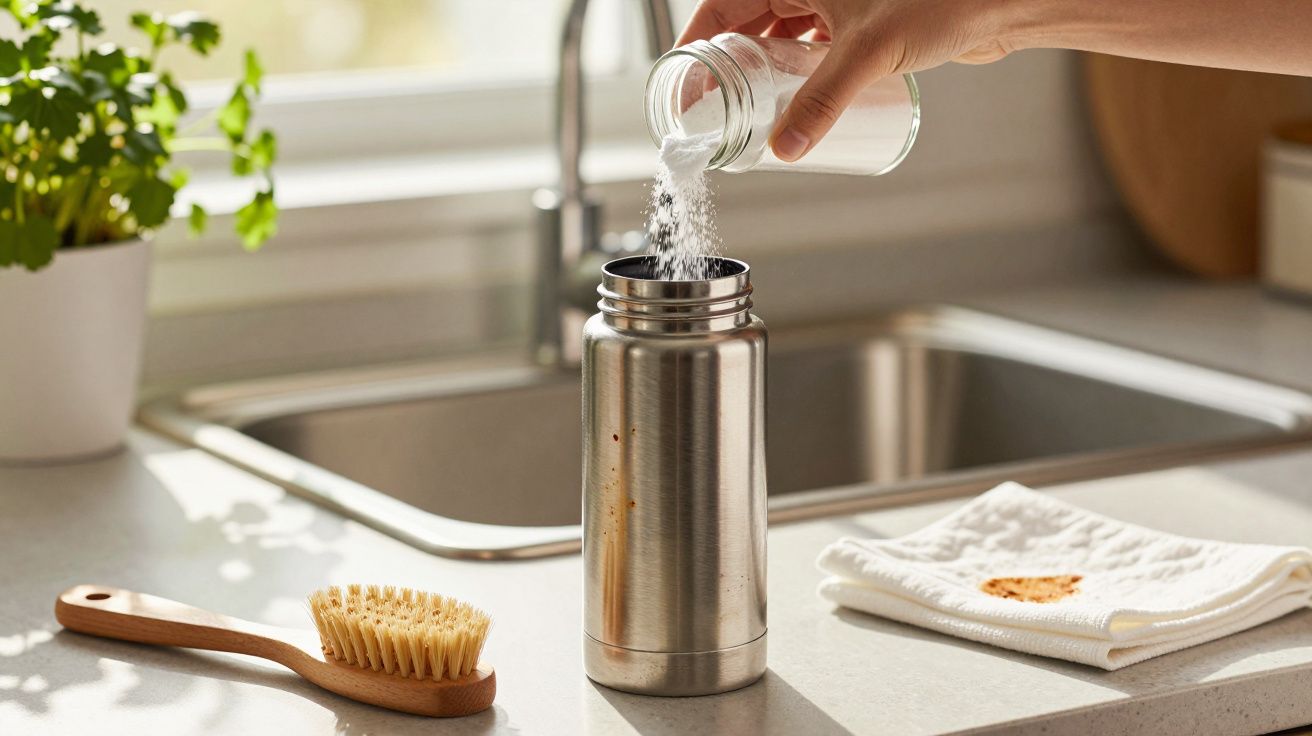
The first clue is nearly always the smell. You twist off the lid of your faithful thermos on a Monday morning, eyes still heavy with sleep, and a flat, stale coffee odour drifts up. The interior that used to gleam like brushed steel now looks faintly smoke-stained. Brown tide marks grip the sides. You rinse it with hot water, give it a vigorous shake, perhaps add a dab of washing-up liquid, and decide that counts as “clean”. Then, an hour later, your “fresh” brew tastes like it’s been reheated three times at a motorway service station.
That’s when you start thinking the whole bottle might be a lost cause and you should just replace it. The staining looks fused to the metal, as if it’s become part of the thermos itself. But between the sink and the cleaning cupboard, there’s usually a humble white powder waiting to do the heavy lifting.
Baking soda is ridiculously good at this.
Why coffee stains cling so stubbornly to your thermos
Coffee doesn’t merely tint stainless steel or plastic - it holds on. The natural pigments in coffee, known as tannins, behave much like a dye. Each drink left sitting in a thermos for more than a couple of hours leaves behind tiny residues you can’t see. Over time, those traces build into the familiar caramel-brown film. At first, you hardly notice. Then one day you lift the bottle towards the light and wonder how it got that bad.
And it isn’t just a cosmetic issue. That build-up quietly affects flavour. Green tea can pick up a faint coffee aftertaste. Water can start to taste vaguely bitter. Even when you can’t spot every mark, your brain still files it under “not quite clean”.
A nurse I know, powered by shift coffee, learnt this the unpleasant way. Her stainless steel thermos went everywhere: night shifts, train commutes, weekend trips. For months, she did nothing more than quick rinses between refills. One day she left it open on the table and her partner peered inside. “You’re drinking from that?” he said, genuinely appalled. The interior looked as though it had been varnished with brown lacquer.
She tried every obvious fix: extra washing-up liquid, boiling water, and a brush that barely squeezed through the neck. The outcome? The stain shifted from dark brown to a murky beige. The smell never really left. She decided the thermos must simply be “old” and permanently ruined.
There’s a straightforward reason those usual tricks fail. Coffee residue inside thermos bottles is a combination of tannins, oils and microscopic deposits that lodge into tiny imperfections in the steel or plastic. Hot water mainly shifts what’s fresh. Washing-up liquid targets grease more than pigment, and in a narrow bottle it often doesn’t reach every surface properly. Aggressive scrubbing can even scratch the interior, giving the next round of coffee more places to cling.
What you actually need is something gentle that both loosens the stain chemically and offers mild abrasion without damaging the surface. That’s exactly where baking soda comes in, quietly waiting in its little box at the back of the cupboard.
How to clean coffee stains from a thermos with baking soda (and make it feel “like new”)
The method is almost annoyingly simple.
- Empty and rinse: Tip out any leftover coffee and give the thermos a quick rinse with warm water.
- Add baking soda: Sprinkle in 1–2 tablespoons (roughly 15–30 g) of baking soda, enough to dust the base.
- Add very hot water and shake: Fill the bottle about halfway with very hot (not boiling) water, screw the lid on, and shake for a few seconds. You’ll often notice a soft fizz as it starts working.
- Top up and wait: Open it again and fill almost to the top with more hot water. Leave it for at least 30 minutes. For stubborn, long-standing stains, leave it for a couple of hours or overnight.
- Tip out and rinse: When you pour it away, don’t be surprised if the water looks like weak coffee - that’s the residue lifting out.
Those “internet hacks” that promise miracles and deliver nothing are familiar to all of us. Baking soda tends to be different: you can usually see progress. A reader once sent me before-and-after photos of an old camping thermos. Before: deep brown walls, almost matte. After an overnight soak with baking soda: the steel looked noticeably lighter, with silvery patches showing through again.
On their second go, they added a bottle brush. After leaving the hot baking soda solution for an hour, they scrubbed gently - especially around the curved base where stains love to hide. The remaining marks came away like softened paint. No harsh industrial cleaner. No eye-watering fumes. Just the plain supermarket powder doing its job.
Baking soda works so well thanks to a combination of chemistry and texture. It’s mildly alkaline, which helps break down coffee’s acidic compounds and loosen their grip. At the same time, the fine grains provide a very gentle scouring action that won’t scratch stainless steel. That two-part effect is why, the first time you rinse and see the brown film slide away, it can feel almost unreal.
Realistically, hardly anyone does this daily. But a baking soda clean every 1–2 weeks stops that thick, stubborn layer from forming at all. Your coffee tastes cleaner, and your thermos is far more likely to survive the winter without being binned out of frustration.
A quick note on those “you might also like” links
If you’ve seen odd suggestions popping up alongside cleaning tips, you’re not imagining it. They often look like this:
- This quick strawberry dessert comes together with only three simple ingredients
- How to use an eyebrow pencil correctly, according to pro make-up artists
- Mark Zuckerberg’s AI announcement shakes the global scientific community
- Supermarket tinned sardines have a surprising effect on the brain
- “I thought budgeting was about discipline, but it turned out to be about structure”
- When silence speaks volumes: what psychology reveals about people who speak little
- In 2008 China built metro stations in the middle of nowhere: we finally understand why
- Why putting a lemon in boiling water can help refresh a dull kettle
They’re not part of the cleaning method - just the sort of unrelated “related reads” that often get embedded around articles.
Small gestures, big difference: getting the most out of baking soda for your thermos
If you want to go from “improved” to “honestly impressive”, use a slightly more deliberate routine after the main soak. Tip out most of the liquid, leaving a small amount at the bottom. Add another teaspoon of baking soda and use a long-handled brush - or even a clean wooden spoon handle wrapped in a cloth - to gently work around the inner walls. Pay extra attention to the neck and the base curve, where residue tends to linger.
Rinse thoroughly with hot water until there’s no trace of white powder. Also clean the parts people forget: the lid and the gasket. Soak them separately in hot water with ½ teaspoon of baking soda, then rinse and leave them to air-dry.
If your thermos has a delicate inner coating or coloured lining, take it slowly. You don’t need to treat it like you’re sanding down a table. Longer soaks and gentle movement usually outperform heavy-handed scrubbing. And avoid combining baking soda with strong commercial cleaners - particularly bleach - inside a sealed bottle. You don’t need a miniature chemistry experiment in your sink.
One final step that matters more than people think: drying. Closing a thermos while it’s still damp encourages lingering smells and invisible biofilm. Once it’s clean, leave it open on the worktop for a few hours so air can circulate. Over months of daily use, this tiny habit makes a noticeable difference.
Two extra, often-overlooked points can help as well. First, if you regularly switch between drinks (coffee one day, squash or herbal tea the next), a quick weekly baking soda soak prevents flavour “ghosting” from one drink to the next. Second, check your lid seal now and then: old gaskets can trap odours even when the bottle itself is spotless, and replacements are often inexpensive.
“The first time I cleaned my thermos with baking soda, I thought I’d damaged it,” laughs Clara, a barista who tests travel mugs for fun. “The water poured out brown and cloudy. Then I rinsed it, and the inside was the cleanest I’d seen it since the day I bought it.”
- Use the right dose: Too little baking soda and you’ll barely notice a change; too much and you’re simply wasting it. One to two tablespoons for a standard thermos is the sweet spot.
- Let time do the work: Resist the urge to rush. The longer the solution sits (right up to overnight), the deeper it can work into old staining.
- Rinse and ventilate: Rinse with hot water and leave the thermos open to dry. This helps stop odours returning and keeps drinks tasting fresher.
Living with less residue: what a clean thermos quietly changes
A clean thermos isn’t flashy. It’s not a new gadget or a dramatic kitchen upgrade. Yet the benefit shows up in small, daily moments. Your first sip on the train tastes like the coffee you actually brewed, not like yesterday’s leftovers. Herbal tea doesn’t come with a stale espresso after-note. Even plain water tastes more neutral and less “off”.
If you carry a bottle everywhere, this little routine becomes a low-key act of care: you keep an item in use for longer, you throw away less, and you rely less on harsh cleaners packaged in plastic. All from the same basic powder many of our grandparents used for cleaning the sink.
So the next time you crack open your thermos and catch that faint sour edge, treat it as a reminder rather than a failure. A spoonful of baking soda, very hot water and a bit of patience can undo weeks of neglect. Those stains are proof of countless rushed mornings; cleaning them is simply a way to start again - without buying anything new.
| Key point | Detail | Value for the reader |
|---|---|---|
| Use baking soda soaks | 1–2 tablespoons in hot water, 30 minutes to overnight | Lifts coffee stains gently and improves taste |
| Combine soak and light scrub | Extra teaspoon plus a soft brush on walls and base | Tackles stubborn rings without scratching |
| Rinse and dry open | Hot rinse, lid off, air-dry on the worktop | Helps prevent odours and extends thermos life |
FAQ
Question 1: Can I use baking soda on any type of thermos interior?
Answer 1: It’s generally safe for stainless steel and many plastics, but take care with fragile inner coatings or painted interiors. If you’re unsure, test with a short soak first and avoid firm scrubbing.Question 2: How often should I deep-clean my thermos with baking soda?
Answer 2: If you use it daily for coffee, a baking soda clean every 1–2 weeks is usually enough. Quick rinses after each use plus this routine help stop stains becoming permanent.Question 3: Will baking soda remove bad smells as well as stains?
Answer 3: Yes. Baking soda is excellent at neutralising odours. A longer soak, a thorough hot rinse and air-drying with the lid off will usually clear sour or musty smells.Question 4: Can I mix baking soda with vinegar inside my thermos?
Answer 4: The fizz is satisfying, but the two largely cancel each other out. If you want to use vinegar, do it as a separate step rather than mixing it directly with baking soda inside a closed bottle.Question 5: What if baking soda doesn’t remove the stain completely?
Answer 5: Repeat the soak, extend it overnight, and add a gentle brush the next day. Very old staining may not disappear 100%, but it almost always fades and stops affecting flavour.





Comments
No comments yet. Be the first to comment!
Leave a Comment