
A comprehensive study carried out by the Technical University of Munich has helped settle the argument about which heating system is the best choice. The researchers compared 13 different heating systems, assessing both their financial value for money and their environmental footprint. The findings challenge several common assumptions.
With energy prices soaring and environmental concerns intensifying, selecting the right heating system has become a major decision. Homeowners are often left unsure when faced with the range of options on the market: heat pumps, pellet stoves, gas systems and more. Every installer tends to champion their preferred solution - but what holds up when tested properly? In a study published in 2024, a team of German researchers finally provides clear, practical answers grounded in scientific evidence.
A rigorous methodology that changes the picture for heating systems
The scientists took a thorough approach. To produce robust results, they simulated the operation of 13 different heating systems in a typical two-storey house. Their innovative method combines Life Cycle Assessment (LCA) to quantify environmental impact with Net Present Value (NPV) to evaluate economic viability. This paired analysis makes it possible to spot the solutions that perform well on both fronts.
The team factored in every major variable: installation costs, energy use, maintenance expenses, as well as CO₂ emissions and the consumption of natural resources. The modelling also incorporated expected shifts in energy prices and likely future changes to the German electricity mix.
Beyond the headline results, this kind of assessment is particularly useful because it looks past day-to-day running costs alone. A heating system can be cheap to operate yet costly to maintain, difficult to service, or environmentally intensive once manufacturing and resource use are accounted for - and those hidden trade-offs often drive the overall outcome.
Air-to-water heat pump with photovoltaics takes top spot for eco-efficiency
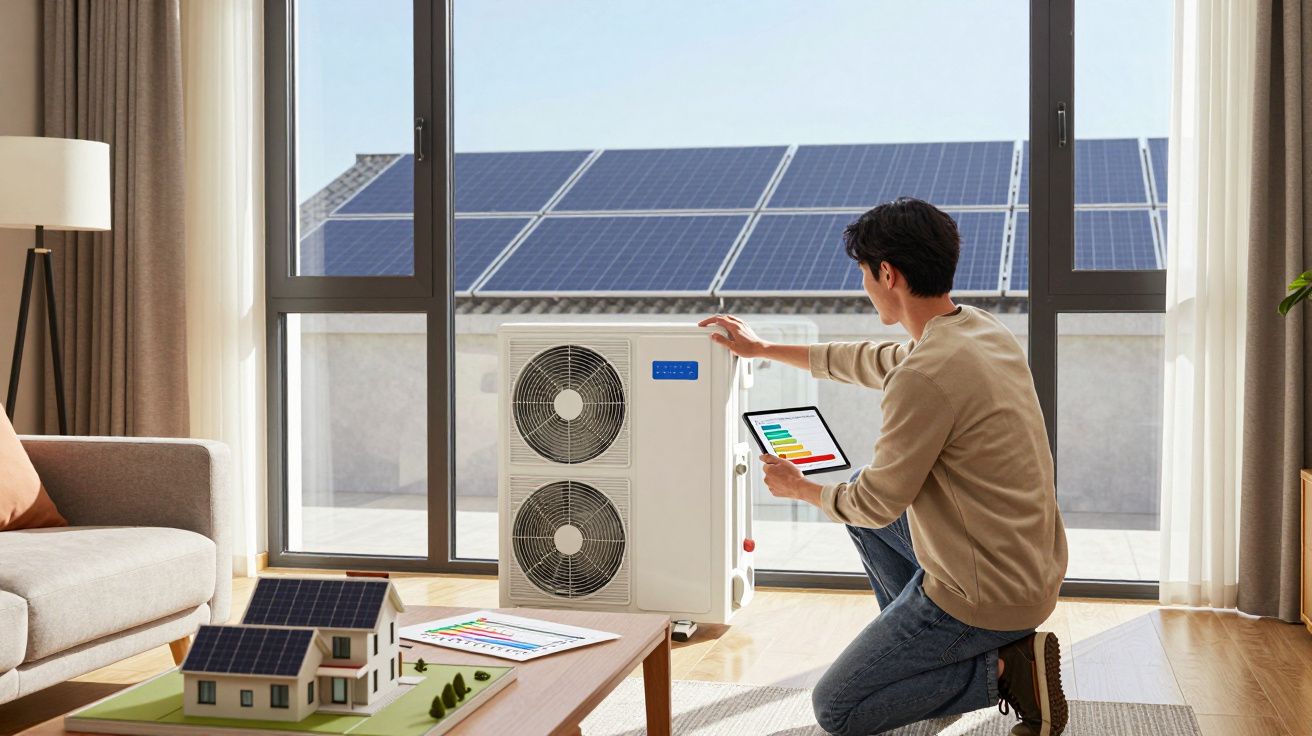
The conclusion is clear: the air-to-water heat pump paired with photovoltaic panels ranks first for eco-efficiency. Compared with the reference system (a gas boiler), it delivers a 17% lower environmental impact while also reducing costs by 6%. Even under the least favourable scenario modelled by the researchers, this set-up still outperforms many alternatives.
This strong performance comes down to a combination of advantages. First, an air-to-water heat pump makes highly effective use of heat available in outdoor air. Second, adding photovoltaic panels significantly cuts both the electricity bill and the system’s carbon footprint. The researchers also note that improving photovoltaic self-consumption - using more of the generated electricity on site - could push performance even further.
In practice, that means households may benefit most when the system is designed as a whole: appropriately sized panels, sensible controls, and a heating schedule that aligns demand with solar generation. When these elements are well matched, the heat pump–photovoltaics combination becomes not just cleaner, but more economically resilient over time.
Unexpected results in the eco-efficiency ranking of 13 heating systems
One surprise is the strong showing of the wood gasification boiler, which comes second for eco-efficiency. Its environmental impact is 42% lower than the gas boiler’s, although it costs 20% more. This result is largely linked to treating wood as a renewable resource - provided it comes from sustainably managed forestry.
By contrast, some systems often presented as especially “green” fail to impress. The pellet boiler combined with solar thermal and the heat pump with an ice storage tank deliver the weakest eco-efficiency performance. According to the researchers, the complexity of these systems and their high costs are not sufficiently offset by their environmental benefits.
Meanwhile, the gas boiler, although economical in everyday operation, is heavily penalised by its environmental burden. It produces the highest greenhouse gas emissions of all the systems analysed, even when paired with solar thermal panels.






Comments
No comments yet. Be the first to comment!
Leave a Comment