
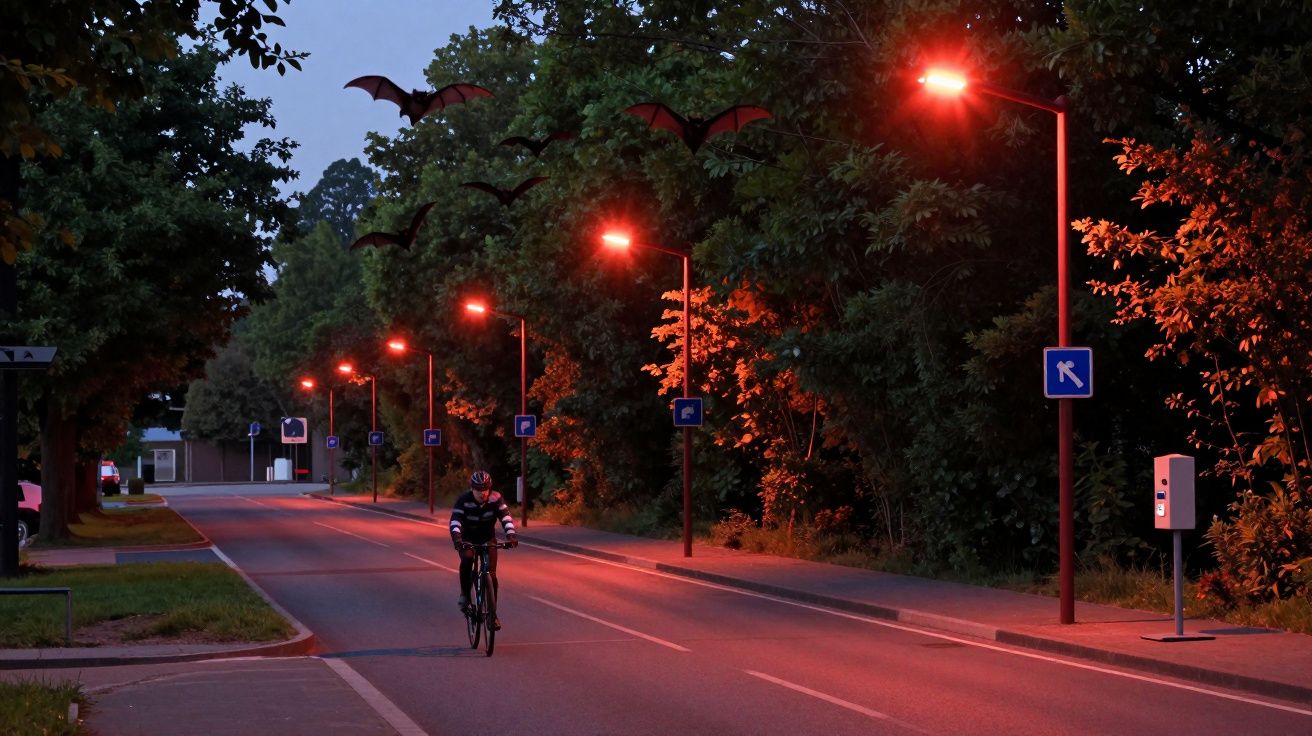
In Denmark, one municipality has opted to swap the white glow of its street lamps for red lighting. The aim is twofold: to shield nocturnal wildlife-highly vulnerable to light pollution-while also cutting the city’s energy use.
Since 8 February, drivers in Gladsaxe, a small municipality on the outskirts of Copenhagen, have watched Frederiksborgvej (one of the main roads running out from the capital’s centre) take on a striking, bright red hue. The former lights lining the road have been replaced to prevent the carriageway being washed in the familiar white-blue halo produced by LED systems now commonplace across European towns and cities.
Across much of Europe, white light is generally favoured primarily for road safety. The drawback is that this part of the spectrum can be a major source of light pollution for certain nocturnal animals. In effect, it is an example of post-Anthropocene urban design: the city adjusting to the animal kingdom, rather than expecting wildlife to adapt to the city.
A wall of light: a nightmare for bats along Frederiksborgvej
The road runs beside dense woodland areas that are home to two particularly vulnerable bat species: the common pipistrelle (Pipistrellus pipistrellus) and the brown long-eared bat (Plecotus auritus). For these flying mammals, conventional white LED street lighting is profoundly disruptive.
Bat vision is extremely sensitive to short wavelengths (blue and ultraviolet). Because white LED lighting is rich in blue light, it can overwhelm their retinal receptors. For these species, crossing a bright “curtain” of light means risking exposure to natural predators such as the kestrel or the long-eared owl.
So, while the space around Frederiksborgvej may be physically open, it becomes biologically closed: bat colonies end up effectively boxed in along the road. Unable to reach roosts or feeding grounds, the landscape loses ecological permeability, trapping them in narrow vegetation corridors that are very difficult to escape.
Gladsaxe bat-friendly red lighting: a truce between tarmac and forest
In standard white LED lighting (street lamps and other luminaires), a diode emitting blue light (around 450 nm) is used to excite a phosphor layer, which then produces the other colours. This blue component is what drives bats’ light avoidance.
Gladsaxe therefore chose to replace the old street lamps on Frederiksborgvej with new fittings using monochromatic red LEDs. The output is concentrated only at wavelengths above 620 nm. As bats lack photoreceptors sensitive to long wavelengths, they barely register this light and can finally cross the road when they need to.
Human vision, by contrast, detects red very effectively because the retina contains L-cones specifically tuned to longer wavelengths. Motorists can therefore continue to drive safely, even though the same area may appear almost entirely dark to bats flying overhead.
Beyond bats, this sort of spectral change can also influence other night-active species and the wider night-time ecosystem. By reducing the blue-rich component linked to light pollution, red lighting can help restore darker conditions along green corridors-an approach increasingly used where roads slice through habitat networks.
To make such measures credible and scalable, outcomes need to be tracked over time. Monitoring bat activity, collision risk, and driver visibility along Frederiksborgvej helps ensure that the intervention genuinely improves ecological connectivity without compromising road safety, and provides evidence for other councils considering similar upgrades.
Part of a wider European programme for smart lighting and sustainable mobility
This urban initiative sits within the European programme Lighting Metropolis – Green Mobility, a cross-border cooperation project in the Greater Copenhagen region, covering eastern Denmark and southern Sweden (Scania). Its ambition is to position the region as a global leader in smart lighting and sustainable mobility, using innovative LED applications to improve urban safety while saving energy.
Why not bring the idea to France?
So what is stopping decision-makers from bringing this kind of thinking to France? Upgrading public street lighting-now largely outdated across much of the country-is a modest price compared with the services bats provide. By naturally helping to curb mosquito populations (among other benefits), these much-maligned mammals support public health and deserve cities designed with their way of life in mind.






Comments
No comments yet. Be the first to comment!
Leave a Comment