
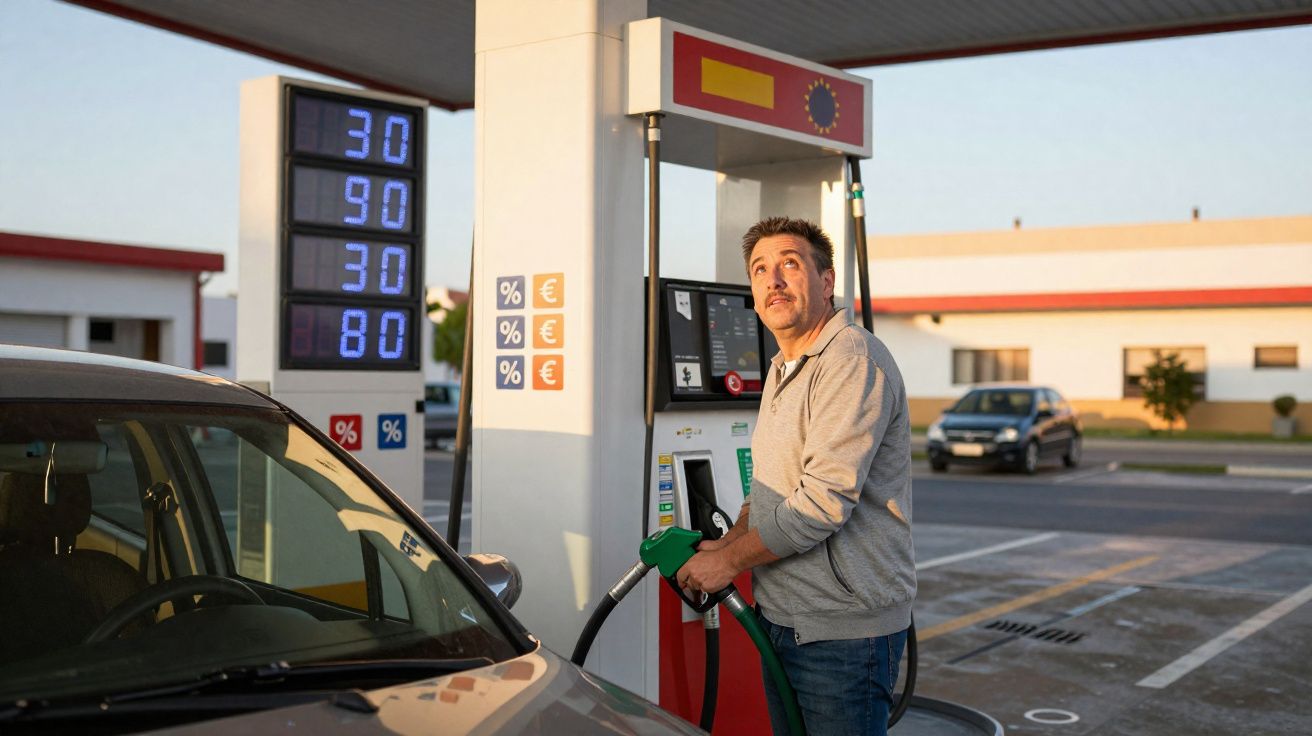
Since the conflict in Iran began, energy and fuel prices have surged at speed across much of the world. To soften the blow for households and businesses, many countries are rolling out mitigation measures - but Spain, just next door, has gone further than most.
Even though it was among the slower countries to respond to rising prices, Spain set out this week one of the broadest packages yet to tackle the increases, with measures that can deliver savings of up to 30 cents per litre.
To achieve that sizeable cut, Spain’s Council of Ministers approved a plan worth more than €5 billion, in force until 30 June. One of the standout actions among the 80 measures announced by Pedro Sánchez’s government is a reduction in VAT on all forms of energy (fuel, natural gas and electricity) from 21% to 10%.
Sectors most exposed to the crisis - hauliers, farmers and fishers - also receive an extra discount of 20 cents per litre on professional diesel.
Other taxes have been reduced or suspended too, including a special duty on hydrocarbons. The Spanish government’s package also covers taxes linked to electricity production and consumption, and it forecasts a 13% reduction in electricity bills.
Fuel prices in Spain: how much are petrol and diesel?
If fuel in Spain was already typically 15–20 cents cheaper per litre than in Portugal, the new measures have widened that gap considerably. Since the measures were introduced last weekend, the average price of standard diesel has fallen by 17 cents per litre to 1,772 €/l, while petrol has dropped by 21 cents per litre to 1,579 €/l.
Compare the average fuel prices between Portugal and Spain yesterday, 24 March:
Based on the average prices in both countries, filling a 50-litre tank in Spain brings a direct saving of more than €17 on petrol and more than €14 on diesel, compared with Portugal.
Portugal also has a "tax discount"
Spain’s "tax discount" is sizeable, but Portugal is also using the same type of tool, applied to ISP (Tax on Petroleum and Energy Products) and VAT. Since the conflict began, the government has announced an increase to that extraordinary discount, which stacks cumulatively against the reference price recorded on 6 March. The total, however, is far smaller than in Spain: 4,7 cents per litre on standard petrol and 9,3 cents per litre on standard diesel.
In Portugal, from the start of the conflict up to last Monday (23 March), standard diesel has already built up a rise of 41,1 cents per litre, and standard petrol of 21,7 cents. In Spain, with the latest measures already included, those figures are 33,3 cents per litre and 9,7 cents, respectively.
In addition, the Portuguese executive announced an extraordinary mechanism for professional diesel, providing an extra rebate of 10 cents per litre, up to a maximum of 15 thousand litres per vehicle, for three months. The government also said it will increase the subsidy for the solidarity gas bottle to €25, likewise for a three-month period.
What other European countries are doing
Portugal and Spain are not alone in introducing measures to cushion the rise in fuel prices. Germany, for instance, is planning to ban price increases more than once per day, fixed at midday, while simultaneously maintaining its boycott of Russian gas.
In France, the oil company TotalEnergies has taken the lead, voluntarily capping prices at its stations. Italy has chosen to use the surplus VAT revenue to compensate consumers, and it has also announced penalties for companies that inflate profit margins during the crisis.
Outside the European Union, the United Kingdom has introduced two higher-impact steps: freezing electricity and gas bills until the end of June - an average saving of £117 (around €135 at the current exchange rate) per household - and a fund of more than £53 million (€61 million) aimed at families that rely on oil heating.
Outside Europe: more drastic measures
Energy scarcity is pushing several Asian nations into actions that, until recently, would have seemed unthinkable. In Sri Lanka, the public sector is closed every Wednesday and fuel has been rationed: cars are entitled to only 15 litres per fill-up and motorbikes to just five litres. In Myanmar, the response has been different but just as striking: private vehicles may only circulate on alternate days, determined by the registration number.




Comments
No comments yet. Be the first to comment!
Leave a Comment