
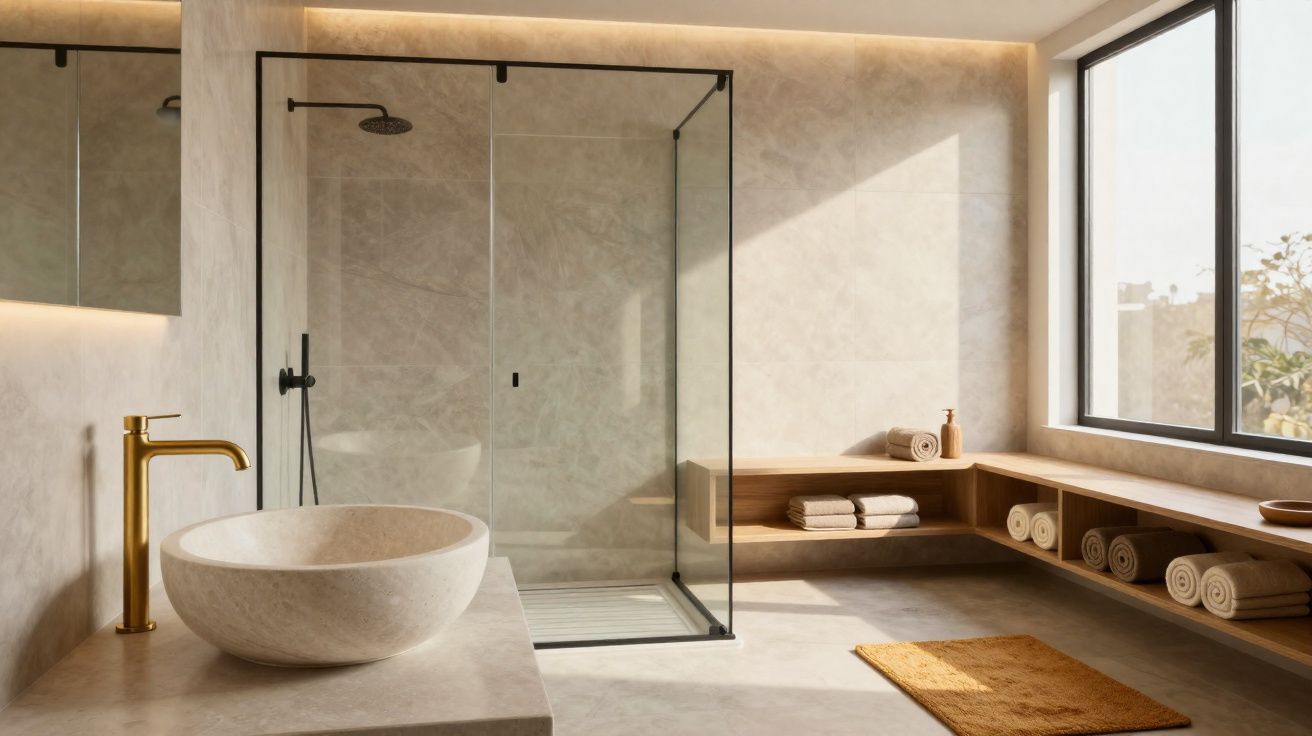
Many bathrooms look clean yet feel dated - and it often takes only a few well-chosen updates to turn the room into somewhere you actually enjoy spending time.
Wall tiles right up to the ceiling, harsh fluorescent lighting and absolutely no spa atmosphere: that’s still the reality in countless bathrooms across German-speaking Europe. If you’re planning to rip everything out for 2026, you could spend a lot for surprisingly little payoff. The newest bathroom trends focus instead on smart, targeted improvements that build on what’s already there and upgrade it deliberately.
Why a new way of thinking about the bathroom is taking hold
The bathroom is shifting from a purely practical space to a room where you can pause, breathe and genuinely feel comfortable. At the same time, energy bills and labour costs are rising, and booking skilled tradespeople is harder than ever. As a result, both homeowners and tenants are looking for ideas that meet two clear requirements:
- as little mess and noise as possible
- as much visual change and comfort as possible
That is exactly what the bathroom trends for 2026 deliver. Instead of full strip-outs, the emphasis is on overlay systems, well-chosen materials, and thoughtful lighting and textiles.
"If you want your bathroom to feel modern over the next few years, don’t start with a sledgehammer - start with a plan."
Trend 1: Low-joint surfaces and a slip-resistant floor
In many bathrooms, the biggest mood-killer isn’t the suite - it’s the grout: darkened, cracked and difficult to keep clean. New surface systems tackle that problem without needing to remove the existing tiles.
Continuous coatings rather than piecemeal fixes
Microcement, mineral resins or engineered wall panels can be applied straight over existing tiles. The result is an almost joint-free surface on walls and, in some cases, the floor as well.
- Less mess: No tile demolition, minimal rubble and a much shorter project timeline.
- Less cleaning effort: Fewer joints means fewer places for dirt and mould to build up.
- A contemporary finish: The look of concrete, stone or plaster without the clinical “wall of tiles” effect.
In small bathrooms, this can be a game-changer: uninterrupted surfaces make the room feel larger and noticeably more premium.
Slip-resistant tiles with personality
Flooring is worth reconsidering too. Many older bathrooms have smooth tiles that become slippery when wet. The 2026 direction is clearly towards textured surfaces, combining two advantages:
- improved safety for children, older people or anyone with reduced mobility
- visual zoning - for instance, by using different stone effects to define areas
Matt natural-stone looks and porcelain tiles with a lightly grained finish are especially popular. If you want more character, subtle patterns (such as a checkerboard) or gentle tonal shifts can visually pick out walking routes or the shower area.
Trend 2: XXL panels for 2026 bathroom trends - a new look without demolition
Another powerful update comes from large-format wall panels that can be bonded directly over old tiles. These boards read as an elegant lining, while avoiding the tedious work of chiselling everything off.
Common finishes include:
- a finely veined “marble” look
- rugged stone or slate effects
- soft concrete in warm greys
- wood designs that look like real timber but are water-resistant
These panels are particularly effective for upgrading three areas quickly:
- the shower back wall
- the wall behind the basin
- one or two feature walls in the room
"An afternoon can be enough to turn an ‘80s bathroom into a modern spa look - without throwing the tiles away."
Trend 3: A styled washbasin area instead of a boring standard unit
The basin area has become a focal point rather than a purely functional fixture. For 2026, the look is a blend of furniture-like presence, visual lightness and everyday usability.
Floating units and open frames
Wall-hung vanity units keep the floor clear, which brings two benefits: the room feels more spacious, and cleaning is easier. As an alternative, slim metal frames are becoming more common, giving the basin area a designer feel.
Popular combinations include:
- slender metal legs in black or brass
- worktops in natural-stone or engineered-stone looks
- simple countertop basins
With careful planning, you can also incorporate accessibility: slightly lower working heights, wheelchair-friendly clearance beneath the basin, or side ledges that are genuinely useful day to day.
Mixed materials with a living-room feel
One strong direction is unmistakable: materials associated with living spaces are moving into the bathroom. Exposed metal frames, warm wood-effect fronts and stone surfaces make the “washing zone” feel more like a piece of furniture than a utility corner. Complementary wall colours include softened whites, sand tones or sage green.
Trend 4: A level-access shower as a comfort upgrade
The traditional shower tray with a high step is gradually disappearing from new builds - and there are also ways, even in existing bathrooms, to get closer to a level-access feel.
Typical features of the 2026 look:
- low, almost invisible transitions instead of noticeable steps
- continuous flooring that visually enlarges the space
- open shower areas rather than tight enclosures
- integrated benches or niches for storage
Benches can be finished with hard-wearing materials such as marine-grade vinyl or porcelain tiles, keeping them easy to maintain while still comfortable. A hand shower on a riser rail adds flexibility - helpful for washing hair, and also for anyone who prefers to shower while seated.
"The level-access shower has become the symbol of a modern bathroom - it stands for comfort, accessibility and visual calm."
Trend 5: Taps, lighting and textiles as the real game-changers
The fastest transformations often come from the details you touch every day and see constantly.
Taps as statement pieces
Standard chrome is losing its dominance. Many brands are leaning into jewellery-like finishes:
- matte black
- brushed steel
- warm brass or bronze tones
Unlacquered brass is particularly interesting, as it develops a patina over time. The result feels richer and more personal - a long way from the clinical hotel-bathroom look of earlier years.
Lighting and textiles that set the mood
A single ceiling fitting can make any bathroom feel stark and cold. A more on-trend approach layers several types of light:
- glare-free ambient lighting on the ceiling or wall
- focused mirror lighting, ideally via fittings on both sides
- accent lighting, for example behind the mirror or beneath the vanity
Warm colour temperatures remove the chill from the space. Add to that bold towels and bath mats in deeper shades such as teal, rust, dark green or burgundy. If you like a vintage touch, an oriental-style rug can work too - provided ventilation and upkeep are handled properly.
How to plan your bathroom update up to 2026, sensibly
Before you book the first tradesperson, it helps to set clear priorities. One practical approach:
- Identify the biggest frustration (for example, grout lines, lighting, a basin that’s too small).
- Set a budget - including a buffer of around 10 to 15 percent.
- Decide which surfaces will stay and only be refinished or covered.
- Create a colour and materials concept that suits the rest of the home.
- Only then choose products and contractors.
Working step by step helps you avoid the classic mistake of trying to change everything at once and getting lost in the details. Often, two or three targeted measures are enough to turn a tired existing bathroom into a space that still feels current in 2026.
What terms like “microcement” and “slip-resistant” mean in practice
A lot of trend vocabulary sounds technical at first. Two examples that come up repeatedly during planning:
- Microcement: A thin, high-strength coating applied over tiles, screed or plaster. It creates a concrete-like appearance, can be tinted to different colours, and needs proper sealing to protect against moisture.
- Slip-resistant tile: A tile with a defined level of grip, typically marked with an R rating. In private bathrooms, mid-range classes are usually appropriate, offering security without feeling like sandpaper.
If you’re unsure, order samples and test them barefoot when dry and when wet. Real life matters more than a brochure photo.
Risks to keep in mind
As tempting as quick changes can be, a bathroom is a wet room with technical demands. When coating over existing tiles, the substrate’s stability is crucial. Loose tiles or hollow spots must be repaired first - otherwise cracks can develop later.
Lighting also needs proper planning: sockets, luminaires and switches must comply with bathroom safety zones. If you have any doubts, bring in a qualified electrician early, before walls are closed up or covered.
Keeping these points in view makes it far easier to use the bathroom trends for 2026 to transform a plain functional room into a space that energises you in the morning and calms you at night - without a full strip-out.


Comments
No comments yet. Be the first to comment!
Leave a Comment