
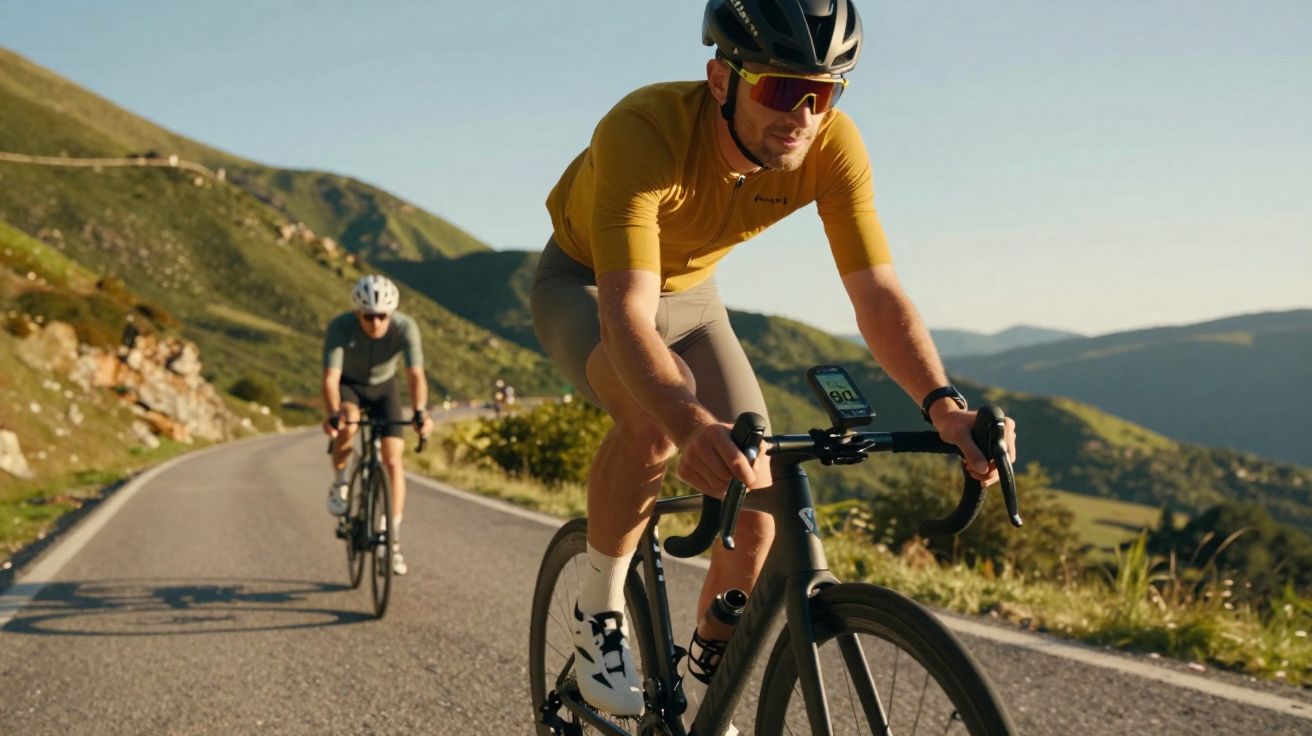
You glance down at your computer: 58 revolutions per minute. The gradient bites, your pulse is thumping, and your legs suddenly feel like they’ve been filled with concrete. Every pedal stroke turns into a little battle. Still, you cling to the wheel in front because you refuse to be dropped. A few metres later, the rider ahead drifts away as if it’s nothing-clicks into an easier gear, legs spinning-and you crack. At the top you’re empty. He looks like he’s only just started.
We talk endlessly about watts, weight and aero. Yet hardly anyone talks about the thing you actually feel the moment fatigue hits: cadence. And why so many of us ride with it far too low.
Why we instinctively pedal too slowly - and why that makes us tire faster
On the surface, slow, forceful pedalling seems sensible. Big gear, solid pressure through the pedals, and you instantly feel strong. That “I’ll grind this out on pure muscle” sensation is flattering to the ego. Especially on climbs, plenty of riders only shift down once it’s already bordering on painful. Until then, they heave the big gear around as if they’re chasing a leg-press personal best.
There’s also a cultural memory at work. Many of us still picture the pros of the 1990s, stamping over Alpine passes at 60–70 rpm. That image sticks. Add a quiet worry that a high cadence looks a bit “silly”-too twitchy, like you’re not in control of the bike-and you get the typical outcome: we ride too hard a gear, too slowly, with too much pride.
A mate of mine-let’s call him Marc-is a textbook case. Office job, two kids, has ridden a road bike for years, highly motivated, training plan downloaded online. He used to boast about his “climbing strength”. His Strava times looked respectable, right up until we rode together with a power meter. His uphill cadence? Between 55 and 62 rpm. Heart rate permanently in the red, totally cooked after 40 minutes. On a 90-minute loop, the second half turned into a slog every single time.
We changed nothing except cadence. Same climb, same power in watts, but with one target: at least 80 rpm. He had to drop two gears; his ego protested. After a handful of rides, something interesting happened: he wasn’t arriving at the top faster-but he was less destroyed. On the final climb of the loop he could suddenly accelerate. No magic training block, no miracle nutrition. Just a different balance between force and cadence.
The mechanics are fairly straightforward. A low cadence means you need more force per pedal revolution. Your muscles end up working more like strength training: fast fatigue in the fibres, with muscle burn dominating what you feel. With a higher cadence, some of the load shifts towards the cardiovascular system. Your heart does more of the work, while each individual contraction in the legs is less brutal. At first it can feel odd, even “inefficient”, because your breathing ramps up sooner.
Over time, though, you spare your muscles and can sit closer to your limit for longer. Studies with professional and amateur riders repeatedly show that a band of roughly 80–95 rpm tends to settle as an efficient cadence zone for many people on longer rides. Not because it’s a magic number, but because it often strikes a useful compromise between muscle preservation and cardiovascular contribution. The “right” cadence isn’t a doctrine; it’s a personal sweet spot-and it’s almost always higher than most riders dare to ride at first.
How to adjust your cadence (rpm) without feeling like you’re riding a different bike
The most practical starting point is embarrassingly simple: look at your head unit. Many cycle computers already display live cadence; if not, an inexpensive sensor will do. First, measure what you actually ride-rather than what you assume you ride. Do your usual loop without changing anything, then check the average afterwards. If you’re under 80 rpm on the flat and often below 70 rpm on climbs, you’ve got a clear baseline.
Next time, don’t try to overhaul an entire ride. Pick one segment only-say a climb that lasts 5–10 minutes. On that section, aim to pedal a steady 5–10 rpm higher than normal. Not by riding faster, but by selecting an easier gear. The speed can feel identical; that’s the point. You’re not training a “head record”-you’re teaching your body a new movement pattern. Only once that higher cadence starts to feel normal should you extend it to a second section.
Early on, many riders fall into the same trap: they spin faster but keep the same gearing. Heart rate then rockets, breathing turns ragged, and the verdict becomes: “High cadence isn’t for me.” That’s the frustration trap. You’re not just changing a number on a screen-you’re changing the relationship between gear choice, rhythm and expectation. It’s completely normal for it to feel a bit awkward at first.
Let’s be honest: hardly anyone practises this daily. Most of us hop on the bike, ride the loop, done. Precisely because of that, it pays to commit to a deliberate two- or three-week block where you include a small “cadence experiment” on each ride. Once, 5 minutes at 90 rpm on the flat. Once, one hill where you stay at 80 rpm instead of 60. This isn’t about perfect discipline; it’s about curiosity and feedback. You’ll quickly discover the point where things tip-and that’s where it gets interesting.
A coach I spoke to summed it up dryly:
"Most amateur riders climb as if they’ve only got a single heavy gear left in the drivetrain-and then wonder why they’re empty after an hour."
If you want to shift that pattern, three simple guardrails help:
- On the flat, aim for a target cadence of roughly 85–95 rpm, without trying to go faster at all costs.
- On climbs, shift down one gear earlier than you think and try to stay above 75–80 rpm.
- Once a week, ride short 1–2-minute blocks at very high cadence (100–110 rpm) to help your nervous system get used to quicker leg speed.
These aren’t commandments-more like a handrail you can hold while you experiment. In the end, the “perfect” cadence is as individual as your sleep rhythm. But if you never test anything, you’ll stay stuck in comfortable, tiring grinding.
What changes when pedalling gets lighter - in your body and in your head
Anyone who’s deliberately ridden with a higher cadence knows the moment: the bike suddenly feels “lighter”, even if your speed hasn’t changed. Your legs turn more smoothly, pressure through the joints eases, and your muscles stop screaming with every stroke. Instead, you mainly notice your heart and your breathing. Yes, that can feel intimidating at first. It mercilessly exposes how fit your cardiovascular system really is.
At the same time, something calming happens mentally. You no longer have to fight every little rise just to force a heavy gear over the top. You give yourself permission to shift into an easier gear early-without reading that as weakness. The distance becomes less of a battlefield and more like a sequence of rhythms. On good days it all blends together: you can almost hear your body working in time with the chainring.
After a few weeks of intentional cadence work, many riders notice a surprisingly practical side effect: they feel less wrecked after longer rides. That classic “concrete legs” fatigue after 80 kilometres gives way to a more manageable, overall tiredness. You notice it in the evening when you’re not cursing your way up the stairs. Or the next day, when you actually want to ride again rather than avoiding the bike.
It gets more interesting when you look at endurance performance in a cold, honest way. Plenty of riders who gradually raise their cadence find they can hold similar average speeds with a slightly lower heart rate. Or they can maintain the same pace uphill without collapsing dramatically in the final third. It’s not an Instagram miracle, not +50 watts in two weeks. It’s quiet, realistic progress that pays off most in the second half of the ride.
Maybe that’s the real point: the right cadence rarely feels spectacular. It’s unspectacular efficiency. No heroics on the first climb, no strength-mode world records-just a better ending to your ride. And that’s what’s most underestimated. When you roll home with fresher legs, you ride more often. When you ride more often, you get fitter as a side effect. Simple, and easy to overlook.
Next time you see someone glide past you with a “sewing-machine cadence”, you can roll your eyes-or you can honestly ask yourself whether they might be onto something. Stroke by stroke, revolution by revolution, your own comfort zone shifts. And one day you realise: you don’t miss the grinding at all.
| Key point | Detail | Benefit for the reader |
|---|---|---|
| Cadence that’s too low fatigues the muscles | More force per revolution, higher local muscle stress, faster fatigue | Understand why you “suddenly crack” even though the pace and route are familiar |
| Individual sweet spot usually between 80–95 rpm | Better balance between muscular load and cardiovascular strain | A concrete reference range for adjusting your cadence deliberately |
| Gradual adjustment instead of a radical switch | Small experiments on specific sections, targeted cadence blocks, conscious gear choice | A realistic, everyday approach you can apply immediately without high-tech training |
FAQ:
- How do I find my ideal cadence? Start with ranges between 80 and 90 rpm on the flat and pay attention to how your heart rate, breathing and fatigue feel. Then adjust in steps of 5 rpm and notice where you feel most balanced over longer periods.
- Is a high cadence always better? No. Extremely high cadences above 100 rpm for long stretches can be inefficient if your technique and fitness don’t support it. The goal is a range where you pedal smoothly, not a maximum spin rate.
- Difference between flat roads and climbs? On climbs, cadence drops automatically for many riders. Still, try not to fall permanently below roughly 70–75 rpm. On the flat, the range can sit a little higher, often between 85 and 95 rpm.
- I have knee pain - does a higher cadence help? Often yes, because the force per pedal stroke decreases. Easier gears and a slightly higher cadence reduce stress on joints and tendons. If pain persists, it must be assessed by a doctor or physio.
- Do I absolutely need a cadence sensor? It helps, but it isn’t essential. Many modern cycle computers already have it integrated. Without a sensor, count your pedal revolutions for 15 seconds and multiply by four to estimate your rpm.
Comments
No comments yet. Be the first to comment!
Leave a Comment