
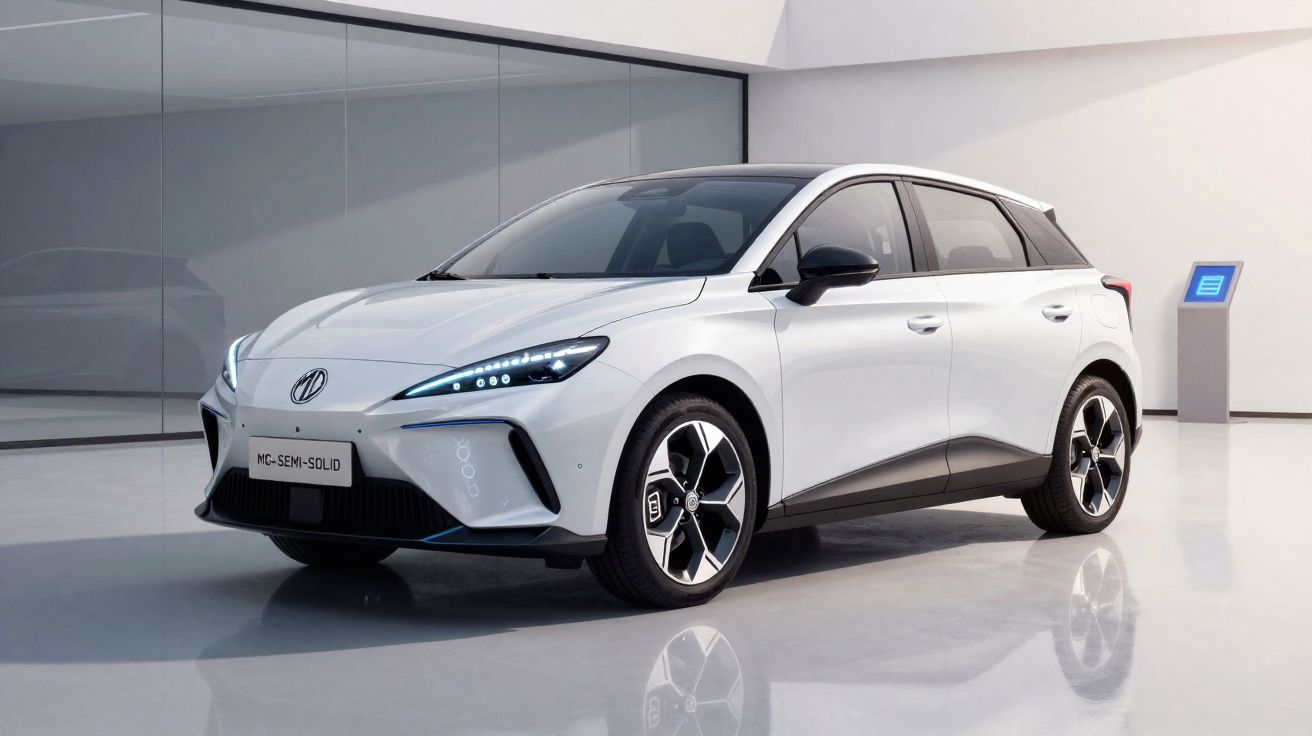
SAIC Motor has already opened order books in China for the new MG4, with prices starting at 73,800 yuan - around €8,805 at today’s exchange rate.
However, the headline-grabbing price in the Chinese market is not the biggest talking point of the second-generation Chinese electric model, which has not yet arrived in Portugal. The key development is the introduction of an MG4 fitted with semi-solid-state batteries, due to reach the Chinese market towards the end of the year.
This is not the first model within the SAIC group to debut the technology - that honour went to the IM 6 saloon - but it does not diminish the MG4’s achievement in becoming one of the first high-volume models to adopt this new type of battery.
MG4 Anxin Edition (MG4 semi-solid-state battery model)
In China, the MG4 has already launched with two LFP (lithium iron phosphate) battery options: 42.8 kWh and 53.9 kWh, delivering ranges of up to 437 km and 530 km respectively (CLTC cycle).
The semi-solid-state battery version is set to be unveiled in September, with deliveries scheduled for the end of the year. This information emerged after early disclosure from the MIIT (China’s Ministry of Industry and Information Technology), which also revealed that this specific variant will be called the MG4 Anxin Edition.
What remains unclear are the battery’s final specifications, such as capacity and the range it will provide in the MG4. It is known that this lithium-ion battery will be supplied by Suzhou QingTao Power Technology, but the chemistry is still in doubt: whether it will be lithium manganese oxide (LMO) or a manganese-rich NMC (nickel, manganese, cobalt) formulation (LMR).
Elsewhere, it is confirmed that the MG4 Anxin Edition will use the same 120 kW (163 hp) electric motor and 250 Nm as the other versions. It is also expected to be the most expensive model in the line-up.
What are the advantages of a semi-solid-state battery?
According to SAIC, the new semi-solid-state battery has already proven to be safer in testing (successfully passing a three-direction puncture test) and performs better at low temperatures than LFP or NMC, managing to retain up to 75% of its range in sub-zero temperatures with pre-conditioning.
So what is the difference between the much-hyped solid-state batteries and semi-solid-state ones? As the names suggest, semi-solid solutions sit somewhere between conventional and fully solid-state technology. The distinction comes down to how the electrolyte is used.
In today’s mass-market lithium-ion batteries, the electrolyte is liquid; in solid-state batteries, it is - as the term implies - solid. Semi-solid batteries combine both approaches: the electrolyte contains solid particles, but these are suspended in a conductive liquid.
Beyond the benefits already mentioned, semi-solid-state batteries also have the potential for higher energy density and are easier and cheaper to manufacture than solid-state batteries. That is because they are not dramatically different from the production methods used for other lithium-ion batteries, which has a significant effect on cost - one of the crucial factors for electric vehicles.
Will it come to Portugal?
There is still no confirmation of when the second-generation MG4 will arrive in Portugal or the wider European market. It also remains to be seen whether the semi-solid-state MG4 will be sold here.





Comments
No comments yet. Be the first to comment!
Leave a Comment