
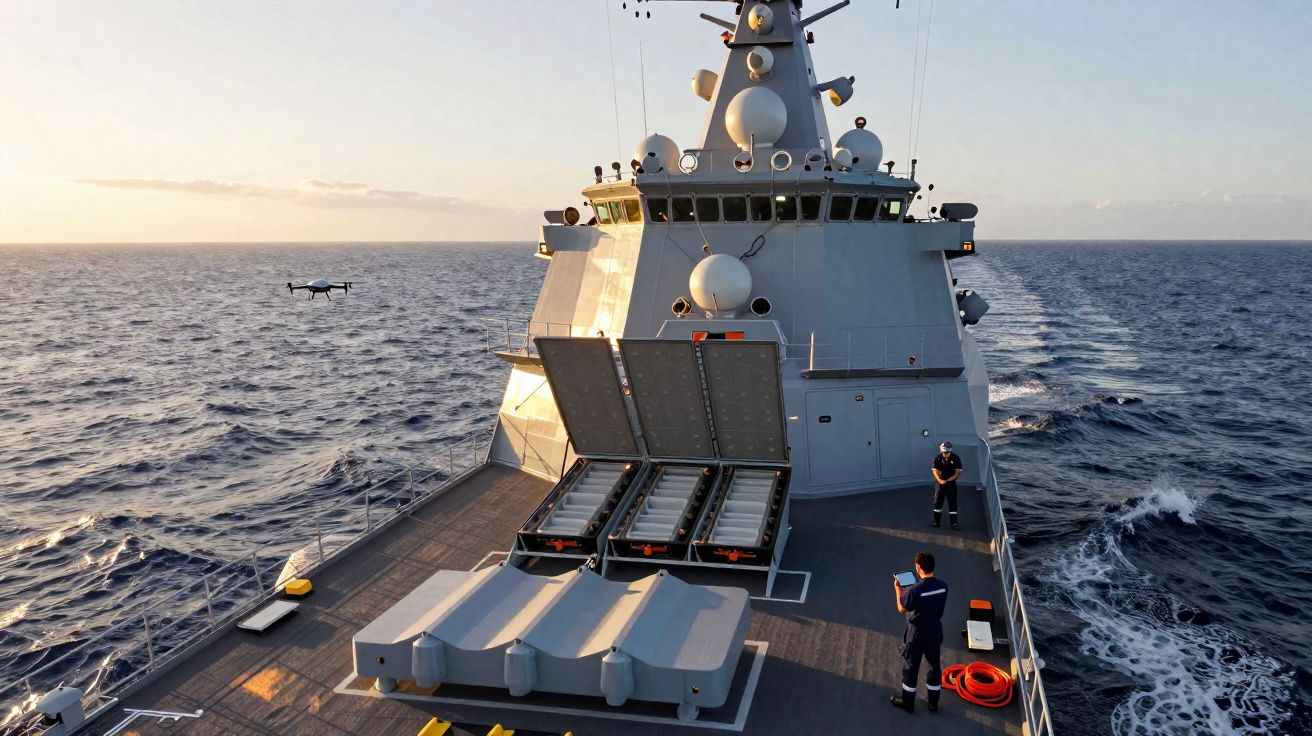
Behind what looks like a technical decision about missile silos, France is effectively reworking how its navy will safeguard carrier groups, supply convoys and overseas interests across the 2020s and into the early 2030s. Choosing to equip the new Defence and Intervention Frigates (FDI) with 32 vertical launch cells rather than 16 elevates these ships into a substantially higher capability bracket.
From “light escort” to serious air-defence player for FDI frigates
When the FDI programme was first presented, it was framed as a well-rounded, multi-role frigate: anti-submarine warfare, surface combat, a capable radar, and a limited air-defence fit. Early ships were expected to embark only 16 Sylver A50 vertical launch cells-closer to what you might expect from an escort focused on patrol tasks than from a ship intended to provide a protective umbrella.
That baseline has now shifted. From the fourth and fifth hulls-Amiral Nomy and Amiral Cabanier-the French Navy is moving to a 32-cell arrangement. The adjustment was politically validated during the annual defence budget review, making clear that it is a firm design direction rather than a mere “option”.
"By doubling their vertical launch cells, the FDI frigates move from “can defend themselves” to “can defend the group” in a high-threat air environment."
This change matters on three fronts: it increases how long an FDI can keep fighting before its missile stock becomes a constraint, improves its ability to respond to attacks arriving from several directions at once, and gives Paris more latitude to assign its limited number of high-end air-defence destroyers to other priorities.
Why 32 vertical launch cells make such a difference
Vertical launch silos sit at the heart of a modern warship’s striking and defensive power. Each cell holds a missile that can be launched within seconds. More cells translate into a greater ability to absorb and defeat large raids without having to break off, withdraw to rearm, or lean heavily on allied cover.
On the FDI, the Sylver A50 system is tailored to medium- and long-range surface-to-air weapons, including the Aster 30. Expanding from 16 to 32 cells brings several direct benefits:
- More concurrent engagements against incoming aircraft or missiles
- Increased endurance on extended deployments where replenishment is challenging
- More scope to combine missile types to suit different tasks
- Psychological deterrence: adversaries must plan for a thicker defensive barrier
"The key shift is not just extra missiles, but the ability to maintain a thick defensive umbrella through a long, complex air attack."
With swarming drones, sea-skimming cruise missiles and the prospect of hypersonic threats, a magazine of only 16 ready rounds can be used up alarmingly fast. Doubling the load does not make a ship invulnerable, but it lengthens the window before it must disengage or depend entirely on other units.
SeaFire radar and Aster 30: the new core pairing
A bigger missile outfit only delivers value if the sensors and combat system can exploit it. That is where the FDI’s SeaFire 500 radar comes in: a fully digital active electronically scanned array (AESA) developed by Thales.
SeaFire is designed to follow many air and surface contacts at the same time, including small, quick and low-flying objects that legacy radars can struggle to detect early enough. Its responsiveness is particularly useful against complicated, multi-axis raids in which drones, decoys and real missiles are deliberately mixed.
Paired with SeaFire, the FDI’s principal long-range interceptor is the Aster 30 surface-to-air missile. Aster 30 is intended to counter aircraft and inbound missiles-including certain ballistic threats-at ranges beyond 100 km depending on configuration.
| Component | Role on FDI |
|---|---|
| SeaFire 500 radar | Detect and track multiple targets, provide fire-control quality data |
| Sylver A50 launch cells | House and launch Aster 30 and future compatible missiles |
| Aster 30 missiles | Long-range air and missile defence around the task group |
"The SeaFire–Aster 30 combination turns the FDI into a genuine node in France’s layered air and missile defence architecture, not just a self-defence asset."
Industrial timing and political signalling
The FDI class is expected to enter service from roughly 2025 to 2032, then remain a central element of the French surface fleet for decades. Altering the fit mid-series-from 16 to 32 cells on later ships-therefore sends messages both to industry and to potential adversaries.
From an industrial perspective, shipyards and suppliers have to adjust plans covering structural work around the launch modules as well as cabling, power distribution and other integration details. Sticking with Sylver A50, rather than adopting a larger or entirely new launcher, helps cap complexity and avoids forcing a wholesale redesign.
On the political and operational side, the change reflects experience drawn from recent high-threat theatres, including the Red Sea, the eastern Mediterranean and the broader Indo-Pacific. Western navies have had to contend with more drones, more cruise missiles and increasingly restrictive rules of engagement. Paris appears to have judged that lighter missile fits no longer leave enough margin.
Balancing weight, energy and growth potential
Notably, the French Navy has described the move as part of a wider optimisation effort, rather than a blunt demand for “more of everything”. By keeping the A50 launcher as the near-term standard, planners can make gains in weight, energy requirements and maintenance burden.
The FDI is also designed around an “open architecture” approach. In practical terms, this is meant to make later additions-new missile families, alternative electronic warfare equipment, and even directed-energy weapons-easier to incorporate without dismantling major parts of the ship.
"The goal is to raise firepower today while keeping enough space, power and data capacity for tomorrow’s weapons and sensors."
From escort duty to zone defence
French practice has traditionally centred on a small number of high-end air-defence destroyers-such as the Horizon-class-to shield the Charles de Gaulle carrier and other high-value amphibious or logistics units. With the revised FDI load-out, that responsibility can be distributed across a larger portion of the fleet.
With 32 cells and an advanced radar, an FDI can function as a local “zone defender” for part of a task group or a convoy. It will not equal the sheer magazine depth of a bigger destroyer, but it can still address serious air threats within a defined defensive area.
This added capacity also eases logistical strain on missile stocks. A frigate with a deeper magazine can remain on station longer between replenishments and can manage its shots more deliberately during complex engagements, rather than fearing a follow-on wave will arrive when its launchers are empty.
Dealing with saturation attacks and drones
Recent conflicts have underlined how inexpensive drones-used in swarms-can stretch even well-armed ships. Combine that with sea-skimming cruise missiles and possible ballistic threats, and the problem becomes one of volume as much as technical sophistication.
By increasing the number of missiles immediately available, the FDI can conduct more interceptions before its defensive “wall” begins to thin. It also gains more freedom to tailor its load, such as pairing longer-range intercepts with shorter-range weapons or future interceptors that are better suited to drones.
"The extra 16 cells buy time-time to react, time to manoeuvre, and time for allied ships or aircraft to join the fight."
Key terms and what they mean in practice
For readers less familiar with naval jargon, a few definitions clarify what has changed:
- Vertical launch system (VLS): launch tubes set into the deck that fire missiles upwards before they turn towards the target, enabling rapid engagement in any direction.
- Zone defence: defending not only the launching ship but a wider area around it-such as a carrier force or a tanker group.
- Saturation attack: a strike employing many weapons at once, often from several bearings, intended to overwhelm sensors and exhaust missile stocks.
On an FDI fitted with 32 cells, a task group commander could, for example, assign the frigate responsibility for a slice of airspace around a logistics convoy while another ship covers a separate sector. SeaFire can contribute tracks to the wider group combat system, enabling cooperative engagements where one platform fires using another ship’s radar picture.
Future scenarios and operational trade-offs
Imagine a future French-led formation escorting merchant shipping through a contested strait. An FDI limited to 16 cells might be forced to husband missiles, engaging only the most dangerous tracks. With 32 cells available, commanders have more freedom to eliminate drones earlier and reduce the size of the raid before it becomes unmanageable.
Trade-offs remain. A larger missile outfit increases weight and maintenance demands, and it could encourage commanders to treat FDIs as mini-destroyers, dispersing them across multiple hotspots. If spread too thin, even a 32-cell frigate can be worn down by a well-designed, multi-wave assault.
Future weapons are another open question. Directed-energy systems, such as shipborne lasers, may eventually handle the “cheap drone” layer, keeping expensive Aster 30 rounds for higher-end threats. The FDI’s open architecture keeps that possibility available, but budgets and schedules will determine how quickly such concepts progress from slide deck to steel.
"France has not turned the FDI into a silver bullet, but it has given the class enough depth to matter in serious, contested operations."
For now, moving to 32 vertical launch silos conveys a straightforward message: French surface forces intend to remain relevant in an era in which the sky and the sea are crowded with more threats, arriving from more directions, than at any point since the Cold War.






Comments
No comments yet. Be the first to comment!
Leave a Comment