
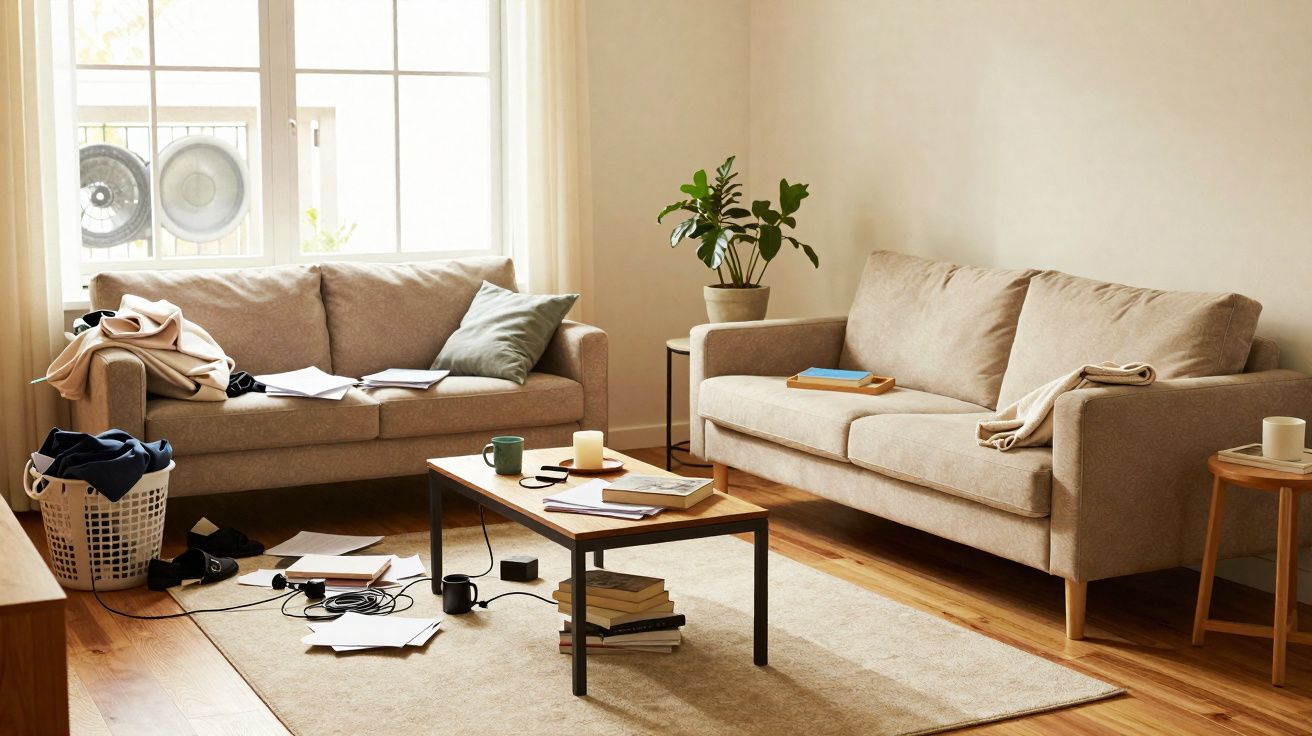
The flat was described as “spacious” - at least according to the listing. In reality, the corridor was edged with shoes, the worktops had disappeared beneath gadgets, and unopened post had formed a kind of barricade around the sofa. The square footage was exactly what the photos promised. The sensation of living there wasn’t.
It’s an odd sleight of hand that homes pull. The walls stay put, but over time rooms begin to feel more cramped, lower, and somehow nearer to your face.
And it almost never arrives in one dramatic moment. It’s the gradual drift of belongings: the “I might need this one day” habit, the sentimental mugs, and the infamous cable drawer we never quite have the courage to tackle.
Eventually, a soft question starts knocking at the back of your thoughts.
Why clutter makes a room feel smaller in your mind before it does on paper
Step into an empty room and you immediately register the volume - your gaze moves from wall to wall and floor to ceiling without resistance. Add a sofa, a rug, a bookcase, and it can still feel roomy. Then the “extras” appear: a second coffee table, a chair that never gets used, laundry baskets, toys, and boxes stacked “temporarily”. All at once, the same room starts to feel as if it’s tightening around you.
Your brain hasn’t got the measurements wrong. What it’s responding to is visual noise. Each additional item becomes another thing your eyes must notice, sort, and avoid. The space stops reading as a simple shape and starts behaving like an obstacle course. You’re no longer just looking - you’re navigating.
Psychologists sometimes describe this as “cognitive load” made physical. Even when you’re not trying to, your mind runs a continual stocktake of what you own. Rather than taking in the room as a single scene, your attention is chopped into dozens of small pieces. That scattered, on-edge sensation in a cluttered home isn’t a vague “vibe”; it’s your brain working harder in a room that won’t stop talking.
When you enter a cluttered area, depth perception can warp. Towers of stuff and congested corners interrupt clear sightlines, making the walls seem closer than they are. Shelves crammed right to the top can make the ceiling feel lower - like a visual weight pressing down. Even the floor can feel as though it’s “coming up” to meet you when it’s dotted with baskets, bags, or heaps of clothes.
How you move changes as well. Instead of walking straight, you end up weaving. That small sidestep around a box, or the slight shift to avoid a chair sticking out, reduces the sense of available routes. Fewer routes means less freedom, and less freedom registers as less space. Your body reads the room before your conscious brain does.
Lighting matters too. Clutter absorbs light. Every object takes a little, throwing tiny shadows that darken corners and soften edges. We tend to interpret light as openness and shadow as enclosure. So a room filled with objects isn’t only busy to look at; it can genuinely feel darker, heavier, and nearer. The room hasn’t changed size - but your experience of it has, and that’s what sticks.
A London survey of renters found that more than 60% felt their flat was “too small”. When researchers compared those responses against floor plans, an interesting pattern showed up. In plenty of cases, the homes weren’t unusually small for the city. What they did feature were wardrobes packed to bursting, narrow hallways turned into storage corridors, and kitchen tables buried beneath paperwork.
Consider the classic UK box room. On paper it’s a compact single bedroom or a small office. In practice, it often turns into the household’s “everything space”: spare bed, ironing spot, overflow wardrobe, home gym, filing cabinet, plus a depot for Christmas decorations. Open the door and you’re met by a wall of “stuff energy”. People describe it as tiny and barely usable. The tape measure disagrees. Their nervous system doesn’t.
On a video call, a professional organiser showed a client two images of the very same living room. In the first, every visible surface was occupied. In the second, 40% of the objects had been taken away. Most viewers estimated the second room was at least a third bigger. The dimensions hadn’t moved at all - only the amount of rest their eyes could find.
Small, smart declutter moves to give your space its breathing room back
Begin with a single surface rather than attempting the entire room. Choose the kitchen counter, the coffee table, or the top of a chest of drawers. Empty it fully. Give it a quick clean. Then return only three to five items that genuinely deserve to be there - a lamp, a plant, a key bowl. Nothing more. Sit with that small “island” of space for a few days.
This isn’t a pursuit of perfection. It’s about offering your brain one calm landing place. Once you’ve experienced the shift that one clear surface creates, it becomes a gentle benchmark. You start noticing how tense your eyes feel when they leave it. That contrast is what nudges you towards the next surface - not pressure and not guilt.
Let’s be honest: nobody really keeps it up every single day.
Think in “zones” rather than whole rooms. A living room can secretly be three areas squeezed into one: a reading nook, a TV spot, and a work-from-home corner. When boundaries blur, clutter multiplies. Try sketching the room quickly on scrap paper and marking what each section is meant to do. Then take out anything in a zone that doesn’t support its main job.
For example, if the dining table has turned into a semi-permanent office, give your work items a contained home. That could be a crate that slides under a chair, a small trolley you can roll away, or even a sturdy tote you put in a cupboard at the end of the day. The act of packing work away gives the table back its real purpose: somewhere to eat, talk, and leave the laptop elsewhere for a bit.
People often try to “solve” clutter by buying storage. It feels efficient - even commendable. But adding more units, baskets, and boxes can make a room feel more crowded and therefore smaller. The bigger shift comes from asking a tougher question: “What if this didn’t live here at all?” Sometimes the boldest design choice is leaving space empty.
“Clutter isn’t just about how your home looks. It’s about how you feel when you walk through the door,” confided a Manchester therapist who began asking clients to describe their living spaces before talking about their stress.
Once you start to declutter, shame can show up quickly. You spot a pile in the corner and think, “How did I let it get this bad?” That voice adds weight and stops momentum. A kinder way is to see clutter as past decisions that no longer match the life you’re living now. No judgement, no failure - just overdue updates.
- Take out one “space-blocker” piece of furniture from the most-used room.
- Start with the floor: bags, boxes, piles. Being able to walk freely changes the whole feel.
- Deliberately keep at least one shelf or drawer empty.
- Use baskets for short-term triage, not long-term hiding.
- Stop “organising” things you don’t even like.
Living with less visual noise so your home can finally feel its real size
Clutter usually begins with good intentions. A hobby you planned to return to. Children’s artwork you couldn’t bring yourself to bin. Spare bedding “for guests” you hardly ever have. Then life accelerates, and those intentions solidify into quiet stacks. Your home becomes a gallery of unfinished plans and delayed choices, and that burden shows up as stuffed drawers and crowded shelves.
On a quiet evening, look at a single room and ask: “Does this help me live today, or is it only tied to a past version of me or an imagined future?” There’s nothing wrong with nostalgia or planning. But when the majority of what fills a room belongs to older selves, the current you has nowhere to expand. Space isn’t only physical - it’s also about time. When you keep fewer things that genuinely serve your life now, the same four walls can feel unexpectedly larger.
We don’t often acknowledge the social cost either. Many people feel too embarrassed to invite friends round because their place feels “too small” or “too messy”. They apologise for the flat before anyone has even sat down. That kind of retreat has a price. As you quietly reclaim corners and surfaces, you’re not merely getting square metres back. You’re making room for company, laughter, and late-night chats at a kitchen table you can actually see again.
Your home doesn’t need to resemble a showroom. It simply needs less visual noise so you can notice the life happening inside it. When the objects retreat, the people come forward.
| Key point | Detail | Why it matters to you |
|---|---|---|
| Clutter distorts perception | Visual noise and blocked sightlines make rooms feel smaller than their actual dimensions | Helps explain why a home feels cramped even when floor plans say otherwise |
| Start with one clear surface | Target a single area, strip it back, and keep only a few meaningful items | Offers a realistic, low-pressure way to feel quick wins and build momentum |
| Prioritise space over storage | Remove items and furniture instead of constantly adding new boxes or units | Shows how to gain breathing room without expensive makeovers |
FAQ:
- Why does my tidy-but-full room still feel small? Because your brain reacts to quantity, not just mess. Even neatly arranged items add to visual load and make walls and ceilings feel closer.
- Is clutter really bad for mental health? Studies link cluttered spaces to higher stress and lower focus. You might feel more tired, irritable, or overwhelmed without quite knowing why.
- How do I start if I feel totally overwhelmed? Pick a tiny area you can finish in 15 minutes: one drawer, one shelf, one side table. Stop when it’s done, even if the rest still looks chaotic.
- Should I buy storage solutions first? Wait. Declutter before you spend money. You often need far fewer boxes and units than you think once some things are gone.
- What if I regret letting something go? Take photos of sentimental items before parting with them, and use a “maybe box” you seal for three to six months. If you don’t miss what’s inside, you’re ready to let it leave your space for good.



Comments
No comments yet. Be the first to comment!
Leave a Comment