
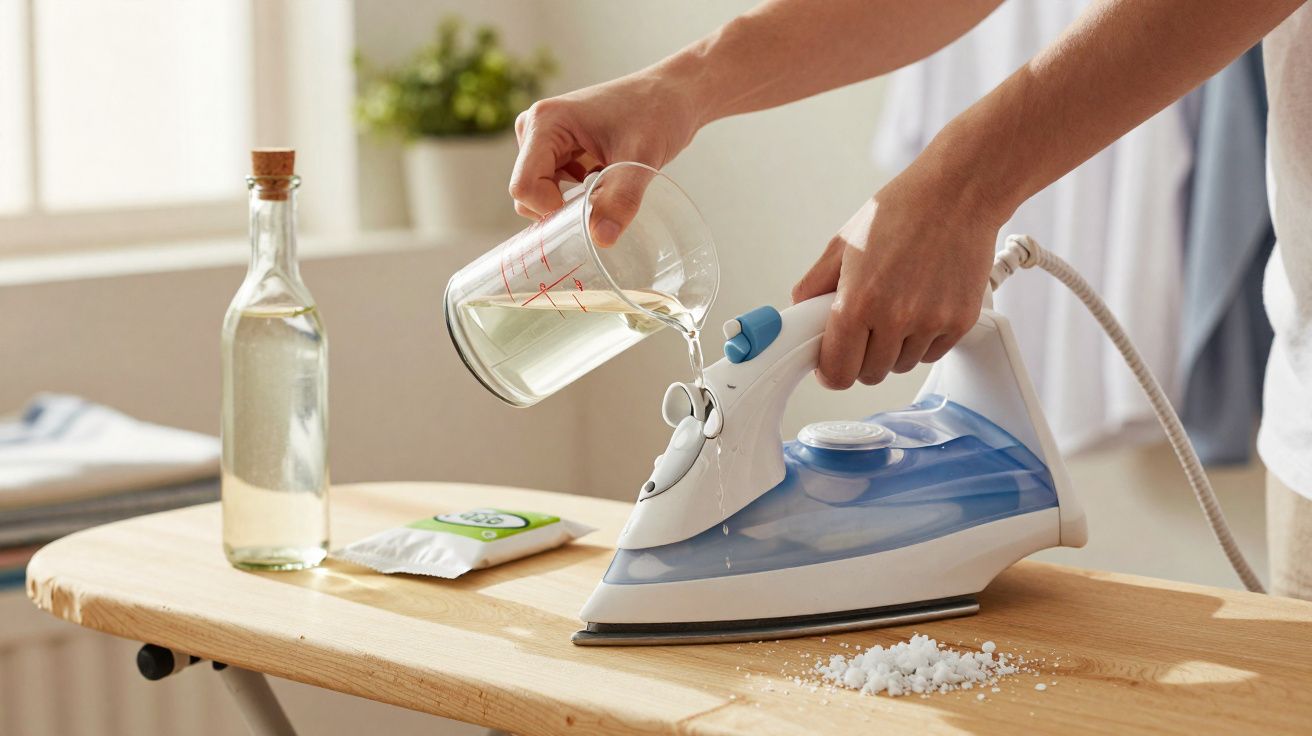
Across hard‑water areas, steam irons often start to struggle with limescale well before they actually fail. The upside is that a straightforward, low‑cost routine can restore most steam irons and prevent those annoying marks from spoiling your clothes.
Why hard water quietly wrecks steam irons
In much of the UK (and across large parts of the US), tap water contains dissolved minerals such as calcium and magnesium. When that water is heated again and again inside a steam iron, those minerals crystallise and gradually turn into limescale.
As the deposits accumulate, they stick to heating elements and line internal surfaces. Because limescale behaves like an insulating layer, the iron has to work harder to hit the same temperature. Over time, that extra load can put stress on the thermostat, seals and pump.
If the build‑up is allowed to continue, partial blockages push pressure back towards the pump and internal joints. The result can be leaks near the base, sudden shut‑offs, or lasting electronic failure. At that stage many people assume the iron is “finished” and throw it away, even though the real trouble began months earlier with routine scaling.
When your steam iron starts talking: early warning signs of limescale
Limescale inside a steam iron almost never appears in one go. It develops slowly in the tank, the steam chamber and the narrow internal channels. Long before the appliance stops working, it usually gives you hints that something’s wrong.
"Limescale rarely kills an iron instantly; it weakens performance for months first, leaving a trail of clues on your laundry."
Most people notice the steam output first. You hit the boost button and get a weak puff rather than the thick burst you’re used to. Steam may also come and go, and you can sometimes hear crackling or whistling as water fights through restricted pathways.
A second giveaway is residue on clothing: light‑coloured specks on dark items. Those pale crumbs are mineral deposits breaking loose from inside the iron, and they’re a sign the steam chamber is already coated with hardened scale.
If you carry on regardless, symptoms tend to worsen. Deposits can combine with tiny fibres that have burnt onto the soleplate. That mix can appear as brown, rusty droplets that spit onto shirts and blouses. On white cotton or silk, those stains can be extremely difficult to shift.
"Brown drips usually mean oxidised limescale and residue have built up to a point where they’re contaminating the steam."
A limescale‑blocked iron can also start to feel as though it’s dragging. Instead of gliding, the soleplate may catch slightly, making you press harder-raising the risk of shiny patches on synthetics or creases that become difficult to remove.
The vinegar and water trick: how to descale without scrubbing
For most build‑up, you don’t need specialist products. Plain white vinegar and a bit of time are often enough to break down the deposits.
"A 50/50 mix of white vinegar and water can dissolve stubborn limescale inside the tank and steam channels, no dismantling required."
Step‑by‑step descaling with vinegar
- Unplug the iron and allow it to cool fully.
- In a jug, combine equal parts white vinegar and clean water.
- Fill the water tank with the mixture up to the normal max line.
- Keep the iron switched off for around 30 minutes so the acid can act at room temperature.
Try not to heat vinegar inside the iron. Warm acidic vapour can irritate your eyes and throat, and repeated hot cycles can be tougher on rubber seals.
Once the soaking time is up, empty the tank completely. Then rinse it several times with fresh water, gently shaking the iron to help dislodge loosened fragments. This stage is important: if you rush it, you may notice a vinegar smell the next time you iron.
After rinsing, refill the tank with plain water and heat the iron to its highest setting. Hold it over a sink or an old towel, switch on steam, and press the steam boost repeatedly.
"During this “steam purge”, you’ll often see flakes and cloudy droplets spurting out. That mess is exactly what you want to eject now, not onto your favourite shirt."
Citric acid: the odour‑free alternative
If the smell of vinegar puts you off, citric acid is a more discreet option. It’s widely sold as a food‑grade powder, produced through natural fermentation, and it’s very effective against mineral deposits.
How to use citric acid safely
For most household irons, a workable mixture is:
- 1 tablespoon citric acid powder for about 250 ml of warm (not boiling) water
- Stir until the crystals dissolve completely
- Pour into the cold iron, leave for 30 minutes, then rinse repeatedly
After soaking, follow the same approach as with vinegar: rinse thoroughly, then perform a steam purge using plain water. Because citric acid is odourless, many people find it more comfortable to use in small flats or shared homes.
The ideal maintenance schedule so your iron lasts for years
In hard‑water areas, a single “big clean” once a year is rarely enough. Smaller, regular descaling sessions are typically more effective-and gentler on the appliance.
"Think of descaling as routine maintenance, not an emergency repair. Little and often keeps steam powerful and clothes stain‑free."
As a general guide, if you iron several times a week and you’re using hard tap water, aim to descale every one to two months. Where water is very hard, reduce the gap further. In soft‑water areas-or if you only iron occasionally-quarterly descaling may be sufficient.
| Water hardness | Iron usage | Recommended descaling |
|---|---|---|
| Very hard | Daily or near daily | Every 4–6 weeks |
| Medium | A few times a week | Every 2 months |
| Soft | Occasional | Every 3–4 months |
It also helps to keep a small “descaling kit” near your ironing board: a measuring jug, white vinegar or citric acid, and an old cotton cloth for the purge. Most of the time is passive soaking; the hands‑on effort is only a few minutes, and you can easily fit it around other household tasks.
Day‑to‑day habits that slow down scaling
Alongside periodic descaling, a handful of simple habits can significantly slow how quickly limescale forms.
- Empty the tank after every session so water isn’t left sitting and crystallising inside.
- In very hard‑water areas, use a blend of tap water and demineralised water.
- Don’t pour fragrance or fabric softener into the tank; they can create sticky residues.
- Once the iron has cooled, wipe the soleplate with a damp cloth-particularly after ironing synthetic fabrics.
Many newer irons include “anti‑calc” cartridges or self‑clean functions. They can help, but they don’t replace proper descaling. Cartridges still clog, and automatic cycles often rely on you doing a thorough rinse and steam purge to fully clear loosened debris.
What “descaling” actually does inside your iron
If you’re cautious about using acids near an electrical appliance, it helps to know what the chemistry is doing. Limescale is mainly calcium carbonate. Mild household acids-such as acetic acid in vinegar or citric acid powder-react with it, turning it into soluble compounds and releasing carbon dioxide gas.
"Used in low concentrations and at room temperature, household acids target mineral deposits rather than metal parts or plastic housing."
The crucial point is restraint. Strong acid solutions, especially when heated aggressively, can damage coatings and seals. A gentle, cool soak keeps the reaction aimed at the chalky deposits you want gone.
Real‑life scenarios: when a clean iron genuinely saves the day
Imagine the morning of a job interview. You reach for the iron to give your shirt a final pass, hit the steam boost-and a brown streak dribbles across the front. That’s often the moment people start looking up descaling, unfortunately too late for that particular item.
Routine upkeep changes the experience. With clear vents and channels, the iron reaches its chosen temperature more quickly and uses energy more efficiently. Clothes press more evenly, without damp patches or surprise stains, and you’re less likely to crank up the heat in frustration-something that can scorch delicate fabrics.
There’s a wider impact too: fewer “dead” irons ending up in household waste. When limescale is kept under control, the mechanical parts and electronics often keep going far longer than most people expect, meaning one dependable iron can last for years instead of being replaced every couple of seasons.





Comments
No comments yet. Be the first to comment!
Leave a Comment