
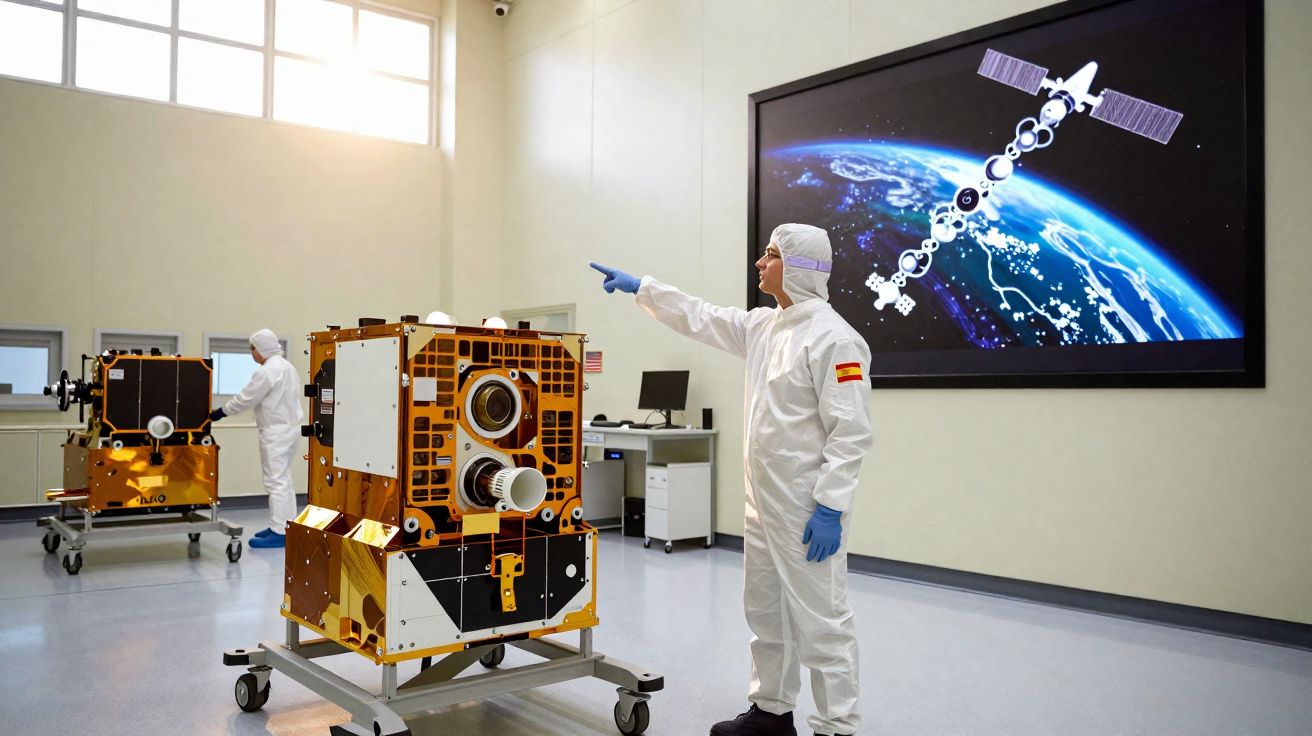
Spanish company Arquimea has been chosen by Lanteris Space Systems, a subsidiary of Intuitive Machines, to supply the structure for 18 satellites for the Space Development Agency’s Tranche 3 Tracking Layer constellation (SDA), an organisation within the United States Space Force tasked with accelerating the country’s military space capabilities.
What the SDA Tranche 3 Tracking Layer is designed to do
This deal places the Spanish firm inside one of the Pentagon’s most ambitious defence space programmes, focused on strengthening orbital detection and tracking of advanced threats, including hypersonic and ballistic missiles.
From an operational standpoint, the importance of the award is not only about scale. The SDA has stated that the Tranche 3 Tracking Layer will broaden warning, detection, tracking and identification capabilities against conventional and advanced threats, including hypersonic types. Once integrated with the Transport Layer, it is intended to improve the coverage and accuracy required to shorten detection and response chains when facing complex threats.
How Arquimea fits into the wider industrial chain
Arquimea’s role sits within a broader supply chain. In December 2025, the SDA awarded L3Harris a contract of up to 843 million dollars to build and operate 18 Tranche 3 Tracking Layer satellites, as part of an overall package of 72 satellites spread across four prime contractors. Later, in early March 2026, Intuitive Machines announced that its subsidiary Lanteris had been selected by L3Harris to design, manufacture and deliver those 18 space platforms.
Arquimea’s work on the Lanteris 300 LEO platform
Within that arrangement, Arquimea’s contribution will focus on the satellites’ structure, a critical element of the programme. The work will be carried out for the Lanteris 300 platform, a standardised LEO satellite bus designed for series production, multi-satellite joint deployment and sustained operations in high-tempo constellations. For the Spanish company, it will also be its first involvement with this specific platform, a meaningful step towards consolidating its position as a supplier for US defence LEO constellations.
What it signals for Spain’s space industry
For Spanish industry, the announcement underlines that national companies are no longer competing solely in civil or institutional niches of the space sector, but are also entering the core of the emerging defence-linked orbital economy. In Arquimea’s case, the contract strengthens its standing as an international provider of structural solutions for satellites and space vehicles, placing it within a US industrial chain connected to one of Washington’s current strategic priorities.






Comments
No comments yet. Be the first to comment!
Leave a Comment