
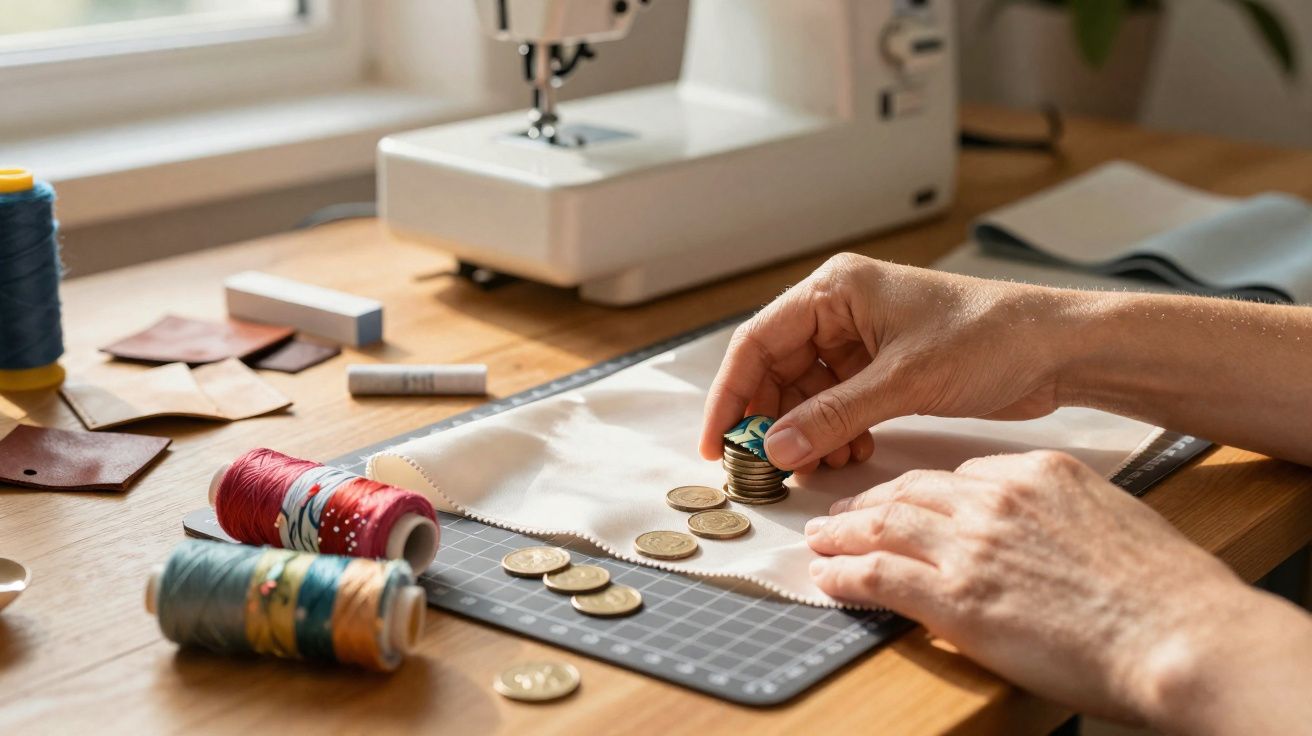
Working with silk, softshell or leather comes with a familiar headache: a single pin can leave damage you cannot undo. That is why a surprisingly straightforward idea has been passed around professional workrooms for years: unwanted coins are repurposed into small weights that hold pattern pieces in place without touching the fabric with a pin. What looks like worthless metal turns into a precise sewing aid.
Why coin pattern weights are so popular at the sewing machine
In plenty of homes there is a jar of old coins tucked away somewhere. Foreign currency, obsolete coins, bent pieces or ones that are heavily worn – they are no longer usable for paying. Among sewing enthusiasts, those exact coins become practical tools: they work as pattern weights that keep the paper pattern steady on the fabric, with no pins at all.
Coin weights keep fabric and pattern securely in place – without holes, without pulled threads, and without damaging the fibre structure.
Textile specialists have been advising for some time that, with delicate or technical materials, you should pin as little as possible. Every puncture can create a micro-perforation. You may not always notice it immediately, but it can permanently weaken the fibres.
Typical troublemakers include:
- Silk, chiffon, organza and other ultra-fine woven fabrics
- Softshell, performance fabrics and coated outdoor textiles
- Leather and faux leather
- Oilcloth, coated cotton and other coated fabrics
- Fine jerseys and knitted fabrics
With a rain jacket or softshell jacket, a pin suddenly becomes a genuine risk: each hole can later allow water through. Leather keeps every puncture like a scar. And silk can tear or ladder easily. This is exactly where coin weights shine: they hold everything in place using weight and friction alone.
Before you start: which old coins can you actually use?
Before you drop coins into your sewing box, it is worth taking a moment to check whether they have value. Not every old coin is automatically scrap. Some are still of interest to collectors; others may at least be worth something for their metal content.
Collectors often judge this using a rarity index from 0 to 100. A low number means the coin is common and usually less sought-after. One example from numismatics: a widely available silver coin with an index of 4/100 appears very frequently, but still has value because of its silver content.
That is the dividing line: coins containing precious metals do not belong in your sewing drawer. They should be checked first and, if in doubt, sold or kept.
Rule number one: sort first, then make – not the other way round.
Many of the best candidates for a sewing room are made from cupronickel – a copper–nickel alloy with no meaningful precious metal content. These pieces are ideal as working material:
- old circulation coins with no silver insert
- foreign cents, pennies or other “small change”
- visibly worn, scratched or tarnished coins
- coins produced in huge quantities that nobody collects
The key point is that you are not drilling through the coins or heavily deforming them. They are stacked, wrapped and remain clearly recognisable as coins. If you later discover a particular series is collectible after all, you can remove it from the fabric bundle.
How heavy good pattern weights should be
In day-to-day use, a clear range has proved itself: pattern weights for regular cutting typically fall between 40 and 60 grams each. That is heavy enough to stabilise a pattern piece without stretching or distorting the fabric.
A simple calculation helps with planning. If a typical old coin weighs about 10 grams, stacking four to six coins gives you the ideal weight for one sewing weight.
A useful rule of thumb:
- light, slippery fabrics (silk, chiffon): closer to 40 g
- standard woven fabrics (cotton, linen): 50–60 g
- sturdy fabrics (denim, canvas, coated fabrics): place multiple weights close together
What matters is not only total weight, but also how that weight spreads over the surface. A wider, flatter weight provides more stability than a narrow, tall stack.
Step-by-step: sew your own coin weights for the sewing room
You can make these helpers from a handful of leftover materials already in your sewing space. Here is the process, step by step.
1. Clean the coins
Old cupronickel coins can smell unpleasant or develop tarnish. A quick clean is enough:
- soak in lukewarm water with a little washing-up liquid
- give them a brief scrub with an old toothbrush
- rinse well and leave to dry completely
Only use coins that are genuinely dry, otherwise moisture can build up inside the fabric bundle later.
2. Build coin stacks
Now stack the coins into small towers – usually four to six coins, depending on the weight you want. If you prefer precision, keep kitchen scales nearby and check the gram reading. Ideally, all weights in one set should be as close in weight as possible so they behave consistently.
3. Add anti-slip cushioning
To stop the coins rattling inside and to help prevent the outer fabric from sliding, add a simple intermediate layer:
- wrap a strip of masking tape around the stack, or
- place a small circle of felt or thin cork sheet on the top and bottom
This keeps the stack firm and reduces metal-on-metal rubbing.
4. Sew fabric covers
For the cover, fabric offcuts in cotton or linen work well. Squares of about 10 × 10 centimetres are a proven size. Proceed as follows:
- cut the fabric pieces; optionally turn under edges or neaten them
- position the coin stack in the centre
- fold the corners in, like wrapping a small gift or sweet
- stitch close to the edges by machine or by hand
You end up with a compact little fabric parcel that sits comfortably in the hand, has no sharp edges, and holds the coins securely. Many people deliberately choose bright scraps – it makes the cutting table easier to scan and adds a bit of colour to the workroom.
Getting the best results with coin weights on softshell, silk and leather
In use, the benefits become obvious very quickly. A typical scenario is cutting a softshell rain jacket: if the pattern is held only with pins, tiny puncture channels can form in the membrane. Over time, persistent rain can push water through those openings.
If you sew with performance fabrics, keep the number of punctures as low as possible – ideally only in seams, not along cutting edges.
With coin weights, the workflow changes:
- lay down the pattern and smooth it flat
- place weights along the outer edges and at the corners
- on long straight runs, add extra weights in the middle
- mark seam allowances directly with chalk or a fabric marker
- cut with a rotary cutter or scissors without puncturing anything
On silk, fine viscose or jersey, the pressure from above stops the fabric shifting or warping while you cut. Pins can quickly cause ladders or visible holes in these materials. The coin bundles apply downward force only, without damaging the structure.
Leather is especially unforgiving: every pin mark remains visible because the fibres do not spring back. Pattern weights avoid that issue entirely. If you also want to minimise pinning during construction, you can use Wonder Clips or clamps and only put pins into seam allowances that will be hidden later.
Practical tips for everyday use in the sewing room
A little organisation helps coin weights keep performing well over time:
- Storage: keep them in a small box or basket next to the cutting mat
- Mix of sizes: have a few lighter and a few heavier weights ready
- Shape: aim for flatter and wider rather than tall and wobbly stacks
- Labelling: use different colours for different weights
If you often cut large pattern pieces, such as for coats or curtains, it helps to have extra weights that are slightly heavier. For small pieces like pockets or facings, scaled-down versions with two to three coins inside are usually enough.
Why the effort can pay off financially
Ready-made pattern weights can be expensive, particularly metal sets or those with special designs. Using old coins and fabric scraps achieves the same effect for almost no cost. At the same time, less material ends up in the bin, which is a clear plus from a sustainability point of view.
Just as importantly, it reduces the chance of ruining costly fabric. One failed cut in pure silk can cost noticeably more than all of your DIY coin weights put together. If you work with softshell or leather, this method also helps preserve the material’s technical properties – such as water resistance.
There is another side benefit too: the weights are the right size to double as an improvised paperweight, book support or photo holder on your desk. Those old coins become genuinely useful again – just in a very different way than they once were at the supermarket checkout.




Comments
No comments yet. Be the first to comment!
Leave a Comment