
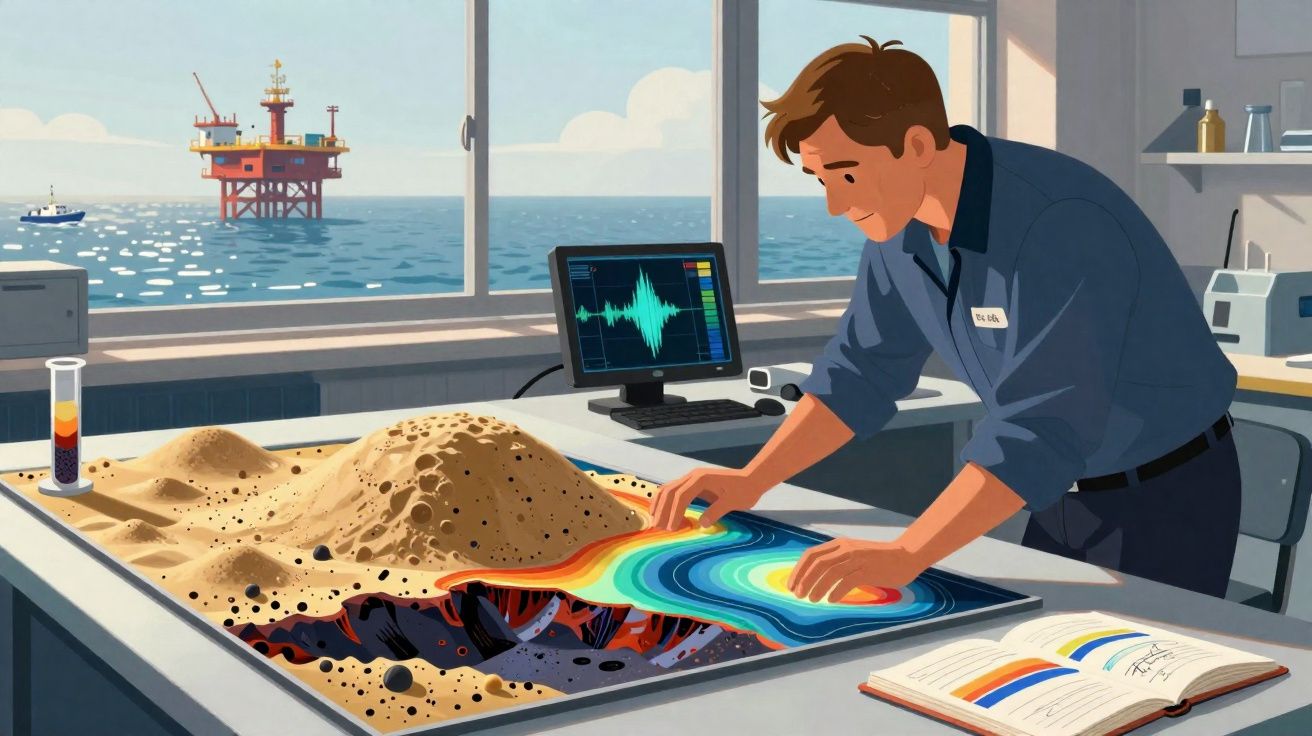
Deep below the North Sea, the seafloor appears to be acting in a way researchers did not anticipate.
Scientists have identified hundreds of enormous sand mounds-some measuring several kilometres across-which, according to a statement from the University of Manchester in the UK, "defy fundamental geological principles".
Sand mounds sitting on sinkites, driven by stratigraphic inversion
The newly recognised mounds are stacked on top of features known as sinkites, produced by a mechanism called stratigraphic inversion. Sinkites have not previously been documented in such high numbers.
"This discovery reveals a geological process we haven't seen before on this scale," says geophysicist Mads Huuse of the University of Manchester.
"What we've found are structures where dense sand has sunk into lighter sediments that floated to the top of the sand, effectively flipping the conventional layers we'd expect to see and creating huge mounds beneath the sea."
Why the layering is surprising: reverse stratigraphy and ‘floatites’
Normally, geological layers are expected to be arranged in a sequence that aligns with time: older strata at the base, with progressively younger layers nearer the top, reflecting the order of deposition.
Stratigraphic inversion-also called reverse stratigraphy-describes the opposite pattern, where younger layers end up lower down and older layers are shifted upwards. This can occur through several mechanisms, including rockslides and tectonic movements.
In this North Sea case, the researchers propose that younger sand layers, being denser and heavier than the softer, lighter material beneath them, gradually sank down. As the sand descended, it displaced older, more porous sediment and pushed that material upwards. The team refer to these porous, uplifted slabs as ‘floatites’, which now rest above the denser sinkite material.
How the North Sea sinkites were identified using seismic data
Huuse and fellow geophysicist Jan Erik Rudjord of Norwegian oil company Aker BP identified the sinkites at the base of the North Sea using detailed seismic data.
As acoustic waves move through the Earth, they travel and reflect differently depending on the density of the materials they pass through. By interpreting these differences, scientists can examine seismic data and map the various rock types the waves encountered.
Within the dataset, Huuse and Rudjord observed that extensive areas of the North Sea floor looked effectively inverted, with younger sandy layers positioned beneath older layers.
Timing and cause: a Miocene–Pliocene boundary origin
The team think the process most likely occurred around the Miocene–Pliocene boundary, approximately 5.3 million years ago.
They describe the older material as a lightweight, rigid, porous layer made mainly of microscopic marine fossils, overlain by a heavier layer. Disturbances such as earthquakes could have broken up the upper layer into sand, which then sank and swapped positions with the floatites.
Over the following millions of years, additional seafloor sediment settled across the entire structure, covering it and producing the rolling, undulating seafloor morphology observed there today.
Why the sinkites matter for reservoirs, sealing, and carbon capture and storage
The researchers are now working to refine and test their interpretation-work that could improve understanding of the oceanic Earth’s crust, including where it is weak, where it is stable, and the processes capable of dramatically changing these characteristics.
"This research shows how fluids and sediments can move around in the Earth's crust in unexpected ways. Understanding how these sinkites formed could significantly change how we assess underground reservoirs, sealing, and fluid migration – all of which are vital for carbon capture and storage," Huuse says.
"As with many scientific discoveries there are many skeptical voices, but also many who voice their support for the new model. Time and yet more research will tell just how widely applicable the model is."
The research has been published in Communications Earth & Environment.






Comments
No comments yet. Be the first to comment!
Leave a Comment