
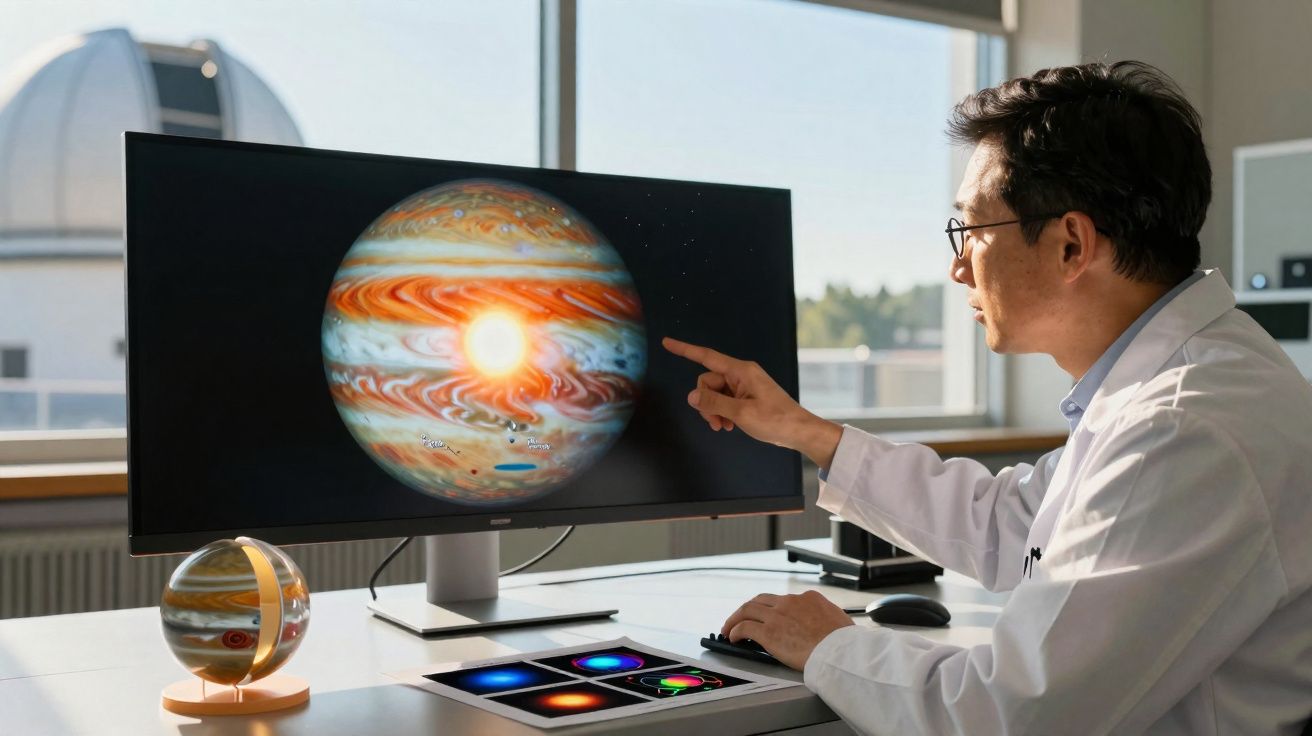
Jupiter still hides major clues deep within its interior, and researchers are not yet agreed on what is happening at the planet’s centre.
As the largest planet in our Solar System, Jupiter appears to contain what scientists describe as a “dilute core”: a central zone without the crisp, well-defined edges once expected. Rather than a clearly separated rocky centre wrapped in distinct gaseous layers, Jupiter’s innermost material seems to merge progressively into the hydrogen-rich layers above, forming a broad, smooth transition region.
What Juno revealed about Jupiter’s dilute core
This unexpected internal structure was first identified using data from NASA’s Juno spacecraft, which has been orbiting Jupiter since 2016. The discovery caught astronomers off guard, because prevailing models had assumed gas giants would typically possess more sharply bounded cores.
The puzzle grew even more intriguing when later observations indicated that Saturn also appears to have a similarly dilute core.
The giant impact theory: a dramatic explanation tested
One widely discussed idea for Jupiter’s blurred, “fuzzy” core proposed a violent collision early in the planet’s history. In this scenario, scientists suggested that a huge body-possibly carrying around half of Jupiter’s core material-smashed into the young planet with enough energy to churn and thoroughly mix the central region.
Such an event would have been extreme, stirring up the dense rock and ice thought to sit at Jupiter’s centre and blending it with the surrounding, lighter hydrogen and helium.
Simulating collisions with Jupiter-sized planets
To evaluate whether this giant impact theory could truly account for the structure Juno detected, a research group at Durham University set out to test it using high-powered computer simulations. Collaborating with scientists from NASA, SETI, and the University of Oslo, they used the DiRAC COSMA supercomputer to model what occurs when massive objects collide with planets the size of Jupiter.
The researchers carried out numerous simulation runs with state-of-the-art software, exploring a range of impact conditions-including exceptionally violent collisions. They also applied newer techniques designed to represent, more realistically, the way different materials would mix during such catastrophic events.
What the simulations showed
The outcomes were both unambiguous and surprising: none of the simulated impacts produced a long-lasting dilute core matching the one inferred for Jupiter. Instead, the models indicated that after a giant collision, the heavy rocky material would rapidly sink and re-form a sharply defined boundary between the core and the hydrogen-rich outer layers-precisely the opposite of what Juno’s measurements imply.
"We see in our simulations that this kind of impact literally shakes the planet to its core, just not in the right way to explain the interior of Jupiter that we see today." - Dr. Thomas Sandnes from Durham University.
The study, published in Monthly Notices of the Royal Astronomical Society, argues that Jupiter’s dilute core is more consistent with a far slower origin.
A gradual formation process, supported by Saturn
Rather than resulting from a single dramatic blow, the research suggests the unusual structure likely emerged as Jupiter formed over billions of years, steadily accreting both heavier and lighter material throughout its growth. This gradual-formation picture is bolstered by the fact that Saturn seems to share a dilute core as well.
Dr. Luis Teodoro of the University of Oslo noted that Saturn’s comparable interior structure supports the view that dilute cores are not the outcome of rare, ultra-high-energy impacts, but are instead produced progressively during the long timescales of planetary growth and evolution.
Implications for planets beyond our Solar System
The conclusions extend beyond our own Solar System. Astronomers have identified many planets around other stars that are similar in size to Jupiter and Saturn. If dilute cores arise through gradual formation rather than exceptional catastrophic collisions, then it is plausible that many of these distant giant worlds also contain comparably complex internal structures.
The work also underlines a broader point: while giant impacts clearly played important roles in shaping planets, they do not account for every internal feature we observe.
As researchers continue investigating our stellar neighbourhood and the thousands of planets beyond it, enigmas like Jupiter’s core are a reminder that the Universe still has plenty left to surprise us.
This article was originally published by Universe Today. Read the original article.






Comments
No comments yet. Be the first to comment!
Leave a Comment