

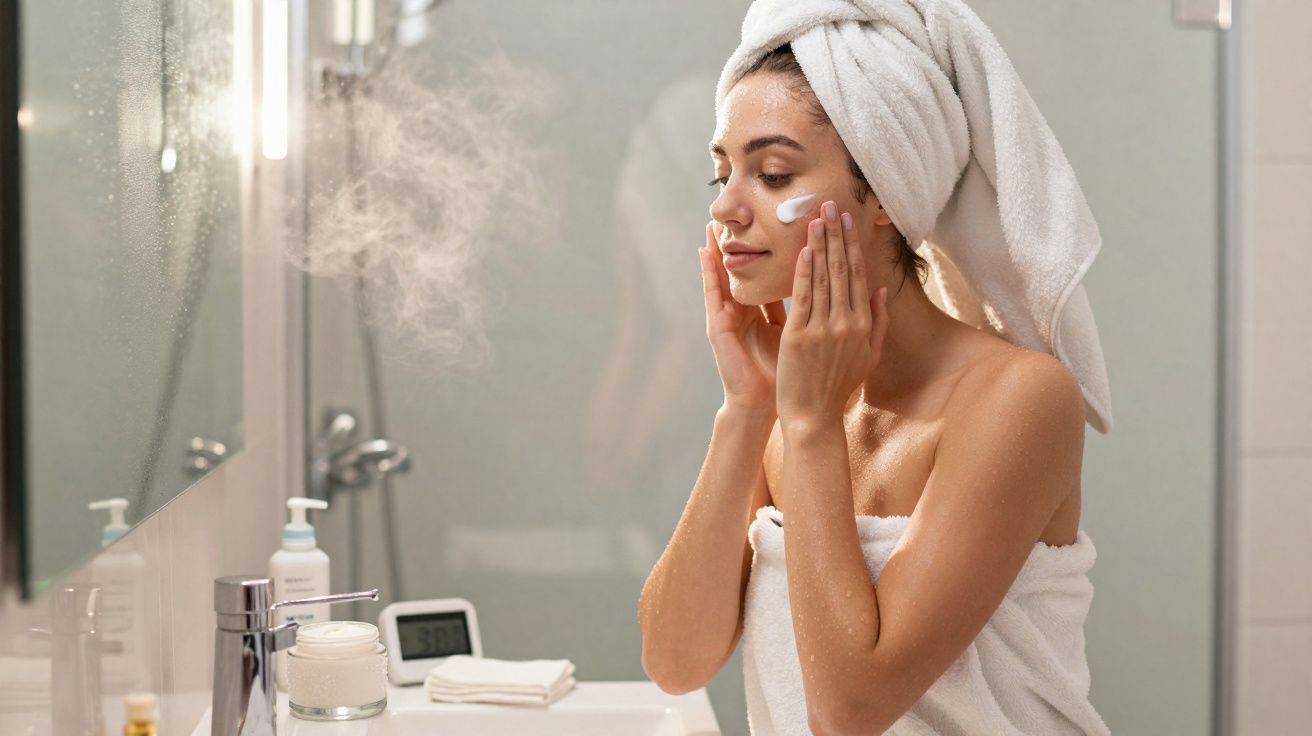
The first crack usually happens in the bathroom - not on your phone screen. You turn the tap off, step out of the shower and grab the same towel that’s been hanging there all week. On autopilot, you do what you’ve done for years: flip your hair over, rub hard, rub again, give it a rough scrunch, then head to the mirror and wonder why your ends look like they’ve been dragged through a sandstorm. Meanwhile the shelf keeps filling up - oils, serums, bond builders, masks that cost more than dinner - yet you still find broken bits in your brush and hair in the plughole. One tiny, mindless habit can quietly undo all that effort and money.
Chances are, you’re doing it right now without realising it’s the culprit.
Why the way you dry your hair matters more than your shampoo (towel-drying and breakage)
Look around any gym changing room or hotel bathroom and you’ll see a familiar routine. People step out of the shower and go at their hair with a standard bath towel like they’re scrubbing a roasting tin. It feels quick and effective, and it’s what most of us learned as kids. A few seconds of vigorous rubbing, then a tight towel turban twisted until it tugs, followed by styling tools cranked up to full heat. The result? Frayed ends, frizz at the crown, and the assumption it’s down to genetics, the weather, or “just bad hair”.
The problem is that hair is most fragile when it’s wet. The cuticle (the outer layer) lifts slightly, the internal bonds are more pliable, and the weight of water stretches each strand. Add friction from a thick cotton towel and the strain of tight twisting, and you create tiny fractures along the hair shaft. Over time, those micro-cracks show up as split ends, rough texture and that tell-tale halo of frizz. We often blame breakage on colouring, bleach or hot tools - but fibre-damage research is clear: repeated mechanical stress (like aggressive towel drying) can, over the long term, rival chemical stress. Your drying routine is quietly shaping what your hair will look and feel like in a few months’ time.
A hairstylist once described a client who poured a small fortune into bond-repair treatments. Her bathroom looked like a salon display: plex-style treatments, keratin, glosses and pricey masks. Yet her mid-lengths kept snapping. When the stylist watched her dry her hair, the issue became obvious: she used a rough cotton towel and “sawed” it back and forth at the scalp as if she were trying to start a fire. The stylist stopped her mid-rub. That seemingly harmless motion, repeated several times a week, was doing more damage than skipping a mask or buying the “wrong” shampoo.
The small drying tweak that changes everything
The fix is almost absurdly simple: stop rubbing and start gently squeezing and blotting with a smoother fabric.
Swap your thick bath towel for a microfibre towel, a dedicated hair turban, or even a soft cotton T‑shirt. Then press water out rather than scrubbing it away. Wrap the fabric around a section, squeeze, release. Think “gentle hug”, not “attack”. You’ll still remove excess water - just without grinding down the cuticle. If you wash your hair frequently, this one change can dramatically reduce mechanical damage.
It’s also the stage where several small mistakes tend to stack up:
- A heavy towel twisted tightly on top of the head can pull at a vulnerable hairline.
- Leaving hair dripping wet and bundled for ages can weaken roots and squash volume.
- Blasting a hairdryer at soaking hair can overheat the strand (and in extreme cases, the water inside it), pushing damage faster than you expect.
If any of that sounds familiar, you’re in good company. Most people don’t do it perfectly every day - but the days we do rush it, our hair keeps the score.
A London-based trichologist told me: “If people changed just one thing in their routine, I’d tell them to stop rough towel drying. I’ve seen less breakage from bleach than from years of aggressive rubbing on fragile hair.”
A better towel-drying routine (microfibre towel, T‑shirt, heat and breakage)
- Swap the fabric - Choose a microfibre towel or a smooth cotton T‑shirt rather than a rough bath towel.
- Change the motion - Press, squeeze and blot sections; avoid back-and-forth rubbing or twisting.
- Shorten towel time - Keep hair wrapped for 5–10 minutes, then let the scalp and roots breathe.
- Lower the heat - Once excess water is removed, use medium heat and keep the hairdryer moving.
- Add a buffer - A light leave-in conditioner adds slip so strands glide instead of snag.
One extra upgrade most people overlook: detangle while your hair is damp, not drenched. After blotting, use your fingers or a wide-tooth comb and start at the ends, working upwards. This reduces snagging when the hair is at its most elastic and least able to cope with tugging.
It’s also worth treating your towel like a tool, not a bathroom fixture. A towel that’s been hanging around for days can be rougher (and less hygienic) than you think. Washing microfibre regularly and letting it dry fully between uses helps it stay smooth, absorbent and kinder to the cuticle.
Your quiet hair revolution starts in the first five minutes
There’s something quietly liberating about realising you don’t necessarily need another £30 spray to see improvement - you need a different habit. Those first five minutes after a shower often decide whether your hair spends the week battling damage or working with you. Slow down just slightly and treat wet hair like the delicate fibre it is, and the shift can be obvious: frizz looks softer, ends tangle less, and your brush doesn’t fill up as quickly. It won’t become a viral TikTok trick, but your hair will register the difference. Sometimes the most effective routine upgrade is the one nobody notices you doing.
| Key point | Detail | Value for the reader |
|---|---|---|
| Gentle drying beats harsh rubbing | Move from scrubbing with a bath towel to pressing with microfibre or a T‑shirt | Less breakage, a smoother cuticle, and more consistent “good hair days” |
| Small habit, big impact | Protecting the drying step can do more than many expensive products | Saves money on treatments while improving long-term strength |
| Wet hair is most vulnerable | Strands stretch more easily and friction creates micro-damage that accumulates | Knowing this helps you handle hair more gently when it needs it most |
FAQ
Question 1: Do I really need a special microfibre towel, or is a T‑shirt enough?
Answer 1: A dedicated microfibre towel is excellent, but a soft cotton T‑shirt already reduces friction significantly compared with a standard bath towel.Question 2: How dry should my hair be before using a hairdryer?
Answer 2: Aim for roughly 60–70% dry after blotting with a towel or T‑shirt, then finish with a hairdryer on medium heat and moderate airflow.Question 3: Is air-drying always better than blow-drying?
Answer 3: Not necessarily. Staying soaked for long periods can cause the hair shaft to swell, so gentle pre-drying followed by controlled blow-drying can be kinder than hours of dripping-wet air-drying.Question 4: Can this small change really compete with bond-repair products?
Answer 4: Yes - because it prevents daily mechanical damage. Products can coat and support hair, but changing the drying habit reduces how often you need “repair” in the first place.Question 5: How quickly will I notice less breakage after changing my towel routine?
Answer 5: Within a few weeks you may see less hair in your brush and fewer snapped ends. More noticeable improvements appear over several months as healthier new growth comes through.



Comments
No comments yet. Be the first to comment!
Leave a Comment