
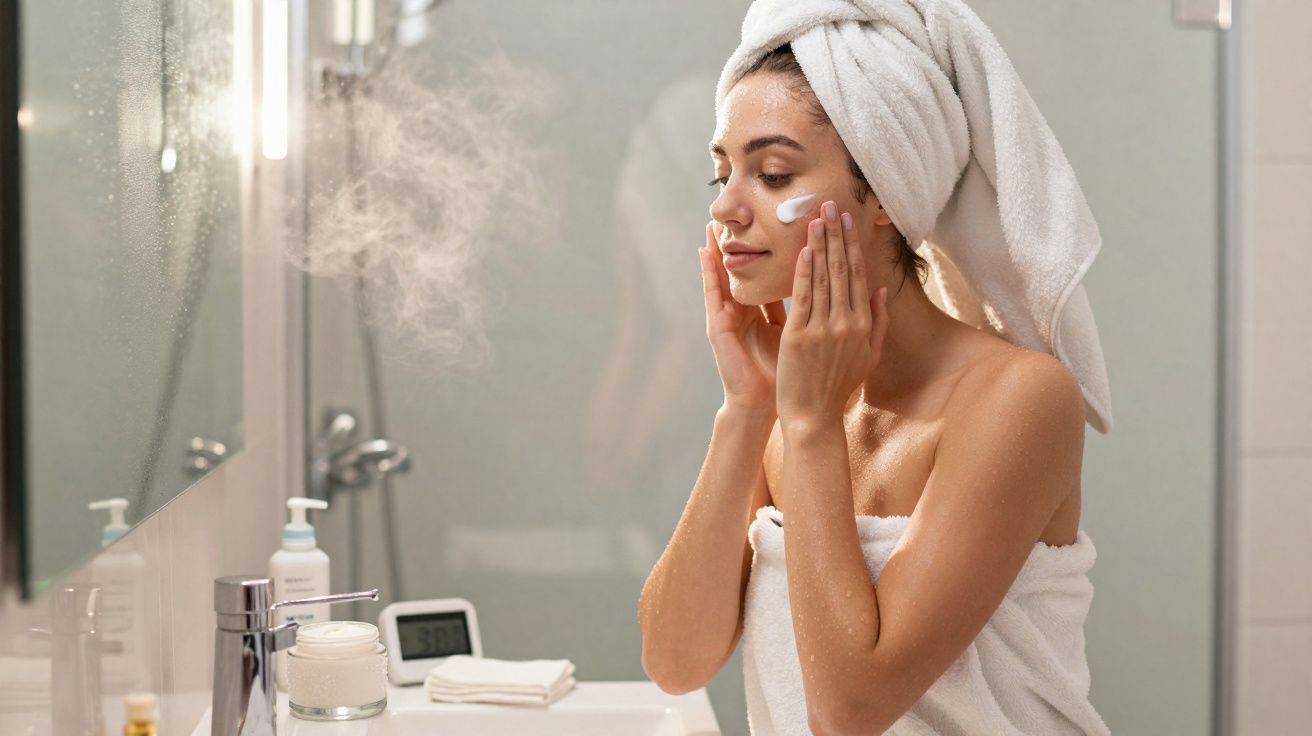
The bathroom mirror is still clouded when you step out of the shower.
The tiles feel warm underfoot; the air is heavy with steam; your towel is wrapped a little too tightly. You swipe a clear circle in the glass and spot your own face-flushed from the heat, with that familiar tightness beginning around your mouth.
Your moisturiser is sitting on the shelf a couple of steps away, like a friend you keep meaning to ring. You tell yourself, “I’ll put it on after I’m dressed.” Then your phone vibrates. The coffee machine chirps. The children shout. Ten minutes disappear. Your skin is now properly dry… and you’re essentially back at square one.
That tiny pause-those distracted five minutes-can be exactly why an expensive cream ends up feeling like it “does nothing”.
Why the 3 minutes after your shower change everything for your moisturiser
Dermatologists often describe the brief window straight after washing as the “moisture moment”. Your skin is holding plenty of water, pores are more relaxed, and the surface barrier is slightly swollen-meaning it can be more receptive than it is later on.
Put moisturiser on during that moment and you’re doing more than “adding hydration”. You’re sealing in the water that’s already sitting in the skin before it escapes into the air-like putting a lid on a simmering pan instead of letting the steam drift away.
Leave it ten minutes and the job changes. You’re no longer locking moisture in; you’re simply spreading product over skin that has already dried out.
A large clinical dermatology review reported something many people find surprising: applying moisturiser to damp skin immediately after bathing can be close to twice as effective at improving hydration compared with using the same product on fully dry skin.
Picture someone dealing with winter eczema. They shower, pat dry, and then straight away apply a plain, fragrance-free cream. After a few weeks, the redness eases, itching settles, and the skin starts to feel tougher and less reactive.
Now imagine the same person using the same cream, but waiting 20 minutes until their skin is bone-dry. Improvement tends to be slower. There are more flare-ups, more scratch marks from the night, and less comfort for the same spend. That is the quiet cost of leaving it too long.
We spend a lot of time hunting for the “right” product, yet timing can change the outcome just as much. It’s like watering a plant in the cool of early morning rather than in midday sun-the effort lands differently.
From a skin-physics point of view, it’s almost dullly straightforward. Water wants to evaporate, and hot showers speed that up. The moment you step out, your skin begins losing water via transepidermal water loss.
When you apply a cream or lotion to damp skin, the emollients and occlusives form a thin film. Humectants such as glycerin or hyaluronic acid help draw remaining droplets into the upper layers, while that film slows down evaporation.
Apply the same cream to dry skin and you’ve removed half the advantage. There’s simply less water available to trap and less to pull inwards. You’ll still soften the surface, but you won’t “flood” it with hydration in the same way.
That’s why a £10 chemist’s moisturiser used in the right three-minute window can quietly beat a luxury jar applied too late.
The “three-minute rule” that helps your moisturiser finally work
The habit is simple, and it changes the whole picture: keep your moisturiser in the bathroom and apply it within three minutes of turning off the water. Not “after the mirror clears”. Not “once I’ve checked my notifications”. Within three minutes.
Pat your skin gently with a towel so it’s no longer dripping, but still slightly damp. Then use a generous amount of product and smooth it on in long, unhurried strokes-face, neck, chest, and whichever body areas tend to protest most in winter.
This isn’t about a spa-style massage. It’s about shutting the door on the water that’s already there.
A typical weekday version looks like this:
- Shower off, open the curtain, and grab your towel.
- Blot for 30–60 seconds, just enough so water isn’t running.
- While you’re still wrapped in the towel, apply moisturiser straight away-face first, then body.
- Two or three minutes later, you can get dressed, check your phone, and wrestle with the hairdryer.
On a chaotic morning-children, emails, doorbells-make it even easier. Keep a pump bottle on the edge of the basin so it’s practically impossible to ignore. Most people won’t manage it every single day, but on the days you do, your skin notices.
On the technical side, the “twice as effective” claim comes from measuring how much water the upper layers of skin hold over time-what researchers call stratum corneum hydration. When moisturiser goes on damp skin, those readings remain higher for longer.
Your skin barrier-a thin, slightly oily wall of corneocytes and lipids-functions better when it isn’t parched and cracking. By closing that moisture moment quickly, you reduce microscopic gaps and keep the barrier flexible.
That’s also why people who adopt this timing often report that their skin seems to “drink less product” after a few weeks. You don’t magically need less cream; your barrier simply stops behaving like a leaky roof.
Getting practical: what to apply, how much, and what to skip
To make the after-shower advantage actually count, choose a moisturiser designed to hold water in place. A strong option usually combines:
- Humectants (glycerin, urea, hyaluronic acid)
- Emollients (plant oils, fatty alcohols)
- Occlusives (petrolatum, dimethicone, shea butter)
Apply enough that you can see a sheen for a second before it sinks in. Too little and you won’t seal much; too much and you’ll feel tacky when you pull on jeans. For the face, aim for roughly a blueberry-sized amount. For the body, think around 30 ml (about a small shot glass) as a rough starting point.
If your skin stings or goes red each time, that isn’t “normal sensitivity”-it’s a sign to change the formula.
In real life, the most common mistake isn’t ingredient choice. It’s the slow drift in timing: you step out, reply to a WhatsApp message, glance at an email, wrap your hair, and suddenly eight minutes have passed.
Another common trap is pairing scalding-hot showers (which strip the skin) with a feather-light gel that smells wonderful but doesn’t properly hydrate. You leave the bathroom fragranced, yet an hour later your shins still look like chalk.
And on a bad day, that can spiral into, “My skin is just difficult.” Often it’s less about your body being “problematic” and more about a routine built for marketing rather than real mornings. Many people know that harsh moment under unforgiving light when you look at your legs and wonder when they started to resemble paper.
“Your moisturiser isn’t weak. It’s just arriving late to the party.” - a London dermatologist told me that in a cramped clinic waiting room, while patients shuffled past with scarves pulled up to their noses.
A quick checklist to keep the three-minute rule realistic
- Right after shower: Pat dry, then apply a generous layer of moisturiser within three minutes, while skin is still slightly damp.
- Water temperature: Keep it warm, not steaming hot, so you don’t strip natural oils before you even reach for the cream.
- Simple formula first: If your skin is reactive, start with fragrance-free, straightforward creams before adding active ingredients.
- Body and face: The same timing applies to both, even if you use different products.
- Make it visible: Store your moisturiser where you physically can’t miss it as you step out of the shower.
Two extra tweaks that amplify the moisture moment
If you live in a hard-water area, you may notice your skin feels tighter straight after rinsing. Hard water can leave mineral residue that makes dryness feel worse, especially in winter. Keeping showers shorter, using a gentle cleanser, and applying moisturiser promptly can offset that “squeaky” feeling without turning your routine into a science project.
It also helps to rethink what happens before the moisturiser goes on. Long, very hot showers and harsh, foaming body washes can compromise the skin barrier, meaning you start the three-minute rule already on the back foot. A mild, fragrance-free wash and a shorter shower length make it easier for your moisturiser to do its job.
The small habit that quietly changes how your skin feels
Treat this less like a beauty trick and more like a tiny environmental adjustment. You’re not reinventing yourself. You’re simply changing what happens during the first three minutes-when your skin is most open, most thirsty, and most forgiving.
For some people, that shift means fewer flaky patches and less foundation clinging to dry areas. For others, it means scratching less at 3 am, or no longer bracing for the sting of tights against raw winter legs. The reward is unglamorous but significant: your skin just… causes less trouble.
There’s something quietly personal about catching that moment and deciding, “Right-let’s lock this in before the day runs away with me.” It’s care that doesn’t demand a selfie and doesn’t instantly change what you see in the mirror. But after a few weeks, your skin tells a calmer story.
You might even find that the very same bottle of cream, used at the right time, finally behaves the way the advert implied. Not because the formula changed-because you did, slightly.
| Key point | Detail | Why it matters to you |
|---|---|---|
| Moisturise within 3 minutes | Apply cream on damp skin immediately after showering | Maximises hydration by sealing in existing water |
| Choose the right texture | A mix of humectants, emollients, and occlusives works best | Better comfort and longer-lasting softness |
| Mind the whole routine | Warm (not hot) water and enough product | Reduces dryness, itching, and irritation day after day |
FAQ
- Do I really need to moisturise after every single shower? Not necessarily, but the more often you catch that post-shower window, the more stable and comfortable your skin barrier tends to become over time.
- What if I forget and my skin is already dry? Apply your moisturiser anyway-you’ll still get softness, but you’ll miss some of the deeper hydration boost you’d get on damp skin, so aim to catch the window next time.
- Is body oil better than cream on wet skin? Oils are excellent at sealing, but they don’t add much water. A light lotion on damp skin followed by a thin layer of oil on top can work very well.
- Can I use my regular face cream on my body after a shower? You can, but it’s usually pricier and not always rich enough for larger, drier areas such as legs and arms, so a dedicated body lotion is often more practical.
- How long should I wait before getting dressed? Give it two to five minutes for the main layer to settle. If your clothes slide on without sticking, you’re good to go.




Comments
No comments yet. Be the first to comment!
Leave a Comment