
New European Union (EU) rules on the driving licence took effect on 25 November, aiming to strengthen road safety, cut accidents and bring Member States’ laws into closer alignment.
Member States now have three years to transpose the directive into national law, plus a further year to get ready for practical implementation. So what, in practice, changes for anyone taking a driving licence in Portugal?
Driving licence at 17 (Category B)
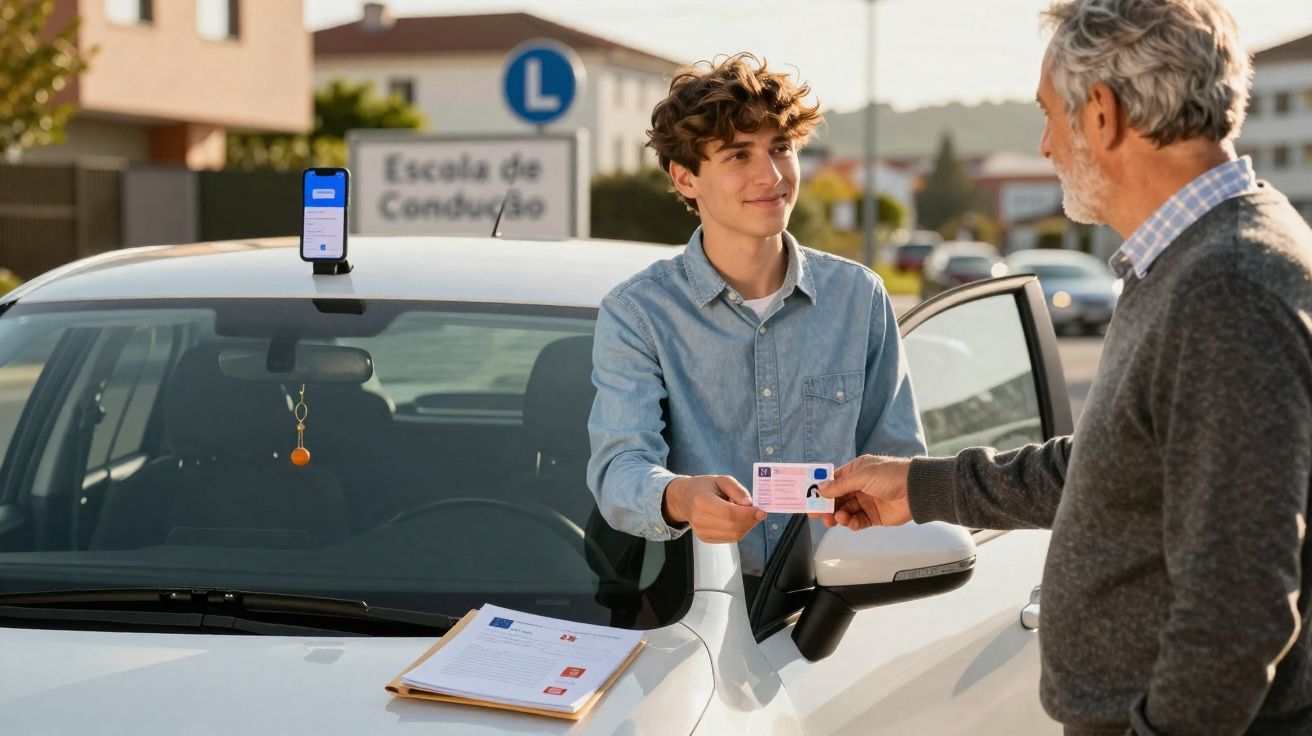
The most notable change is that young people will be able to obtain a light vehicle driving licence (Category B) at 17 - but only under a specific condition. Until they turn 18, they may drive only when accompanied by an experienced driver. At present, in Portugal, a light vehicle licence can only be obtained from the age of 18.
Heavy goods and passenger driving licences (Categories C and D)
For heavy goods vehicles (Category C) and passenger vehicles (Category D), the updated rules mainly restate what already applies in Portugal. With a certificate of professional competence, it is possible to obtain Category C at 18 and Category D at 21; without this certificate, the age thresholds remain 21 and 24. As a result, in this area there is virtually no change compared with Portuguese national rules.
If you are unsure about the requirements for getting a driving licence, you can find more information on the IMT website.
Theory test (highway code)
New drivers will now receive training that is more focused on real-world risk situations. This includes hazards linked to blind spots, driver-assistance systems, safe door opening, and distractions caused by mobile phone use.
The theory test will be updated to reflect these topics, adding to the existing areas covering road signs, legislation and road safety. In Portugal, this is expected to mean a gradual adjustment of the test content, without changing the core approach of the process.
Mandatory probationary period of 2 years
A minimum probationary period of two years becomes compulsory across all Member States. Portugal already applies a probationary period of three years, so this change is unlikely to make much difference domestically.
Validity of the driving licence
The validity period for car and motorcycle licences remains 15 years, although it may be reduced to 10 years if the licence is used as an identity document. Licences for lorries and buses continue to be renewed every five years.
For drivers aged over 65, the validity period may be shortened. However, this is already broadly consistent with Portuguese rules, which require periodic renewal and a medical certificate from the age of 60. You can check how often you need to renew your licence.
Digital driving licence
The new rules also introduce a digital driving licence, accessible via a mobile phone. The EU’s intention is for this to become the official format. In Portugal, a digital version is already available through the id.gov.pt app.
A physical licence will still be available on request, with delivery within three weeks.
What still needs to happen?
Member States have three years to transpose the directive into national legislation and an additional year to prepare its practical rollout.
Overall, the EU’s new rules modernise and harmonise the driving licence framework, but for Portuguese drivers the most meaningful shift is the option to obtain a light vehicle licence at 17, provided driving is supervised. The remaining updates - such as the digital driving licence and modest changes to the theory test - are intended to bring the system up to date without fundamentally altering what is already in place in Portugal.



Comments
No comments yet. Be the first to comment!
Leave a Comment