
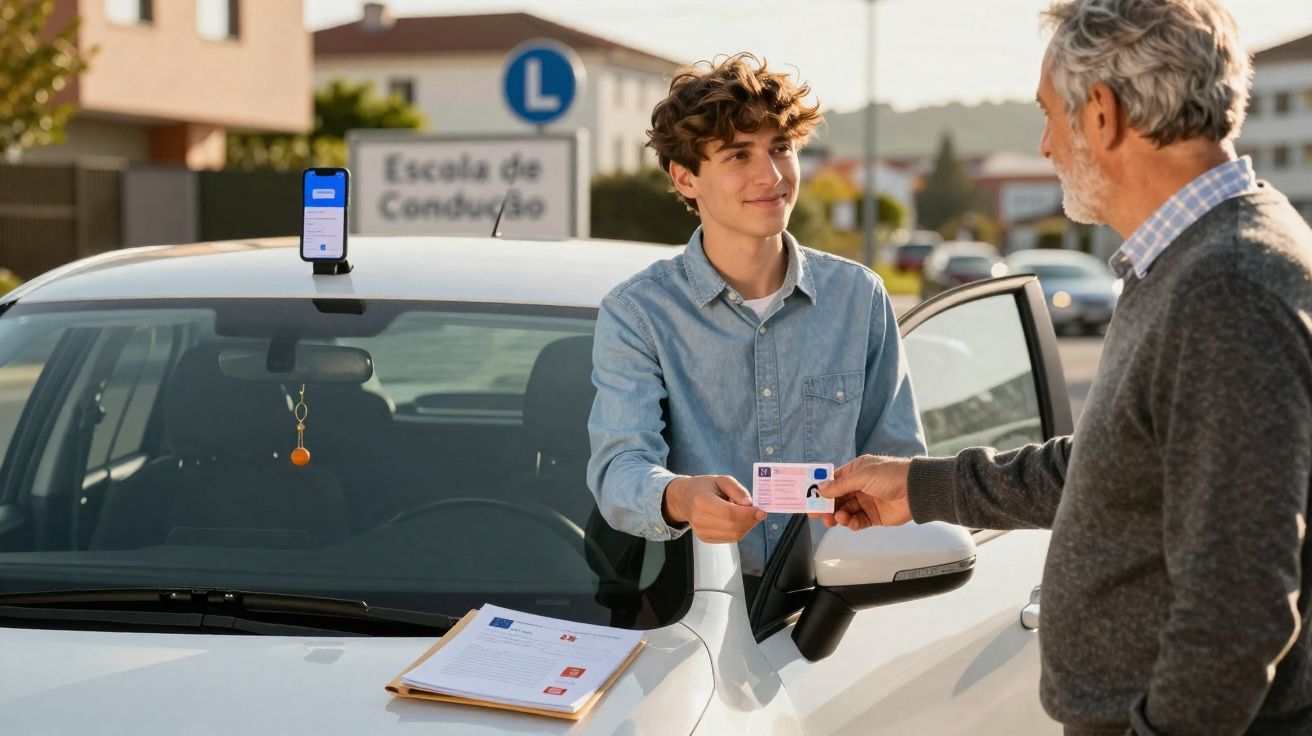
Learning to drive in Portugal is about to change. In a Council of Ministers meeting, the Government approved a new Legal Regime for Driver Training as part of the Mobility 2.0 package. The reform allows people applying for a category B driving licence to learn with a tutor, partially replacing the practical lessons normally taken at driving schools.
This is a major shift from the current approach, although it does not start from scratch. Until now, tutor-supervised driving already existed in law. The key difference is that it will, for the first time, be able to replace part of the traditional practical training.
What was already permitted up to now
Previously, supervised driving with a tutor could only be used to supplement the mandatory practical training-never as an alternative. To use this route, a candidate first had to complete a minimum number of hours and kilometres driving with a certified instructor.
Only after meeting those thresholds could the learner drive with an approved tutor. That tutor had to satisfy specific requirements-ranging from how long they had held a licence to having no serious road traffic offences-and also accept responsibility for offences committed by the learner.
In reality, the system was designed to help learners build additional experience, without replacing the instruction delivered by driving schools.
What has now been approved in the new Legal Regime for Driver Training?
The Government’s decision changes that underlying principle. Under the new regime, learning with a tutor can become an alternative to attending traditional practical lessons, although driving schools will still assess whether additional lessons are required.
“We allow the tutor to be registered, without removing the absolutely essential role of driving schools and the subsequent final driving test,” added Miguel Pinto Luz, Minister for Infrastructure and Housing.
According to the minister, the intention is to create a model that safeguards every aspect of road safety, while also making it possible for teaching to happen, for example, within families-such as from parents to children or from grandparents to grandchildren.
The regime applies to candidates aged over 18 who want to obtain a category B licence (light vehicles).
In addition, the rules on the “sharing and hiring of vehicles” have been clarified, with the aim of reducing costs. “Driving schools can manage their service fleets and can share,” Pinto Luz concluded.
Not all operational details of the new model are known yet, but the direction is clear: learning with a tutor will stop being merely an add-on and may take on a central role in the training pathway-an approach that is already being criticised by the sector.
ANIECA opposes the decision
According to the National Association of Driving Schools (ANIECA), the measure approved by the Government is not broadly accepted. The association calls it a “civilisational step backwards” in terms of road safety and warns of potential negative effects on accident rates.
“ANIECA reminds us that all relevant driver-training bodies expressed their opposition to these measures. Approving structural changes to the legal regime for driver training against the sector’s technical and professional consensus is incomprehensible and deeply worrying,” the statement says.
The association argues that cutting back practical training delivered by certified instructors undermines learning quality, and it points to international examples where similar models were later reversed. By comparison, it highlights countries such as the United States, where this type of system exists but road death rates are significantly higher than in Portugal.
It remains to be seen how the new regime will be regulated in practice, and what measures will be put in place to protect the safety criteria that have, until now, strongly limited this type of learning.





Comments
No comments yet. Be the first to comment!
Leave a Comment