
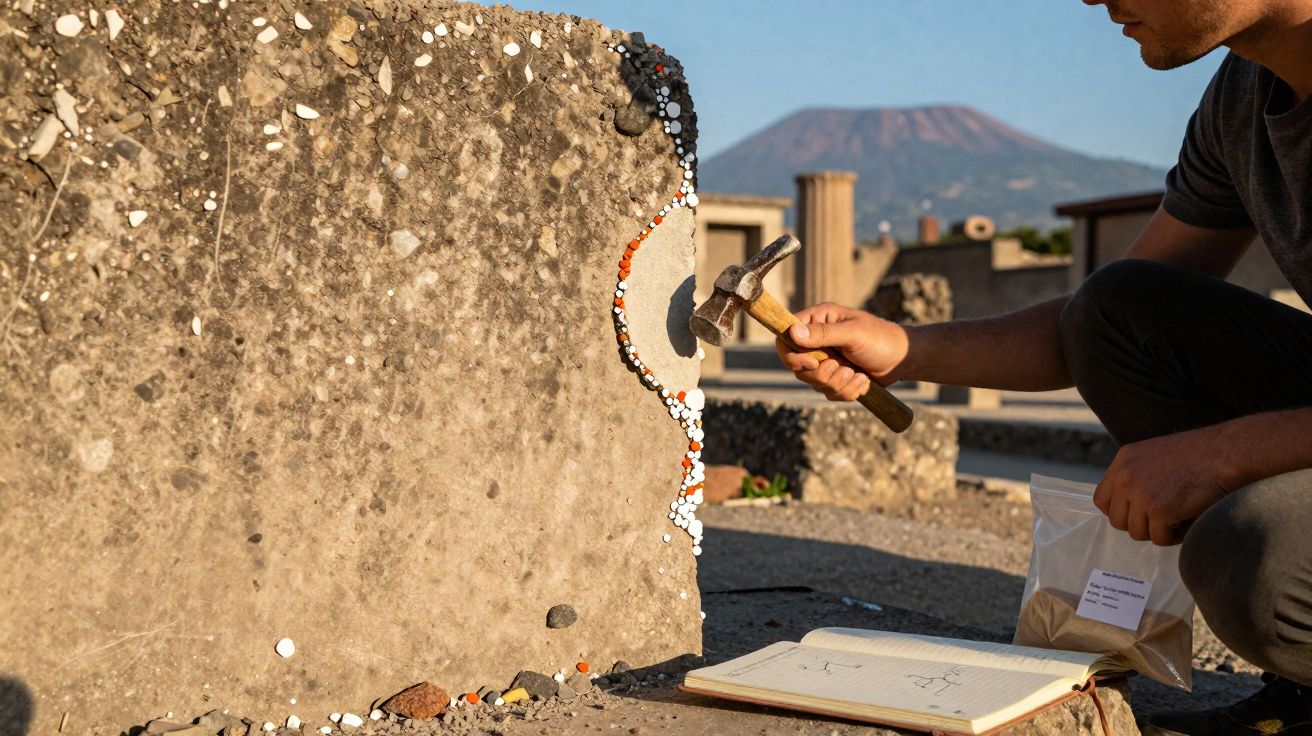
A construction site preserved for almost 2,000 years since the presumed destruction of Pompeii in 79 CE has produced fresh evidence pointing to the hidden factor behind Ancient Rome’s exceptionally durable concrete.
Pompeii’s time-capsule building site and Roman concrete materials
In the past year, archaeologists digging beneath the volcanic ash that entombed Pompeii uncovered a complete, undisturbed construction site - a rare, frozen-in-time view of Roman building practice.
Among the finds were carefully organised piles of raw materials, including components used to make the famously long-lasting concrete seen in structures such as the Pantheon, whose enormous unreinforced dome has endured for millennia.
“Hot-mixing” in Roman concrete: pozzolan, quicklime, and heat
A new analysis indicates the key was a method that MIT materials scientist Admir Masic refers to as "hot-mixing".
In this approach, the concrete ingredients are combined directly: a volcanic-ash blend known as pozzolan is mixed with quicklime, which reacts with water and generates intense heat throughout the mixture.
"The benefits of hot mixing are twofold," Masic said back in 2023 when he first discovered the technique through experimentation.
"First, when the overall concrete is heated to high temperatures, it allows chemistries that are not possible if you only used slaked lime, producing high-temperature-associated compounds that would not otherwise form. Second, this increased temperature significantly reduces curing and setting times since all the reactions are accelerated, allowing for much faster construction."
Lime clasts and the self-healing behaviour of Roman concrete
Beyond speed and chemistry, the method appears to deliver a third, vital advantage: leftover fragments of lime - known as clasts - give the material an unusual ability to heal itself. This may help explain why so many Roman monuments remain standing while works from other societies have fallen into ruin.
As cracks develop, they tend to extend towards the lime clasts, which present a greater surface area than other particles in the matrix. When water reaches the crack, it reacts with the lime and produces a calcium-rich solution. As this solution dries, it hardens into calcium carbonate, effectively bonding the crack shut and stopping further spread.
"There is the historic importance of this material, and then there is the scientific and technological importance of understanding it," Masic says.
"This material can heal itself over thousands of years, it is reactive, and it is highly dynamic. It has survived earthquakes and volcanoes. It has endured under the sea and survived degradation from the elements."
Why Vitruvius’ De architectura didn’t match the evidence
Although hot-mixing helps answer long-standing questions about Roman concrete, it also introduces another: the recipe does not align with the instructions described in the 1 BCE treatise De architectura by the architect Vitruvius.
Vitruvius’ method begins by mixing lime with water - a step called slaking - and only then combining the slaked lime with pozzolan. Yet that sequence does not produce the lime clasts observed in real samples of Roman concrete.
This discrepancy has baffled researchers for years. Vitruvius’ writings are the most comprehensive surviving accounts of Roman architecture and construction. He outlines a wall-building technique known as opus caementicium, but physical evidence from ancient structures has repeatedly conflicted with his description.
Isotope analysis and microscopy: the “archaeological smoking gun”
The Pompeii discovery appears to settle the issue. Masic and colleagues carried out isotope analysis on five dry piles of materials, identifying pozzolan composed of pumice and lithic ash, quicklime, and even lime clasts.
Crucially, the ingredients were already mixed together in dry form - an archaeological smoking gun.
Microscopic examination of mortar taken from walls showed clear signs consistent with hot mixing: shattered lime clasts, calcium-rich reaction rims extending into volcanic-ash particles, and minute crystals of calcite and aragonite forming within pumice vesicles.
Raman spectroscopy supported the mineral changes, and isotope analysis traced the chemical routes of carbonation over time.
"Through these stable isotope studies, we could follow these critical carbonation reactions over time, allowing us to distinguish hot-mixed lime from the slaked lime originally described by Vitruvius," Masic says.
"These results revealed that the Romans prepared their binding material by taking calcined limestone (quicklime), grinding [it] to a certain size, mixing it dry with volcanic ash, and then eventually adding water to create a cementing matrix."
This does not automatically mean Vitruvius was incorrect - he may have been documenting a different concrete-making method, or his text may have been misunderstood - but it does suggest that the most resilient version of the material depended on hot-mixing.
What Roman “hot-mixing” could mean for modern concrete and DMAT
The researchers argue this knowledge could be folded into how concrete is made today, long after the Roman Empire’s collapse, with its buildings still standing as evidence not only of its scale but also of its inventiveness.
Modern concrete is among the most commonly used construction materials worldwide. At the same time, it often performs poorly over the long term, with many structures degrading within decades under environmental pressure. Its production is also highly damaging environmentally, demanding vast resources and adding to greenhouse emissions.
Boosting concrete durability alone could make the material far more sustainable.
"We don't want to completely copy Roman concrete today. We just want to translate a few sentences from this book of knowledge into our modern construction practices," says Masic, who has started a company called DMAT to do just that.
"The way these pores in volcanic ingredients can be filled through recrystallization is a dream process we want to translate into our modern materials. We want materials that regenerate themselves."
The research has been published in Nature Communications.


Comments
No comments yet. Be the first to comment!
Leave a Comment