
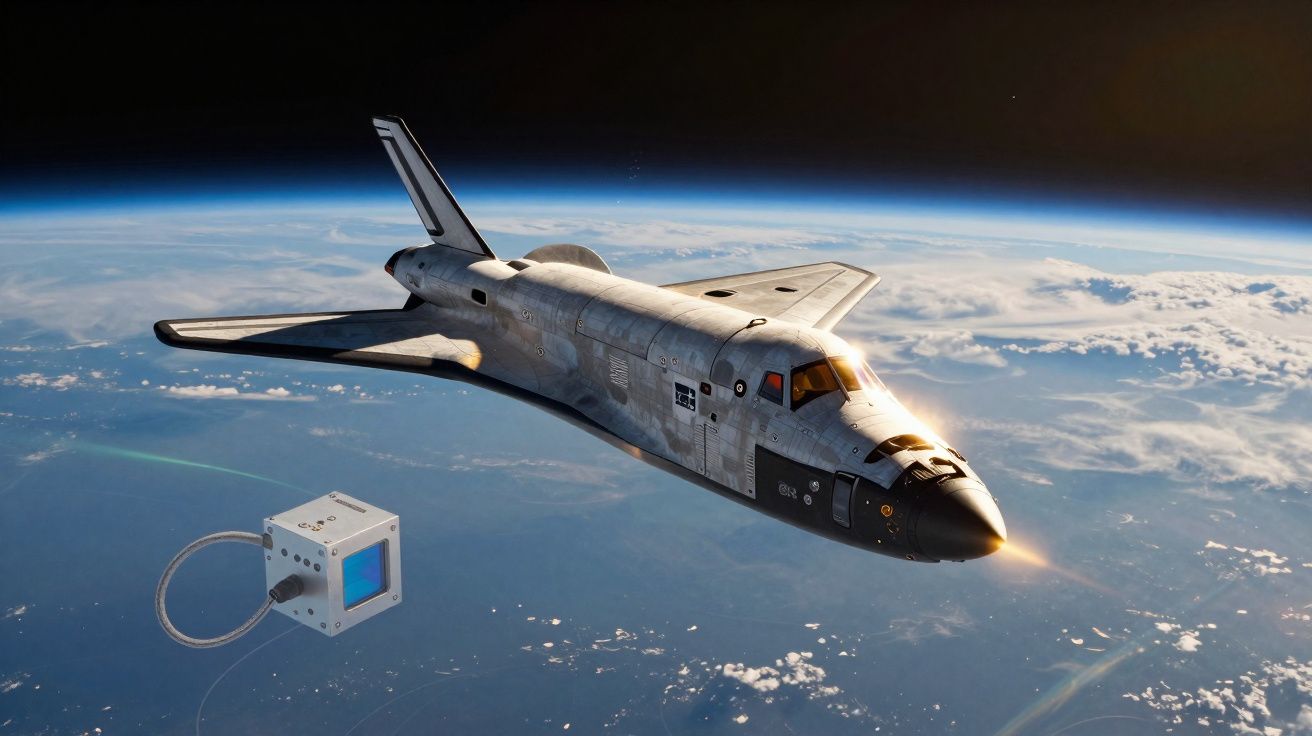
The United States has discreetly revived one of its most enigmatic space programmes, returning the reusable X‑37B military drone to orbit on a SpaceX Falcon 9 rocket. While the Cape Canaveral liftoff looked like a familiar set-piece, this mission carries a potentially game-changing payload: an experimental quantum navigation system intended to steer spacecraft without GPS.
The X‑37B returns to orbit
Late on Thursday 21 August, a Falcon 9 rose from Cape Canaveral, Florida, placing the Boeing-built X‑37B into low Earth orbit. SpaceX streamed the launch live and, on the surface, it appeared entirely standard. The mission itself is anything but.
Roughly 9 metres long, the X‑37B looks like a miniaturised space shuttle, with short wings and a payload bay concealed beneath clamshell doors. It is uncrewed. After separation from the rocket, the spaceplane can remain aloft for hundreds of days, drawing power from solar panels that deploy in orbit.
Boeing says that over its previous seven flights, the X‑37B has amassed more than a decade in space when totalled across missions. Some single sorties have run for more than a year, ending with the vehicle gliding to an autonomous runway landing in a manner reminiscent of NASA’s retired shuttles.
This flight is the X‑37B’s eighth mission. The US military has not said how long it will stay in space, where it will operate, or when it will come back. That opacity has fuelled speculation ranging from orbital surveillance to weapons-related trials, although officials publicly describe the work as research and technology demonstrations.
Official objectives for the X‑37B: lasers and navigation
For this mission, the US Space Force has at least sketched out the headline aims. The X‑37B will support experiments involving:
- Laser communication technologies between satellites
- “Enhanced” methods of navigation in space
- New hardware designed to harden US space infrastructure against disruption
The Space Force says the mission aims to boost the resilience, efficiency and security of American space communication architectures.
Laser links between satellites can deliver quicker, more secure transfers than conventional radio systems. They are also more difficult to jam or intercept-an increasingly important consideration when satellites underpin everything from financial services to battlefield coordination.
The other main focus is navigation. The military is signalling, in unusually clear terms, that it wants spacecraft able to determine their position and trajectory in orbit-and farther afield-without depending on GPS broadcasts from Earth.
Enter the quantum inertial sensor
On 14 August, only days ahead of launch, the US Space Force disclosed a key payload: a “quantum inertial sensor” carried aboard the X‑37B. The system is presented as an alternative to satellite-based positioning such as GPS.
Rather than receiving external signals, the sensor tracks motion and orientation with extreme precision by observing the behaviour of atoms cooled to near absolute zero.
The Space Force calls the device “a welcome step forward for operational resilience in space”, offering navigation even when GPS is unavailable or under attack.
In the official announcement, Colonel Ramsey Horn described the technology as a means of keeping spacecraft on course during deep-space navigation, or in areas where GPS signals are faint, obstructed or intentionally jammed.
How a quantum inertial sensor works
At the heart of the system is atomic interferometry, which exploits the wave-like behaviour of ultra-cold atoms. In simplified, practical steps:
- Atoms are chilled to temperatures only just above absolute zero, minimising random motion.
- Laser beams split and then recombine the atomic “waves” along separate paths.
- Minuscule shifts in the interference pattern expose acceleration and rotation with striking accuracy.
Traditional inertial navigation systems rely on mechanical gyroscopes and accelerometers. Over time they drift, steadily becoming less accurate unless they are corrected using periodic GPS updates. Quantum-based versions aim to cut that drift sharply, enabling a spacecraft to maintain a dependable picture of its own movement for much longer.
Why navigation without GPS matters
Contemporary militaries are deeply reliant on space-based positioning. GPS supports navigation for aircraft, ships, land vehicles and missiles, and it also provides synchronisation for telecommunications networks and power grids. That reliance creates a strategic vulnerability.
In a conflict, GPS satellites could face jamming, spoofing or direct physical attack. Even a temporary outage could cause major disruption. The US and its competitors have, largely out of public view, been seeking fall-back options that do not depend on externally transmitted signals.
For spacecraft in particular-especially those operating beyond Earth orbit-GPS simply does not extend far enough. Vehicles travelling towards the Moon or working in cislunar space require alternative ways to determine where they are and where they are headed.
A working quantum inertial sensor offers a way for spacecraft to “carry” their own navigation reference, like a hyper‑accurate internal compass and odometer combined.
On the X‑37B, engineers can evaluate how a sensor like this survives launch vibrations, copes with temperature swings, endures radiation, and performs through the long, isolated months spent in orbit.
A secretive testbed with a long track record
The X‑37B is a peculiar blend: spaceplane, orbital laboratory and classified technology demonstrator. Built by Boeing for the US Air Force and now operated by the Space Force, it sits somewhere between an experimental craft and an operational capability.
Known characteristics include:
| Feature | Details |
|---|---|
| Length | Approx. 9 metres |
| Power | Solar panels deployed in orbit |
| Launch | Carried to space by rockets such as SpaceX Falcon 9 |
| Return | Autonomous runway landing, glider-style |
| Mission type | Long-duration, unmanned test flights |
Previous missions have included deployments of small satellites, materials-testing work and other payloads the US government prefers not to detail. One earlier flight remained in orbit for well over a year before landing at a US Air Force base in California.
From a defence standpoint, repeatedly flying the same spaceplane and recovering it offers an advantage: rapid iteration. Sensitive hardware can be trialled in space, then brought back for hands-on inspection, adjustment and reflight.
Boeing, SpaceX and the business behind secrecy
A highly classified mission sits atop a very visible industrial partnership. Boeing manufactures the X‑37B, while SpaceX provides the launch. Both firms are tightly woven into US national security space contracting.
Boeing’s share price has moved with fluctuations in aviation demand and the impact of safety controversies, yet its defence and space arm remains strategically significant. Programmes such as the X‑37B represent only a small fraction of total income, but they help secure Boeing’s standing as a prime contractor for specialised government projects.
For SpaceX, military launches provide reliable revenue alongside commercial satellite roll-outs and crewed NASA flights. Falcon 9’s reusability pairs neatly with the X‑37B’s own reusable approach, lowering costs and making more frequent experimental missions achievable.
What quantum navigation could mean beyond the military
If quantum inertial sensors demonstrate dependable performance in space, their effects are unlikely to be confined to classified programmes. Civil applications could be wide-ranging:
- Commercial satellites could manoeuvre and orient themselves without constant support from ground controllers.
- Deep-space probes could operate with greater independence, reducing dependence on Earth-based tracking.
- On Earth, ships, aircraft and submarines could retain accurate positioning in GPS‑denied environments.
Financial systems, electricity networks and telecommunications infrastructure also rely on highly precise timing. Quantum devices connected to navigation can act as exceptionally stable clocks, supporting critical services during outages or disruption.
Risks, limits and realistic expectations
Quantum technology is often surrounded by hype. In reality, creating rugged hardware that functions outside controlled laboratory conditions is difficult. Cooling atoms to near absolute zero on a spacecraft that is shaken during launch and heated by the Sun is a major engineering challenge.
Teams must contend with noise, radiation, mechanical shocks and tight limits on mass and power. For years, quantum inertial sensors may serve as an addition rather than a replacement for existing approaches. Hybrid solutions are likely, combining star trackers, radio ranging, conventional gyroscopes and quantum measurements.
There are strategic implications too. As more countries field GPS‑independent navigation, competitive advantage may shift towards new forms of disruption. Jamming radio is one thing; overcoming an internal quantum sensor is another, potentially pushing adversaries towards cyber intrusion or physical attacks on the spacecraft carrying such systems.
Key terms that help decode the mission
For anyone navigating the terminology associated with this launch, several phrases are particularly helpful:
- Inertial navigation: A technique in which a vehicle computes its position by integrating its own acceleration and rotation over time, starting from a known location.
- Atomic interferometry: A method that treats atoms as waves, splitting and recombining them to detect extremely small changes in motion or gravity.
- Cislunar space: The region between Earth and the Moon’s orbit, increasingly viewed as strategically significant.
- Resilience in space: The capacity of satellites and spacecraft to continue operating despite attacks, failures or the loss of supporting services such as GPS.
Taken together, the X‑37B, the quantum navigation work and the laser communication trials point towards spacecraft-military and commercial alike-becoming more autonomous, more difficult to disrupt and less reliant on Earth-based guidance. Much of the detail will remain behind classification, but each new flight by this compact, secretive spaceplane hints at a gradual shift in how navigation in space may be done.






Comments
No comments yet. Be the first to comment!
Leave a Comment