
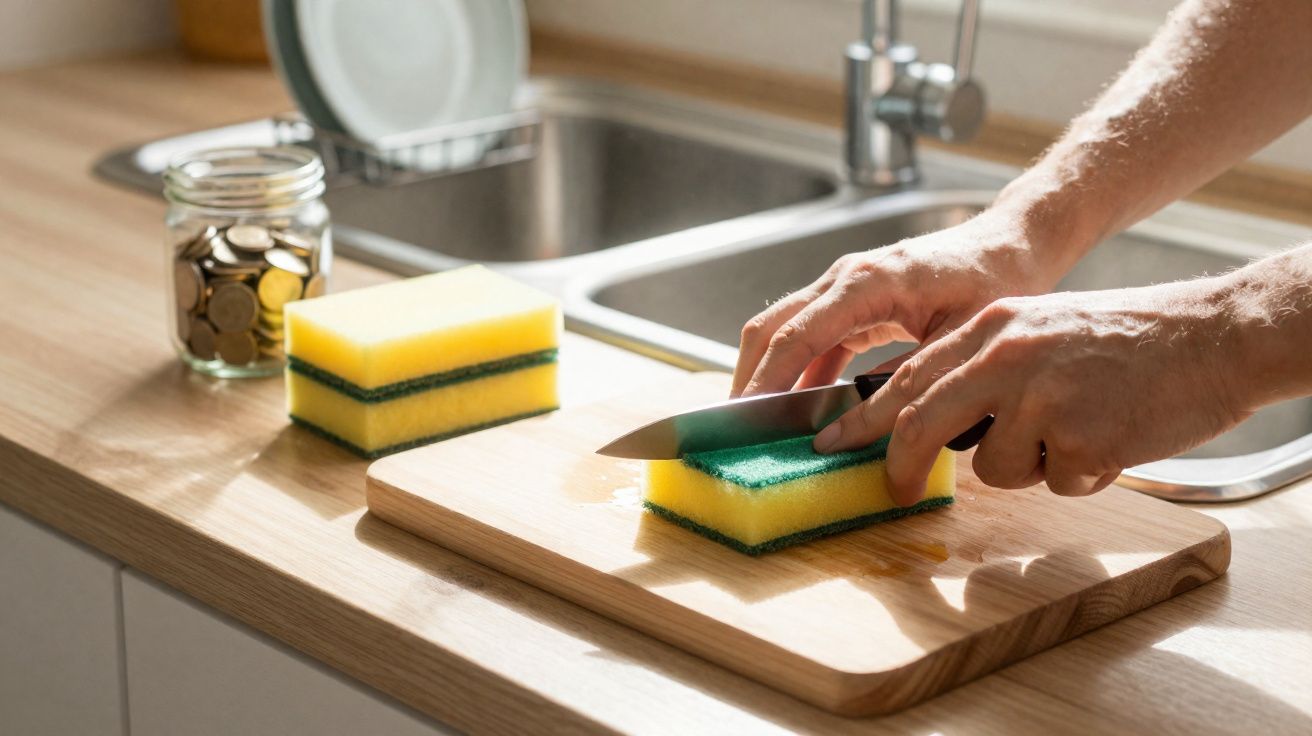
The first time I watched someone neatly cut a brand-new kitchen sponge straight down the middle, I genuinely flinched.
It seemed almost sacrilegious - like slicing a fresh loaf and chucking half in the bin. But she didn’t throw anything away. She placed the two halves side by side at the sink like little troops and said, as if it were nothing: “I haven’t bought a full sponge in months.”
That night, I found myself looking at my own sponge - bloated, greyed over, and carrying that weary smell you try to ignore. I thought about how many I’d casually binned and replaced, as if they were disposable sweets. A tiny routine, quietly pouring money away.
That was when I started to notice. Because what if cutting a sponge in half changes more than you’d expect?
Half a sponge, same results: why it cleans just as well
A full-size sponge looks like common sense: more area, more to hold, more cleaning power - and it feels like better value. In reality, most of us don’t use all of it properly. We end up scrubbing with corners, pinching it, folding it, and squeezing the middle. The extra bulk mostly just sits there.
With a smaller, halved sponge, everything feels a bit more deliberate. It sits neatly in your palm, slides quickly over a plate, and gets right into the curve of a mug. People who try it often say it feels almost “sharper” on grime - not because it’s magically stronger, but because you can steer it better, like choosing a detail brush instead of a big roller when precision matters.
The actual cleaning power isn’t hiding in the sponge’s size. It comes from friction, detergent, and how much pressure your hand applies. Cutting it in half doesn’t cut any of that - it simply removes the extra foam you weren’t truly using.
There’s also a very practical reason this works: sponges rarely “die” because they fall apart after a few days. They get retired because they turn nasty - food lodged inside, bacteria multiplying, and smells building until you can’t pretend anymore. A larger sponge can hold more muck, which encourages people to keep using it longer to “get their money’s worth.”
A half-sponge has less material to soak through, so it reaches the “this is gross” point sooner. That sounds like a drawback, but it’s usually the opposite: you replace it earlier, keep things more hygienic, and still make the same retail pack last longer overall.
From a scrubbing perspective, the abrasive side barely changes when you cut it: the same texture, the same firmness, the same ability to shift dried-on sauce from a pan. What changes is your sense of value - you stop linking “effective cleaning” to “big yellow rectangle.”
Take Laura, a 34-year-old nurse, who began halving her sponges during a tight stretch between paydays. She’d seen the idea in a money-saving thread and thought it looked a bit desperate - even faintly embarrassing - but curiosity won out.
She bought her usual six-pack and sliced every sponge cleanly into two. Instead of burning through six thick rectangles over the following months, she worked through twelve smaller ones. What surprised her was this: they didn’t become nearly as revolting as her old sponges. Because she was changing them more freely, without guilt.
By the end of the year, Laura realised she’d almost halved what she spent on sponges as well. No gadget. No coupon pile. Just a kitchen knife and a slight shift in thinking. As she put it: “It’s like paying the same price, but the pack secretly doubles.”
Half-sponge trick at home: how to make it actually work
The process is straightforward. Begin with a new, dry sponge. Put it on a chopping board and, using a sharp kitchen knife, cut it in half across the shortest side so you end up with two smaller rectangles. Aim for a smooth slice rather than a torn split - a clean cut helps prevent the edges from crumbling.
After that, place only one half by the sink and keep the remaining halves somewhere dry, away from splashes. Think of each half as a short-term tool, not a long-term companion. As soon as it discolours or smells, swap it for a fresh half and don’t second-guess yourself. You’re not being wasteful - you’re rotating.
If you like to keep separate sponges for separate jobs, you can take it further. Cut some halves down again into quarters for the really grim tasks: oven racks, pet bowls, litter mats. Smaller pieces give you more control - and you can bin them sooner without hesitation.
Where people go wrong is treating a sponge like it’s meant to be stretched forever, like chewing gum. One day it’s slightly grey, the next it’s faintly pongy, and then one morning the smell hits you as soon as the hot water runs. And we still keep it. We promise we’ll “deep clean” it using boiling water, vinegar, microwave tricks. Let’s be honest: nobody truly does that every day.
Halved sponges work best when you accept quick turnover. That means dropping the belief that one sponge should last weeks. Change more often and scrub with confidence. The pack lasts longer because each full sponge becomes two (or even four) separate lives - not because each life is dragged out.
Practically speaking, don’t start by cutting sponges that are already fraying or splitting at the edges. Begin this habit with your next new pack. And if you forget for a week, don’t beat yourself up. This is about small, sustainable, low-effort changes - not another rule to feel guilty about.
“I used to feel silly cutting my sponges,” admits Mark, a father of three who keeps a strict grocery budget. “Now my kids do it without thinking. For them, a big uncut sponge looks weird. It’s just what ‘being wasteful’ means in their heads.”
These little behaviours spread quietly. Children see you halve a sponge and learn frugality as an action, not a lecture. Housemates notice the tiny sponge by the tap and often copy it without a conversation.
- Cut new sponges in half before first use, not after they’re dirty.
- Keep a stash of clean halves in a dry drawer or jar.
- Use smaller pieces for “gross” tasks you want to throw away faster.
- Change halves more often instead of clinging to one big sponge.
- Pair the habit with one other tiny saver (like using less washing-up liquid) for compounding impact.
What this small habit really shifts day to day
It’s easy to chuckle at the idea of “sponge economics”. A multipack isn’t going to decide whether you pay the mortgage. Still, this sits alongside habits like carrying a refillable bottle instead of buying plastic, or eating leftovers rather than ordering in again. In a spreadsheet, each choice looks minor. In real life, they change the narrative.
Financially, cutting a sponge in half can meaningfully extend the gap between purchases. If you used to replace one full sponge every week, a six-pack can quietly keep you going for around three months of washed-up dishes. Over a year or two, that drip-feed saving can become money for things that actually feel good: better olive oil, a meal out, or the book you’ve had your eye on.
Emotionally, it can feel surprisingly steadying. On a day when your inbox is chaos and everything feels too much, slicing a sponge in half - and choosing not to waste that small square of foam - can feel oddly sensible. In the tiny theatre of domestic life, you get a little control back over how resources pass through your hands.
You probably won’t tell your friends about it. You may even forget you ever “adopted” the idea. Eventually, it’s simply part of how your sink looks - one of those invisible routines that quietly says: “I pay attention.” Most of us have experienced money feeling like water slipping through our fingers. Sometimes sealing the smallest leaks is what settles your head enough to face the bigger ones.
| Key point | Detail | Why it matters to you |
|---|---|---|
| Half the size, same effectiveness | Cleaning strength comes from friction and detergent, not the amount of foam | Spend less without giving up cleanliness or ease of use |
| More frequent rotation | Half-sponges get replaced sooner, which means fewer bacteria and bad smells | A healthier kitchen and less disgust at a “dead” sponge |
| Lower annual cost | A pack of six sponges can last roughly twice as long when each one is cut | Quiet but genuine savings that stack with other small strategies |
FAQ
- Does cutting a sponge in half really clean as well? Yes. The scrubbing surface and texture stay the same, so grease and food still lift off. You’re removing excess foam, not cleaning power.
- Won’t smaller sponges wear out faster? They may look “used up” sooner because they hold less gunk, but that’s actually an advantage. You swap them more often while still doubling the number of sponges per pack.
- Is this safe from a hygiene perspective? Smaller sponges can be more hygienic because you feel freer to replace them as soon as they smell or discolour, instead of stretching one big sponge too long.
- Can I cut any type of sponge? Most kitchen sponges with a soft side and a scrub side cut well. Very flimsy or already damaged sponges may crumble, so start with new, good-quality ones.
- How much money can I actually save? On its own, the yearly saving might look modest, but combined with other small habits it adds up. And you get a cleaner, fresher kitchen in the process.




Comments
No comments yet. Be the first to comment!
Leave a Comment