
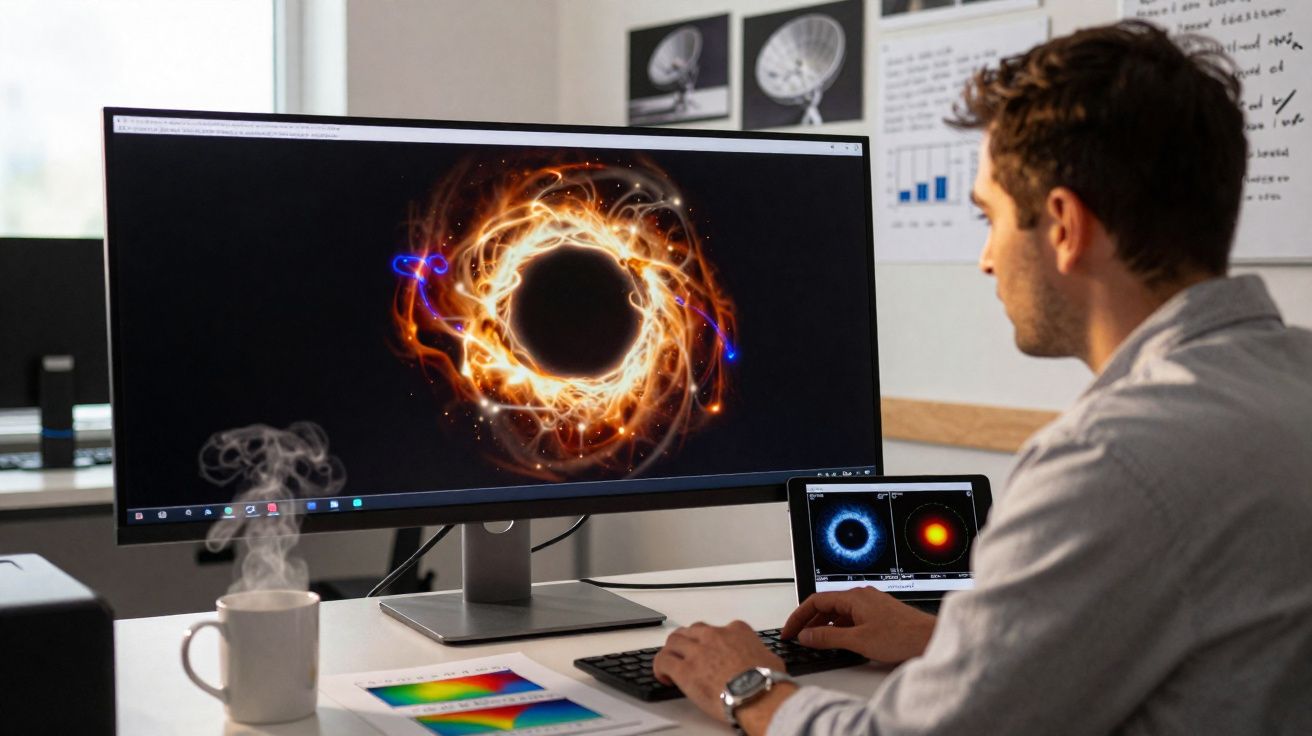
In 2019, the Event Horizon Telescope (EHT) became internationally recognised after publishing the first image ever captured of a black hole. That breakthrough relied on Very Long Baseline Interferometry (VLBI), which combines light gathered by multiple instruments to assemble a single, detailed view of a target.
The landmark picture featured the supermassive black hole (SMBH) in the heart of Messier 87, a giant galaxy around 55 million light-years from Earth. The collaboration later released images of relativistic jets streaming from two luminous galaxies, as well as views of Sagittarius A*, the SMBH at the centre of the Milky Way.
Alongside these observations, researchers within the EHT Collaboration are turning to supercomputer modelling to deepen what they know about the region just outside a black hole’s outer boundary - the event horizon.
EHT researcher Andrew Chael models M87’s black hole shadow
One of the groups pursuing this work is led by Andrew Chael, an associate research scholar at Princeton University and a fellow of the Princeton Gravity Initiative. Chael and colleagues ran simulations of M87’s SMBH using the Stampede2 and Stampede3 supercomputers hosted at the Texas Advanced Computing Center (TACC).
The image produced by their work (shown above) illustrates how light emitted by hot electrons can spiral around just beyond the black hole’s “shadow”.
Chael’s team is part of a wider community using high-end simulations to represent how black hole shadows behave, incorporating high-energy plasma, magnetic fields and intense gravity. These ingredients form a tightly coupled system that enables black holes to accrete incoming material, emit vast quantities of radiation, and generate relativistic jets that may stretch for millions of light-years.
GRMHDS simulations and separate electrons and protons
In total, the work drew on 11 general relativistic magnetohydrodynamic simulations (GRMHDS), which treat the plasma as a fluid while modelling how it interacts with gravity and magnetic field lines.
"Ever since we made that first black hole image, there's been a lot of work trying to understand the environment just around the black hole," Said Chael in a TACC press release.
"We want to understand the nature of the particles of this plasma that the black hole is eating, and the details of the magnetic fields commingled with the plasma that in M87 launches huge, luminous jets of subatomic particles."
Chael has been running this type of modelling since his postgraduate days, using the Extreme Science and Engineering Discovery Environment (XSEDE) together with computing resources made available through TACC’s Advanced Cyberinfrastructure Coordination Ecosystem: Services & Support (ACCESS) programme. Building on recent improvements made by the team using Chael’s own code, their approach goes beyond common models that effectively bundle electrically charged protons and electrons into a single combined component.
"This paper is a first attempt [at] using a more advanced," added Chael, "more computationally expensive technique to directly model these separate particle species of electrons and protons to try to understand how they interact, and in particular, what the relative temperature of the two is."
What the simulations suggest about electron temperatures near M87
From the simulations, the team inferred that electrons close to M87 are far hotter than earlier estimates implied, sitting at a temperature about 100 times cooler than the protons. This matters because the temperature contrast between electrons and protons helps set the brightness and other visible characteristics in the EHT image.
As a result, the findings point to a basic mismatch between some prevailing plasma-physics models and what the EHT is actually observing. Next, Chael and colleagues intend to run their code against additional EHT observations of M87, with the aim of producing a film-like sequence that follows how the system changes over time.
Earlier comparisons with EHT data and changing brightness on the photon ring
In a separate study published in January, Chael’s team compared the EHT’s M87 black hole image with a broad suite of simulations executed on the Stampede2 and Jetstream supercomputers. That comparison indicated that although the SMBH “shadow” maintains a consistent overall size and structure, it can still vary.
They also found that the brightest region on the photon ring drifts with time, driven by turbulent, chaotic behaviour in the plasma flows close to the event horizon. As different pockets of plasma warm and cool, the black hole’s appearance shifts in subtle ways.
"Black holes are extremely complicated environments. The best available tools we have are supercomputing simulations. It's amazing that we've been able to build these computers and codes that allow us to create accurate models of what's going on in such a strange and complicated relationship," said Chael.
"Simulations give us confidence that we are accounting for all these effects, which are all interacting in complicated and sometimes unpredictable ways."
This article was originally published by Universe Today. Read the original article.




Comments
No comments yet. Be the first to comment!
Leave a Comment